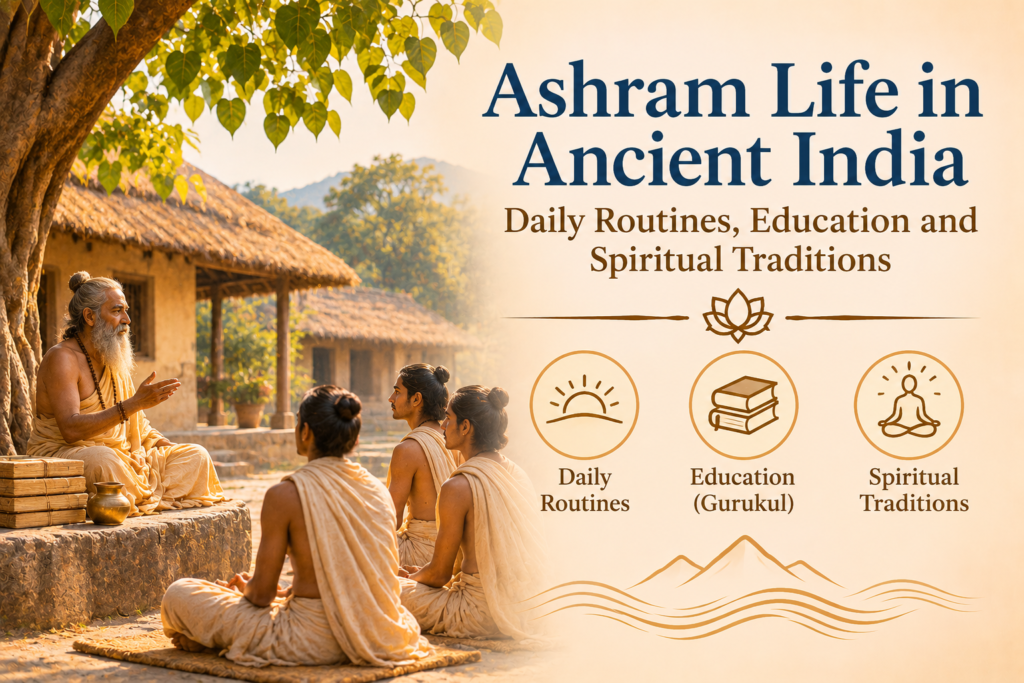
In ancient India, an ashram was a place where education, spiritual practice and everyday responsibilities formed part of a shared way of life. Often described in forests and near rivers, these communities provided an environment for teachers and students to study sacred texts, explore philosophical ideas and develop practical knowledge.
Life in an ashram followed a disciplined routine shaped by the traditions of its teacher and the purpose of the community. Students spent their days studying, reciting texts, performing physical work and participating in religious or contemplative practices. Learning extended into everyday activities, with observation, repetition and personal conduct forming an important part of education.
The ashram tradition was closely associated with the Guru-Shishya relationship, a system of learning that influenced the transmission of Indian philosophy, music, yoga and other traditional disciplines across generations.
What was an ashram in ancient India?
The Sanskrit term Ashrama is associated with disciplined effort, spiritual practice and particular ways of life. In the context of traditional Indian education, an ashram referred to a residence or community where a teacher lived with students and conducted religious, educational and contemplative activities.
Traditional descriptions often place ashrams away from busy settlements, surrounded by forests, rivers and open land. These natural surroundings provided opportunities for study and contemplation while keeping everyday life closely connected with the environment.
The teacher, known as the Guru or Acharya, guided students in their education and personal development. Students, traditionally called Shishyas, lived with the teacher and participated in the responsibilities of the community.
Ashrams also received visiting scholars, spiritual seekers and travellers. Discussions between teachers, students and visitors contributed to the exchange of philosophical and religious ideas.
Descriptions of ashrams appear in several ancient Indian texts. Their organisation and activities varied across historical periods and traditions, so there was no single model followed by every community.
The Guru-Shishya tradition
The relationship between the Guru and Shishya formed the foundation of traditional ashram education. Learning took place through direct interaction, allowing the teacher to explain concepts, demonstrate practices and guide students according to their abilities and progress.
Knowledge was transmitted through oral instruction, recitation, observation and repeated practice. This approach was particularly important in preserving the Vedas, which were passed down through carefully maintained systems of chanting and memorisation.
Students learned to reproduce verses with attention to pronunciation, rhythm and sequence. The teacher corrected mistakes and explained meanings as students gradually developed familiarity with the material.
The relationship also involved responsibilities beyond formal instruction. Students were expected to approach their teachers with respect, attention and a willingness to learn. They participated in everyday activities and developed an understanding of their responsibilities towards the community.
The Guru-Shishya tradition continued to influence several Indian knowledge systems. In Indian classical music, for example, students traditionally studied under a Guru for extended periods, learning through demonstration, repetition and individual guidance. Similar principles of direct instruction and sustained practice remain important in several yoga and performing arts traditions.
Daily life inside an ancient ashram
Daily routines differed according to the teacher, the tradition and the purpose of each ashram. However, traditional descriptions commonly emphasise early rising, study, physical work, meals and periods of contemplation.
The day was organised around a combination of educational activities and community responsibilities.
Early morning activities
The day often began before sunrise. Students attended to personal hygiene before participating in prayer, meditation or Vedic recitation.
Morning hours provided a relatively quiet environment for study. Students could practise chanting, revise previously learned verses or receive instruction from their teacher.
Some traditions also included bathing in nearby rivers and performing morning rituals. These activities formed part of the religious and personal discipline followed by the community.
Study and recitation
After morning practices, students devoted time to learning. The subjects depended on the teacher’s knowledge and the educational purpose of the ashram.
Vedic study formed an important part of many traditional educational settings. Students learned Sanskrit pronunciation, memorised verses and studied their meanings through explanation and discussion.
Other areas of learning included grammar, philosophy, mathematics, astronomy, medicine, music and traditional knowledge systems.
Oral education required regular repetition and revision. Students developed familiarity with complex material by listening carefully, reproducing what they had learned and receiving corrections from their teachers.
Physical work and community responsibilities
Education also involved the practical activities required to maintain the ashram.
Students might collect firewood, bring water, prepare meals, tend gardens or care for animals. These responsibilities were part of everyday life and required cooperation among members of the community.
Such activities were also connected with the idea of Seva, commonly understood as selfless service. Performing tasks for the benefit of the community encouraged responsibility and participation in shared living.
Evening practices
Evenings often included prayer, recitation, philosophical discussions and meditation. Students could review their lessons or listen to the teacher explain subjects that required further understanding.
Some ashrams also included devotional singing, mantra chanting and musical practices. These activities formed part of the religious and cultural life of the community.
After the day’s activities, students rested and prepared to follow the routine again the next morning.
What did students learn in ancient ashrams?
Traditional ashram education covered several fields of knowledge. The subjects studied depended on the teacher, the educational lineage and the purpose of the institution.
Vedic studies
Students learned sacred texts through recitation, memorisation and interpretation. Correct pronunciation and oral transmission were central to this form of education.
The preservation of Vedic texts required detailed systems of recitation, allowing verses to be transmitted across generations with considerable attention to accuracy.
Philosophy
Philosophical education involved questions concerning the self, consciousness, knowledge, reality and liberation.
The Upanishads preserve many discussions between teachers and students on these subjects. Their dialogues demonstrate how questioning, explanation and reflection contributed to philosophical learning.
Yoga and meditation
Certain educational and spiritual traditions included practices involving concentration, breath regulation, physical discipline and contemplation.
The nature of these practices varied across traditions and historical periods. Their inclusion depended on the teacher’s knowledge and the purpose of the community.
Language and grammar
Sanskrit grammar and linguistic study helped students understand the structure, pronunciation and interpretation of classical texts.
Language was particularly important in traditions that relied on oral recitation, where small differences in pronunciation could affect the transmission of a verse.
Traditional sciences
Mathematics, astronomy, Ayurveda and other fields formed part of broader Indian knowledge traditions.
Students interested in these subjects could receive instruction according to the expertise of their teachers and the educational setting.
Music and arts
Music, chanting and other artistic traditions were also transmitted through teacher-student lineages. Their presence and importance varied between communities.
Learning music involved listening, repetition and practical demonstration. These methods became particularly significant in the development and preservation of Indian classical music.
Food and simplicity in ashram life
Food was an important part of daily discipline. Traditional descriptions of ashram life often refer to simple meals prepared from locally available ingredients, including grains, vegetables, fruits, milk and pulses.
Students participated in food preparation and other household responsibilities. Meals were also connected with religious observances and ideas about moderation.
The concept of Ahara, or food and diet, received considerable attention in Indian philosophical and Ayurvedic traditions. Food was discussed in relation to digestion, physical health and mental qualities.
The broader emphasis on moderation encouraged careful consumption and responsible use of available resources. The exact dietary practices varied according to the community, religious tradition and local conditions.
The importance of nature and the environment
Natural surroundings played a significant role in the traditional image of an Indian ashram. Forests and riverbanks provided settings for study, contemplation and everyday community activities.
Students living in these environments could observe plants, animals, seasonal changes and natural cycles as part of their daily lives. The availability of water, vegetation and open spaces also influenced the practical organisation of the community.
Nature appears frequently in ancient Indian literature, where forest hermitages are described as places of spiritual practice and learning.
These descriptions are especially prominent in the Ramayana and Mahabharata. They present forest communities where sages, students and visitors participate in religious activities and philosophical discussions.
Such literary accounts provide valuable insight into how ashram life was understood and represented in Indian cultural traditions. They should also be read in their literary and historical contexts, since actual practices varied across regions and periods.
Ashram life in Indian epics and literature
Ancient Indian epics and literary works contain several well-known descriptions of ashrams. These settings often serve as places of instruction, hospitality and philosophical exchange.
In the Ramayana, the forest hermitages of sages such as Bharadvaja and Agastya appear during Rama’s journey through the forest. These communities are associated with spiritual instruction, hospitality and the presence of students.
The Mahabharata also describes forest communities where sages teach students and engage in discussions about philosophy and religious knowledge. The ashram of Drona, for example, is associated with the education of the Kauravas and Pandavas in martial skills and other disciplines.
The Upanishads preserve a different kind of educational setting through dialogues between teachers and students. These conversations explore questions about the self, ultimate reality and the nature of knowledge.
Together, these literary traditions have shaped the cultural understanding of the ancient Indian ashram as a place of learning, discipline and spiritual inquiry.
The lasting influence of ashram traditions
The influence of traditional ashram education remains visible in several Indian cultural and spiritual practices.
The Guru-Shishya system continues to play an important role in Indian classical music. Students often study under a teacher for extended periods, developing their skills through direct instruction, repetition and individual guidance.
Yoga traditions also preserve elements of disciplined practice, personal instruction, meditation and community living. The emphasis on regular practice and learning under experienced teachers reflects principles associated with older educational lineages.
Modern ashrams vary considerably in their organisation and activities. Some focus on yoga and meditation, while others emphasise religious study, devotional practices or traditional education.
Rishikesh remains an important centre for yoga and spiritual education in India. Students and visitors come to study yoga, meditation, Sanskrit, philosophy and devotional music. The city’s ashrams and educational communities draw inspiration from older Indian traditions while adapting their activities to contemporary needs.
Modern yoga education continues to draw upon several of these traditional subjects. Contemporary 200-hour yoga teacher training in Rishikesh includes the study of yoga philosophy, Vedic chanting, mantra, meditation and teaching methodology. These subjects reflect the continuing place of philosophical study, oral instruction and practical learning in yoga education.
Understanding the history of ashram education provides useful context for the development of modern yoga schools and teacher-student relationships. It also helps explain why direct instruction, regular practice and personal guidance continue to hold an important place in traditional yoga education.
Conclusion
Ashram life in ancient India brought education, spiritual practice and everyday responsibilities into a shared way of living. Students learned directly from teachers, studied traditional knowledge, participated in community work and followed routines shaped by discipline and simplicity.
The Guru-Shishya relationship helped preserve knowledge across generations, while the natural surroundings of many ashrams provided settings for study and contemplation.
The influence of these traditions remains visible in Indian yoga, classical music, philosophy and spiritual education. Their educational approach offers an important perspective on learning as an ongoing process shaped by practice, observation, guidance and participation in everyday life.