Every musical sound contains a combination of frequencies that contribute to its pitch and tonal character. When a guitar string is plucked, a singing bowl is struck or a gong is played, the resulting sound often contains several frequencies at the same time. These additional frequencies shape the richness, texture and resonance of the sound.
Two important concepts in acoustics help explain how these frequencies relate to one another: harmonic and inharmonic overtones. Their relationship influences the sound of musical instruments and helps explain why a tanpura produces a different tonal quality from a gong or singing bowl.
What are overtones?
When an object vibrates, it can produce several frequencies simultaneously. The lowest frequency is generally called the fundamental frequency, while the additional higher frequencies are known as overtones.
For example, when a musical string vibrates, it can move in different patterns called vibration modes. Each mode produces a frequency. The fundamental mode produces the lowest frequency, while higher modes contribute additional tones.
The fundamental frequency usually establishes the perceived pitch of a musical note. The overtones influence its timbre, which is the quality that allows listeners to distinguish between different instruments playing the same note.
The strength and arrangement of these frequencies determine much of an instrument’s characteristic sound.
What are harmonic overtones?
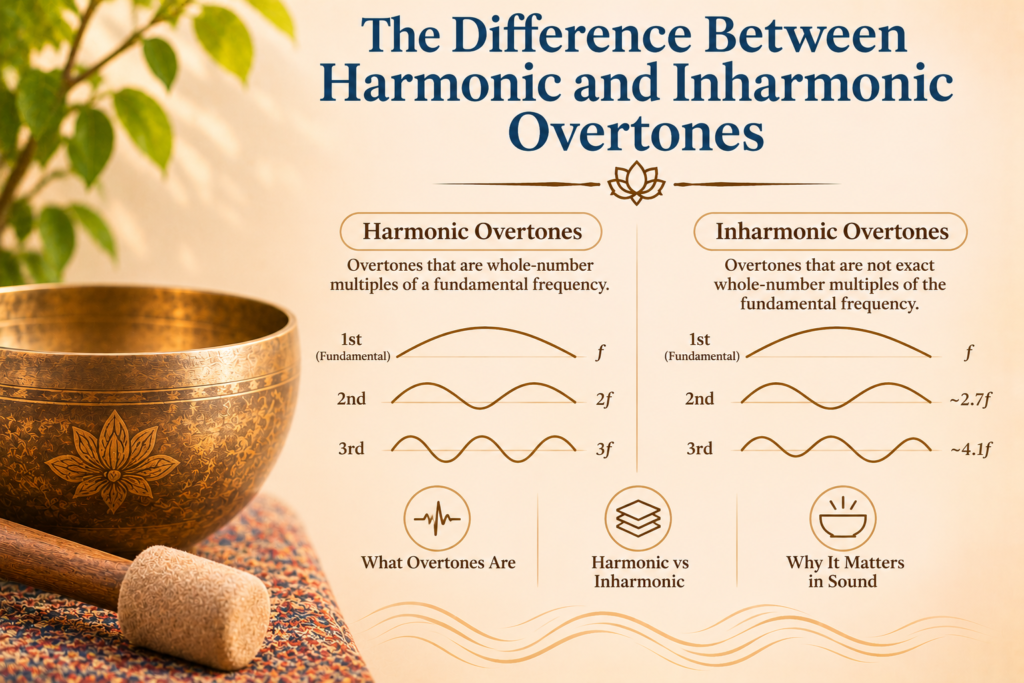
Harmonic overtones are frequencies that occur at whole-number multiples of the fundamental frequency. This means that each higher frequency has a simple numerical relationship with the lowest frequency.
For example, if an instrument produces a fundamental frequency of 100 Hz, its harmonic series may contain the following frequencies:
| Component | Frequency |
| Fundamental | 100 Hz |
| Second harmonic | 200 Hz |
| Third harmonic | 300 Hz |
| Fourth harmonic | 400 Hz |
| Fifth harmonic | 500 Hz |
| Sixth harmonic | 600 Hz |
The second harmonic is twice the fundamental frequency, the third is three times the fundamental, and the pattern continues.
These frequencies are called harmonics because their ratios follow whole numbers. The resulting sound generally has a clearly defined tonal structure.
How harmonic overtones develop
Harmonic overtones commonly occur in musical strings and air columns. Their frequencies depend on the physical properties and boundary conditions of the vibrating system.
Consider a stretched guitar string. When plucked, the string vibrates in several modes. In the fundamental mode, the entire string moves in a single broad pattern. Higher modes divide the string into smaller vibrating sections, producing frequencies at whole-number multiples of the fundamental.
A similar principle operates in many wind instruments, where the vibration of an air column produces a series of resonant frequencies.
Harmonic structures help create the familiar tonal qualities of instruments such as guitars, flutes and many traditional string instruments.
What are inharmonic overtones?
Inharmonic overtones are additional frequencies that do not follow exact whole-number multiples of the fundamental frequency.
In these sounds, the higher vibration modes have frequency relationships that depart from the regular harmonic series. Their arrangement depends on the physical construction, material, shape and vibration characteristics of the object.
A familiar example is the bell. When a bell is struck, its complex shape produces several vibration modes with different frequencies. These frequencies generally do not form a simple harmonic series, giving the bell its distinctive metallic and resonant sound.
Gongs and singing bowls can also produce complex, often inharmonic spectra. Their sound contains several interacting frequency components, which contribute to their characteristic tonal colour.
Why inharmonic frequencies occur
The geometry and physical properties of an object influence its vibration modes.
A stretched string can produce a relatively regular harmonic series because its vibration follows a simple one-dimensional pattern. A metal plate, bell or bowl has a more complex structure. Its surface can vibrate in several patterns across different regions, producing frequencies that do not necessarily follow whole-number ratios.
Material thickness, curvature, tension, mass distribution and boundary conditions all influence these modes.
Inharmonicity is therefore closely connected with the physical design of an instrument.
Harmonic vs inharmonic overtones
The main distinction lies in the mathematical relationship between the fundamental frequency and the higher frequency components.
| Feature | Harmonic overtones | Inharmonic overtones |
| Frequency relationship | Whole-number multiples | Do not follow exact whole-number multiples |
| Tonal structure | Regular frequency relationships | Irregular frequency relationships |
| Common examples | Strings and many air columns | Bells, gongs and metal bowls |
| Acoustic character | Often produces a clear tonal quality | Often produces a complex metallic or bell-like quality |
| Vibration patterns | Often follow relatively regular modes | Can involve complex vibration modes |
Both types contribute to the identity of musical sounds. Their presence and relative strength influence how an instrument is perceived.
How different instruments produce these overtones
The acoustic properties of an instrument determine the frequency components it produces. Comparing a few familiar instruments helps illustrate the difference.
Tanpura
The tanpura is a traditional Indian drone instrument with a rich and sustained sound. Its strings vibrate in patterns that produce harmonic frequency components.
The characteristic buzzing quality of the tanpura is strongly influenced by the interaction between the string and its curved bridge, known as the Jivari. As the string vibrates, its contact with the bridge changes subtly, creating a complex spectrum with prominent upper partials.
This interaction gives the tanpura its distinctive sustained resonance and tonal richness.
Guitar
A guitar string produces a series of vibration modes that are approximately harmonic. The fundamental frequency establishes the note, while the higher harmonics contribute to its tonal character.
The instrument’s body also resonates and influences the sound. As a result, two guitars playing the same note can produce different timbres.
Singing bowls
Singing bowls are made from metal and have a curved, circular structure. When struck or played around the rim, different regions of the bowl vibrate and produce several frequency components.
Their spectra often contain inharmonic partials, although the exact frequency relationships vary according to the bowl’s shape, material, thickness and construction.
This combination creates the characteristic metallic resonance associated with singing bowls.
Gongs
Gongs produce complex sounds through the vibration of their metal surfaces. Their large vibrating areas support several modes of vibration, each contributing different frequencies.
The sound may change considerably depending on where the gong is struck, the mallet used and the strength of the impact. These factors influence which vibration modes become prominent.
The resulting sound often contains a rich collection of inharmonic frequency components.
How overtones influence timbre
Timbre refers to the quality or character of a sound. It helps listeners recognise an instrument even when it plays the same musical note as another instrument.
For example, a guitar and a flute can play the same fundamental frequency, yet their sounds remain clearly distinguishable. Their overtone structures, relative frequency strengths, attack and decay characteristics differ.
Harmonic overtones often contribute to the recognisable tonal structure of pitched instruments. Inharmonic components can create the complex metallic qualities associated with bells and many percussion instruments.
However, timbre depends on several acoustic factors. The distribution and strength of partials, the way a sound begins, its decay and the resonances of the instrument all contribute to the final listening experience.
Why this distinction matters in sound healing
Understanding harmonic and inharmonic overtones can help sound practitioners develop a deeper appreciation of the instruments used during sound sessions.
A tanpura produces a sustained drone with a recognisable harmonic structure, while singing bowls and gongs often produce complex frequency patterns. These differences influence the overall acoustic experience of a session.
When several instruments are played together, their frequency components interact within the listening environment. Some frequencies may reinforce one another, while others may create beating patterns or changes in perceived tonal quality.
For practitioners, learning to recognise these differences can improve instrument selection, playing technique and attentive listening.
At Nada Yoga School, the study of sound includes traditional Indian instruments and their acoustic characteristics. Students interested in exploring these subjects through practical training can learn about the Sound Healing Teacher Training Course in Rishikesh.
How to identify harmonic and inharmonic sounds
A simple listening and observation exercise can help introduce these concepts.
Choose a guitar, singing bowl or another resonant instrument. Play a single note and listen carefully to its tonal quality. Notice whether the sound has a clear musical pitch, a metallic character or several overlapping resonances.
For a more detailed examination, use a spectrum analyser to display the frequencies present in the recording. The resulting graph shows peaks corresponding to prominent frequency components.
Compare the frequency peaks with the fundamental frequency. If they occur at approximately whole-number multiples, they form a harmonic series. If their ratios differ from whole numbers, the sound contains inharmonic components.
A spectrum analyser provides a useful starting point, although accurate analysis requires attention to the recording quality, the instrument’s changing sound and the resolution of the measurement.
Conclusion
Harmonic and inharmonic overtones describe two different relationships between the frequencies produced by a vibrating object. Harmonic overtones follow whole-number multiples of the fundamental frequency, while inharmonic overtones have frequency relationships that depart from this pattern.
These differences help shape the tonal qualities of musical instruments. Strings and many wind instruments produce relatively harmonic sounds, while bells, gongs and singing bowls often display complex inharmonic structures.
Understanding these acoustic principles provides a useful foundation for studying musical instruments, sound production and the listening practices used in sound meditation.