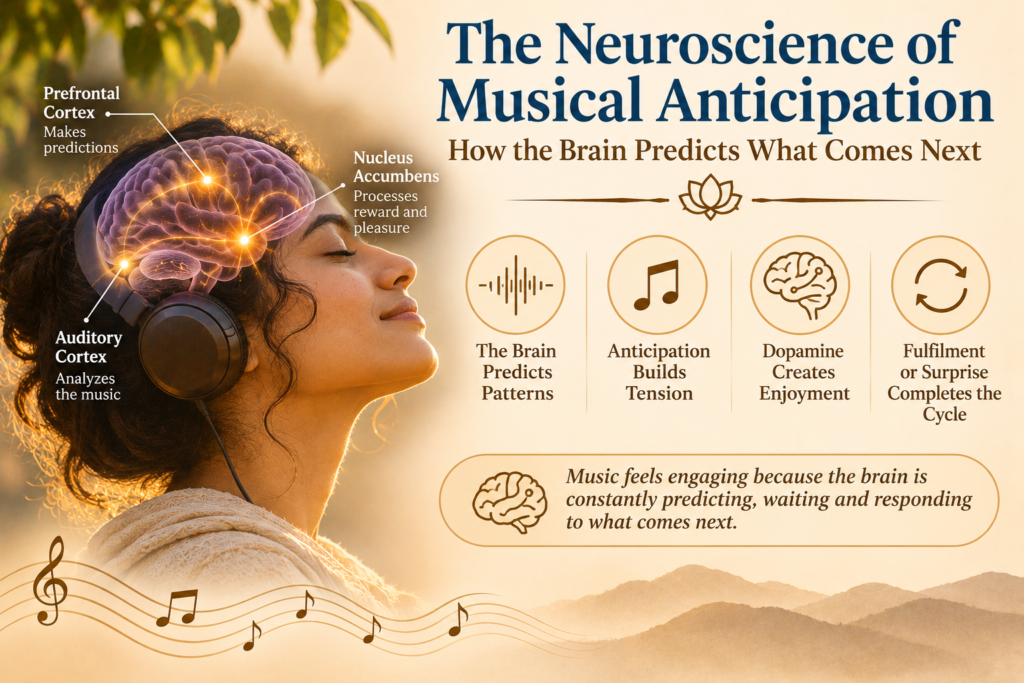
Have you ever listened to a familiar song and found yourself expecting the next note before it arrives? Perhaps you have anticipated the moment when a singer reaches a high pitch, recognised the approaching chorus or felt a sense of satisfaction when a melody resolved exactly as expected.
These experiences reveal an important feature of the human brain: its ability to predict upcoming events. Music provides a particularly interesting environment for this process because melodies, rhythms and harmonies create patterns that listeners gradually learn to recognise.
The neuroscience of musical anticipation explores how the brain forms expectations, responds to unexpected musical events and connects prediction with emotion and pleasure.
How the brain predicts musical patterns
The human brain continuously processes information and forms predictions about what may happen next. This ability helps people understand language, recognise familiar environments and respond to changes in their surroundings.
Music also relies on prediction. When listeners hear a melody, they begin to recognise its structure, rhythm and tonal relationships. Previous musical experience helps the brain estimate which notes, chords or rhythmic patterns may follow.
For example, a familiar melody creates expectations about its next phrase. Even when a listener does not have formal musical training, repeated exposure to musical patterns helps develop an intuitive understanding of how a composition may continue.
This process involves several interconnected brain regions. Auditory areas process incoming sounds, while regions associated with memory, attention and prediction contribute to the interpretation of musical sequences.
The brain continuously compares incoming musical information with its existing expectations. When the music follows a familiar pattern, the prediction may be confirmed. When something unexpected occurs, the brain registers a difference and adjusts its expectations.
The role of expectation in musical enjoyment
Musical enjoyment often involves a relationship between expectation and surprise. A composition can become predictable enough for listeners to recognise its structure while still introducing changes that capture their attention.
Consider a familiar song that repeats a particular melodic phrase. The listener gradually learns the pattern and begins anticipating its return. When the phrase appears again, recognition can create satisfaction.
Composers use this principle in several ways. They may repeat a melody, delay a musical resolution, introduce an unexpected chord or change the rhythm at an important moment.
These techniques influence how listeners experience a composition. A delayed resolution may create tension, while a familiar melodic return may provide a sense of completion.
The experience depends on musical familiarity and individual expectations. A listener with extensive knowledge of a musical tradition may anticipate certain developments that remain unfamiliar to someone hearing that style for the first time.
Musical surprise and the brain’s reward system
One of the most interesting areas of research into musical anticipation concerns the brain’s reward system.
Studies have examined how musical expectations relate to activity in regions involved in reward and motivation, including the striatum. Dopamine, a neurotransmitter involved in several aspects of reward processing, also plays a role in musical pleasure.
Research by neuroscientists has found that pleasurable musical experiences can involve interactions between auditory and reward-related brain regions.
In a well-known study published in Nature Neuroscience in 2011, researchers Valorie Salimpoor and colleagues investigated the relationship between musical anticipation, pleasure and dopamine release. Their findings showed dopamine activity associated with both anticipation and the peak emotional experience of music.
This research helps explain why a listener may experience excitement before a particularly satisfying musical moment. The expectation itself can become part of the pleasurable experience.
However, musical pleasure involves several processes, and dopamine is only one part of this complex system.
Tension and resolution in music
Musical tension and resolution provide clear examples of how anticipation works.
In Western tonal music, certain chord progressions create expectations about where the harmony may move next. A dominant chord, for example, often creates an expectation of resolution towards the tonic.
When the expected chord arrives, listeners may experience a sense of musical completion. If the resolution is delayed, tension can continue for a longer period.
Similar experiences occur in melodic and rhythmic structures. A melody may move towards a note that feels like a point of arrival, while a rhythmic pattern may create expectations about the next beat.
Indian classical music also offers interesting examples of musical anticipation. Ragas develop through characteristic melodic movements, recurring phrases and relationships between notes. Experienced listeners may recognise familiar melodic patterns and anticipate their continuation.
The gradual development of a raga can create expectations through repetition, improvisation and the return of characteristic phrases. The musician can then fulfil or reshape those expectations through performance.
How rhythm influences anticipation
Anticipation also operates through rhythm. When listeners hear a regular beat, the brain begins predicting when the next beat will occur.
This process is closely connected with timing and movement. People often tap their feet, nod their heads or move their bodies in response to rhythmic music, even without consciously deciding to do so.
Research suggests that the brain uses rhythmic patterns to organise attention and prepare for upcoming sounds. Regular rhythms provide a predictable temporal structure, while syncopation and unexpected pauses introduce changes.
For example, a drummer may establish a steady pattern and then briefly leave out an expected beat. The absence of that beat can attract attention because the listener was prepared for its arrival.
These rhythmic expectations contribute to the experience of musical movement and expression.
Memory and musical anticipation
Musical anticipation depends heavily on memory. The brain uses previously heard patterns to interpret new musical information.
There are several ways memory contributes to this process.
Short-term musical memory: Listeners retain recently heard notes and phrases, allowing them to recognise repetition and follow a melody.
Long-term musical memory: Familiar songs and musical styles create expectations based on repeated exposure over time.
Associative memory: A particular melody may become connected with a personal experience, cultural tradition or emotional response. Hearing it again can activate those associations.
These memory processes allow listeners to understand musical structures even when they cannot describe them in technical language.
A person may recognise that a melody sounds incomplete or that a familiar phrase is approaching without consciously identifying the musical theory behind the experience.
Why unexpected notes attract attention
Unexpected musical events can interrupt established patterns and create a prediction error. In neuroscience, prediction error describes the difference between what the brain expects and what actually happens.
When a melody suddenly changes direction or a rhythm introduces an unusual accent, the brain detects a difference between expectation and incoming information.
This response can attract attention and encourage the listener to update their understanding of the musical pattern.
Unexpected events can also create emotional responses. A surprising chord, sudden silence or unusual melodic shift may produce curiosity, excitement or tension.
The effect depends on context. A musical surprise that feels interesting to one listener may seem confusing to another, particularly when they have different levels of familiarity with the style.
Musical anticipation and Nada Yoga
The relationship between listening, expectation and awareness also offers an interesting connection with Nada Yoga.
Nada Yoga explores sound as a focus for concentration and contemplative practice. Through mantra, chanting, musical tones and attentive listening, practitioners develop awareness of how sound is experienced.
Indian classical music provides opportunities to observe anticipation through melodic development. A listener becomes familiar with the characteristic phrases of a raga and begins recognising its patterns as the performance progresses.
In a listening practice, attention can be directed towards the movement of notes, the development of rhythm and the moments when musical expectations are fulfilled or changed.
This approach encourages practitioners to observe their own responses to sound. They may notice when the mind predicts a phrase, how attention changes during silence or how a familiar musical pattern influences their experience.
Those interested in exploring sound, listening and traditional Indian musical practices can learn more about the Nada Yoga Teacher Training Course in Rishikesh. The school also offers a Sound Healing Teacher Training Course in Rishikesh for students interested in sound-based practices and traditional instruments.
A simple musical anticipation exercise
You can explore musical prediction through a short listening exercise.
Choose a familiar instrumental composition and listen carefully to its melodic structure. As the music progresses, notice whether you begin expecting particular notes, phrases or rhythmic changes.
Listen again and focus on moments when the music takes an unexpected direction. Observe how these changes influence your attention and emotional response.
You can also try the exercise with a song you know very well. Before the chorus begins, notice whether your mind anticipates its arrival. Pay attention to the feelings that arise during the few moments before the familiar section begins.
The purpose is to observe how musical expectations develop through listening and memory.
Conclusion
Musical anticipation reveals how the brain actively participates in the experience of listening. Through prediction, memory and reward-related processes, the brain recognises patterns, expects upcoming events and responds when music fulfils or changes those expectations.
This interaction contributes to musical pleasure, rhythmic engagement and emotional expression. It also explains why familiar melodies can feel satisfying and why unexpected musical moments can capture attention.
By listening carefully to melodies, rhythms and moments of silence, practitioners can develop a deeper appreciation of the relationship between music, the brain and human awareness.