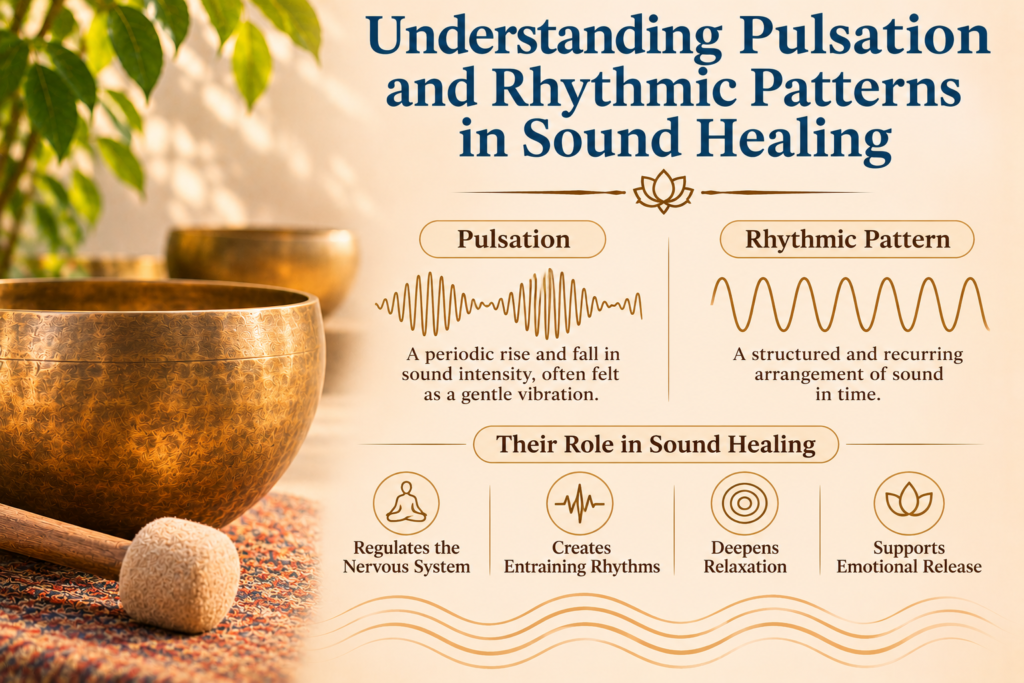
A singing bowl is struck gently. Its tone begins with a clear attack, followed by a sustained resonance that gradually fades. As another bowl is introduced, the sounds overlap and create subtle changes in intensity. The listener may notice moments when the combined sound seems to swell and soften repeatedly.
These changes are connected with two important acoustic concepts: pulsation and rhythm. Both influence how sound develops over time and how listeners experience musical patterns.
In sound healing, understanding these concepts helps practitioners work more carefully with singing bowls, gongs, drums and other instruments. It also provides a foundation for creating sessions with varied textures, timing and sound intensity.
What is pulsation in sound?
Pulsation refers to a recurring variation in sound intensity. It can occur when two sound waves with slightly different frequencies interact and periodically reinforce or reduce one another.
This phenomenon is commonly known as acoustic beating.
Imagine two singing bowls producing tones at slightly different frequencies. When their sounds overlap, their wave patterns sometimes reinforce each other, creating greater intensity. At other moments, the waves partially cancel, producing a reduction in amplitude.
The listener perceives a repeated pattern of swelling and softening. This is the beating effect.
The number of beats per second depends on the difference between the two frequencies. For example, if two tones have frequencies of 440 Hz and 444 Hz, the resulting beat frequency is approximately 4 Hz.
The perceived effect depends on the instruments, their relative loudness, the listening environment and the frequency difference.
Pulsation can therefore emerge naturally when instruments are played together.
Understanding acoustic beating
Acoustic beating occurs when two tones with nearby frequencies combine. Their interaction produces a periodic change in the amplitude of the resulting sound.
Consider two tuning forks with slightly different frequencies. When both are activated simultaneously, the combined sound becomes louder and softer at regular intervals.
The mathematical relationship is straightforward:
[
f_{\text{beat}} = |f_1-f_2|
]
Here, (f_1) and (f_2) represent the frequencies of the two tones.
If one tuning fork produces 256 Hz and another produces 260 Hz, the resulting beat frequency is 4 Hz.
The listener hears four fluctuations in intensity per second, provided the tones are sufficiently close and similar in level.
This principle also applies to musical instruments. Singing bowls, tuning forks and other resonant objects can produce beating when their frequency components interact.
What is rhythm in sound?
Rhythm refers to the organisation of sounds and silences over time. It involves the arrangement of beats, accents, durations and pauses within a musical or acoustic sequence.
Unlike acoustic beating, which results from the interaction of sound waves, rhythm is generally created through patterns of events.
A drummer playing a repeating sequence establishes a rhythmic pattern. A practitioner striking a singing bowl at regular intervals can also create a simple pulse.
Rhythm may be regular, irregular, slow or fast. Its character depends on the spacing and emphasis of the sounds.
In Indian classical music, rhythm has a highly developed structure. The concept of Tala describes organised rhythmic cycles, which provide a framework for musical performance.
For example, Teentaal consists of sixteen beats divided into four sections. Musicians use its repeating structure to organise melodic improvisation and rhythmic development.
This understanding of rhythm offers useful inspiration for practitioners incorporating Indian musical traditions into sound-based sessions.
The difference between pulsation and rhythm
Pulsation and rhythm are related because both involve changes over time. However, they describe different acoustic and musical processes.
| Feature | Pulsation | Rhythm |
| Meaning | Repeated changes in sound intensity | Organisation of sounds and silences over time |
| Origin | Often results from interacting frequencies | Created through timed musical events |
| Example | Two singing bowls producing acoustic beats | A repeating pattern played on a drum |
| Main characteristic | Swelling and softening of sound | Timing, accents and duration |
| Measurement | Beat frequency in hertz | Tempo and rhythmic structure |
A sound healing session can contain both. Two bowls may produce acoustic beating while a practitioner introduces a repeating sequence of strikes.
Understanding the distinction helps practitioners recognise whether a perceived pattern comes from wave interaction or from the way an instrument is being played.
Pulsation in singing bowls
Singing bowls produce complex sounds through the vibration of their metal structures. Their sound often contains several frequency components that develop and decay at different rates.
When two bowls are played together, their frequency components can interact. If two prominent components have nearby frequencies, they may produce audible beating.
The effect varies between bowls because their construction, dimensions, thickness and tuning influence their acoustic behaviour.
For example, two bowls that produce slightly different tones may create a gentle fluctuation in intensity when played simultaneously. Moving the bowls closer or farther apart can also change how the combined sound is perceived.
Practitioners can explore these interactions by playing individual bowls first and then introducing a second bowl.
The exercise encourages attention to the relationship between frequency, resonance and listening.
Rhythmic patterns with gongs and drums
Gongs and drums introduce another dimension to sound-based sessions through their rhythmic possibilities.
A gong can be played with individual strikes, repeated patterns or gradual changes in intensity. The interval between strikes influences how the sound develops.
Drums offer greater control over rhythmic organisation. A practitioner can create a steady pulse, introduce pauses or vary the accents within a sequence.
For example, a simple pattern might involve three evenly spaced strikes followed by a longer pause. Repeating this sequence creates a recognisable rhythmic structure.
The practitioner can also combine different instruments. A gentle drum pattern may provide a temporal foundation while singing bowls introduce sustained tones.
Such arrangements require attention to timing, volume and the way sounds overlap within the room.
How pulsation and rhythm influence listening
Changes in sound intensity and rhythmic organisation can influence attention and musical perception.
A regular rhythm makes it easier for listeners to anticipate when the next sound will occur. When a pattern changes, attention may shift towards the unexpected event.
Similarly, acoustic beating can make a sustained sound feel as though it is gently moving or fluctuating. This gives the listener a changing auditory experience even when the instruments are being held in relatively stable positions.
These responses differ between individuals. Musical familiarity, hearing sensitivity, personal preference and the surrounding environment all influence how a person experiences sound.
In a sound meditation session, practitioners can use these acoustic properties as elements of attentive listening. Participants may be invited to notice changes in intensity, the spacing between strikes and the gradual fading of resonance.
A practical exercise for exploring pulsation
A simple exercise can help practitioners recognise acoustic beating.
Begin with two singing bowls that produce slightly different tones. Strike the first bowl gently and listen to its resonance. Allow the sound to develop before introducing the second bowl.
Listen carefully to the combined sound.
Notice whether the intensity appears to rise and fall repeatedly. If the frequency components are close enough, you may hear a beating pattern.
Next, play each bowl separately and compare the experience. This helps distinguish the individual resonance of each instrument from the changes created when their sounds overlap.
For a rhythmic exercise, use a single bowl or drum. Play four evenly spaced strikes, pause briefly and repeat the sequence. Gradually change the intervals between strikes and notice how the pattern changes.
These exercises provide a practical introduction to acoustic pulsation and rhythmic organisation.
Applying these concepts in a sound healing session
Understanding pulsation and rhythm can help practitioners plan the progression of a session.
A session might begin with individual singing bowl tones, allowing participants to become familiar with each instrument. A second bowl can then be introduced to create overlapping frequencies and possible beating effects.
Later, a gentle rhythmic pattern may be added through a drum or repeated bowl strikes. The practitioner can vary the intervals and intensity according to the intended musical structure.
The session can gradually return to isolated tones and longer pauses, allowing the sounds to fade naturally. During a sound healing teacher training, these techniques are very essential.
Instrument choice, room acoustics and sound intensity should always be considered. Practitioners should also avoid excessive volume and remain attentive to participants who may be sensitive to certain sounds.
Conclusion
Pulsation and rhythm describe two important aspects of sound. Pulsation can arise through the interaction of nearby frequencies, producing repeated changes in intensity. Rhythm involves the organisation of sounds and silences into patterns over time.
Both concepts help explain how instruments such as singing bowls, gongs and drums create different listening experiences.
For sound practitioners, understanding these principles provides a stronger foundation for working with instruments, arranging musical sequences and developing attentive listening practices. It also reveals how small changes in frequency and timing can transform the character of a sound session.