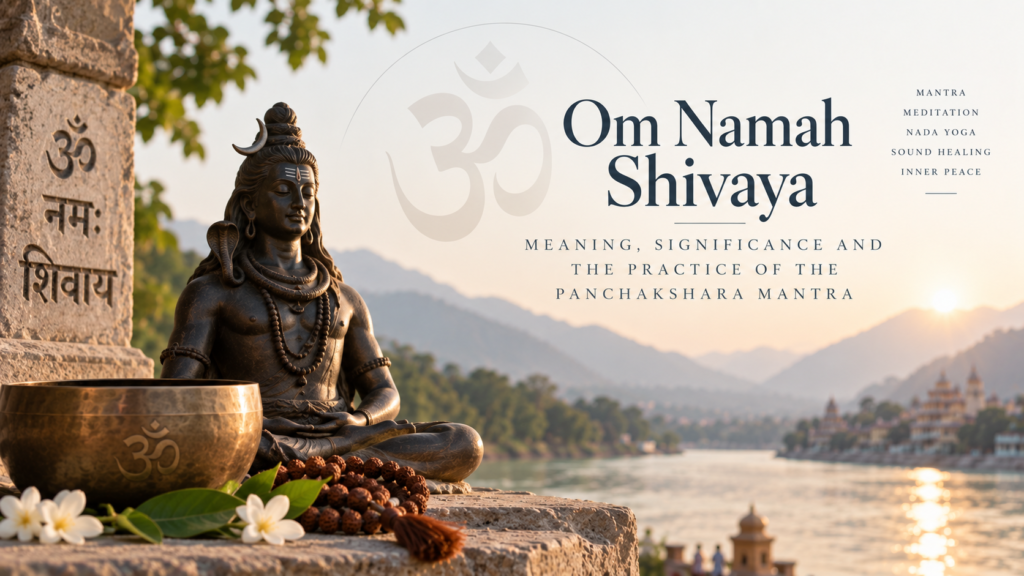
There are mantras that become familiar through repetition. Over time, their sounds can become part of daily life, heard in temples, meditation spaces, kirtan gatherings and personal practice. Om Namah Shivaya is one of the most widely recognized Sanskrit mantras within the Shaiva tradition, and its five central syllables carry a long history of devotional and yogic practice.
Written in Sanskrit as ॐ नमः शिवाय, the mantra is commonly transliterated as Oṃ Namaḥ Śivāya. The core phrase Namaḥ Śivāya is known as the Panchakshara Mantra, meaning the five-syllable mantra. The five syllables are Na, Ma, Śi, Vā and Ya, while Om stands at the beginning as the sacred syllable that accompanies the mantra. The phrase appears in the Shri Rudram of the Krishna Yajurveda, giving it a Vedic textual foundation.
For someone approaching mantra practice through yoga, the value of Om Namah Shivaya lies in several layers. Its meaning invites reverence, its rhythm supports repetition, and its sound gives the mind a steady point of attention. Through Nada Yoga, the practice can also be explored through listening, pronunciation, resonance and silence.
What does Om Namah Shivaya mean?
The simplest translation of Om Namah Shivaya is often given as “I bow to Shiva” or “Salutations to Shiva.” Here, Shiva carries the traditional meaning of the auspicious, benevolent or gracious one. The word namaḥ comes from a root associated with bowing or offering reverence.
The mantra therefore expresses an attitude of reverence. In devotional practice, the practitioner directs that reverence toward Shiva. Within yogic contemplation, the same words can become an invitation to turn attention inward and reflect on the qualities associated with Shiva, such as stillness, awareness and auspiciousness.
The meaning becomes especially interesting when the mantra is repeated many times. At first, the practitioner may focus mainly on the translation. Gradually, attention can move toward the pronunciation, rhythm and vibration of the words. This movement from intellectual understanding toward direct experience forms an important part of mantra practice.
Why is it called the Panchakshara Mantra?
The word Panchakshara comes from pancha, meaning five, and akshara, meaning syllable or imperishable sound. The name refers specifically to Na-Ma-Śi-Vā-Ya.
When Om is added at the beginning, the commonly used form becomes Om Namah Shivaya. Traditional sources therefore distinguish the five-syllable Namah Shivaya from the form beginning with Om, while both remain deeply connected in practice.
The five syllables also receive symbolic interpretations within Shaiva traditions. A widely taught correspondence connects Na, Ma, Śi, Vā and Ya with the five great elements: earth, water, fire, air and space. This interpretation offers practitioners another way to contemplate the mantra, although specific correspondences vary across traditions and commentarial systems.
For a practitioner of yoga, these associations can provide a contemplative framework. Each syllable becomes an opportunity to slow down, listen carefully and bring awareness to the relationship between sound, breath and attention.
Om Namah Shivaya and its Vedic roots
The five-syllable formula has an important place in the Shri Rudram, a well-known Vedic hymn dedicated to Rudra in the Krishna Yajurveda. The phrase appears in the eighth section of the Namakam portion as Namaḥ Śivāya ca Śivatarāya ca.
This history matters because Om Namah Shivaya belongs to a living tradition of Sanskrit recitation. The mantra has continued through devotional practice, temple worship, meditation, japa and different Shaiva lineages.
Its continued use also demonstrates an important feature of Sanskrit mantra practice. A mantra lives through sound as much as through written language. Pronunciation, rhythm, breath and repetition all contribute to the experience of chanting.
The sound of the mantra matters
When you read Om Namah Shivaya silently on a page, you encounter its meaning visually. When you chant it, you experience another dimension.
The voice produces an audible sound that travels through the surrounding space. At the same time, the chanter experiences vibration through the body. Breath becomes involved in the rhythm, the mouth shapes each syllable, and the ear receives the sound as it returns.
This is one reason mantra practice fits naturally within Nada Yoga, the traditional yoga of sound. Nada Yoga gives careful attention to sound, listening and awareness. At Nada Yoga School in Rishikesh, mantra chanting forms part of the school’s Nada Yoga teacher training, where students study mantra pronunciation, meditation with mantras, chanting circles and the relationship between sound and yogic practice.
The mantra therefore becomes something you hear as well as something you say.
How to pronounce Om Namah Shivaya
The Sanskrit form is:
ॐ नमः शिवाय
A commonly used transliteration is:
Oṃ Namaḥ Śivāya
For a simple pronunciation guide, you can approach it as:
Om Na-mah Shi-vaa-ya
The final sound of Namaḥ deserves attention. The Sanskrit visarga ḥ represents a breath-like ending, giving the word a softer finish. Similarly, Śivāya contains the long ā sound, which deserves a clear, sustained pronunciation.
In mantra practice, pronunciation develops through listening and repetition. Hearing an experienced teacher chant the mantra can help students recognize vowel length, consonant placement, rhythm and breath.
What happens when you repeat the mantra?
Japa means repeated recitation of a mantra. The repetition may be audible, whispered or mental, depending on the tradition and the practitioner’s stage of practice.
With Om Namah Shivaya, repetition gives the mind a consistent structure. Instead of following every passing thought, attention repeatedly returns to the same sequence of sounds. The breath begins to settle into a rhythm, and the ear becomes increasingly familiar with the subtle details of the chant.
A mala can provide a physical structure for japa. The practitioner moves from one bead to the next while repeating the mantra, allowing the hands, voice, breath and attention to participate in one continuous practice.
Over time, repetition can also change the way the mantra is experienced. The first few repetitions may feel deliberate. After sustained practice, the syllables can begin to flow more naturally, allowing greater attention to their sound and resonance.
Chanting Om Namah Shivaya aloud
Audible chanting offers a direct relationship with sound.
Begin by sitting comfortably with the spine naturally upright. Take a few calm breaths, then chant Om Namah Shivaya at a comfortable volume. Allow each syllable to remain distinct while keeping the overall rhythm smooth.
After several repetitions, bring attention to the sound itself. Listen to the beginning of each syllable, its continuation and its gradual fading. Notice how the final sound gives way to the next breath.
This simple approach turns chanting into a listening practice.
The process also demonstrates an important principle of Nada Yoga. Sound can become an object of concentration when the practitioner listens with sustained attention.
Om Namah Shivaya and meditation
Mantra meditation gives the mind a defined object of awareness. Om Namah Shivaya can be repeated alongside natural breathing, with attention resting on the sound and meaning of the mantra.
One approach begins with audible chanting. After several repetitions, gradually reduce the volume until the mantra becomes a whisper. Eventually, allow the repetition to continue mentally while maintaining awareness of the breath.
At each stage, listening remains important. The practitioner can observe how the experience changes as the external sound becomes quieter.
This movement creates an interesting relationship between mantra, sound and silence. The practice begins with a clearly audible vibration and gradually brings attention toward subtler forms of experience.
Om Namah Shivaya and Nada Yoga
Nada Yoga places sound at the center of yogic attention. Traditional teachings explore sound through different levels, from audible expression toward increasingly subtle forms of awareness.
Om Namah Shivaya offers a practical entry point into this approach because the mantra contains clear syllables, rhythm and sustained vocal sounds. The practitioner can begin with the external sound and gradually develop greater sensitivity to listening.
At Nada Yoga School, students explore this relationship through mantra, music, meditation and sound-based practices. The school’s Nada Yoga teacher training in Rishikesh includes mantra pronunciation, mantra meditation, kirtan, chanting circles and healing practices involving mantras and ragas.
This perspective also helps distinguish mantra practice from simply listening to relaxing music. The practitioner actively participates in creating the sound while simultaneously learning to listen to it.
The connection between mantra and sound healing
Mantra chanting also has a natural place within the broader field of sound-based practices. Sound healing uses sound, vibration, listening and musical or acoustic tools in structured practices designed to support relaxation, meditation and wellbeing.
Mantra and sound healing share an interest in the effects of sound on attention and experience, while their traditional frameworks differ. A Sanskrit mantra belongs to a specific linguistic, spiritual and cultural tradition. Contemporary sound healing can involve singing bowls, gongs, tuning forks, voice, music and other forms of sound-based practice.
Understanding this distinction helps practitioners approach both fields with greater clarity.
A sound healing course in Rishikesh can introduce students to practical work with sound, listening and instruments, while Nada Yoga gives greater attention to the yogic dimensions of sound, mantra and inner listening. Nada Yoga School’s Sound Healing Teacher Training includes guided listening, instrument practice and the application of sound healing methods within a traditional yogic setting.
For students interested in both disciplines, mantra can become an important bridge between voice-based practice and broader sound work.
The five syllables and the five elements
Traditional interpretations often connect the five syllables of Namah Shivaya with the Pancha Mahabhuta, the five great elements.
| Syllable | Traditional element |
| Na | Earth |
| Ma | Water |
| Śi | Fire |
| Vā | Air |
| Ya | Space |
These associations belong to traditional Shaiva interpretations and can be used as a contemplative framework.
The sequence can be contemplated gradually during japa. Earth can suggest stability, water can evoke movement, fire can suggest transformation, air can bring attention to movement and breath, while space can point toward openness.
The practitioner can hold these meanings lightly while maintaining attention on the actual sound. This keeps the practice rooted in both contemplation and listening.
From chanting toward silence
One of the most interesting aspects of mantra practice appears between repetitions.
After Om Namah Shivaya ends, there is a small space before the next repetition begins. With sustained attention, that space becomes easier to notice.
The silence does not require any special technique. Simply allow the sound to fade naturally and listen to what follows. Then begin the next repetition.
This approach fits naturally with the contemplative direction of Nada Yoga. Sound becomes a doorway into attentive listening, while silence provides the space in which listening can deepen.
The same principle can be explored through Indian classical music. A musician learns to hear pitch, resonance, sustain, movement and the spaces surrounding each note. Mantra practice can cultivate a similar sensitivity to the life of a single sound.
A simple Om Namah Shivaya practice
You can begin with a short practice of around ten minutes.
Sit comfortably and allow your breathing to settle. Then chant Om Namah Shivaya slowly for several repetitions, keeping the pronunciation clear and the volume comfortable.
After a few minutes, bring more attention to listening. Notice the resonance of the voice, the movement of the breath, and the way each repetition ends. Gradually soften the volume until you are whispering the mantra.
For the final few minutes, repeat the mantra mentally. Let the breath remain natural and allow the attention to rest on the rhythm of the inner repetition.
When the practice ends, sit quietly for a short time. Let the last repetition fade naturally before returning to ordinary activity.
This simple progression gives you an experience of voice, sound, listening, and silence within one practice.
Om Namah Shivaya as a lifelong practice
The strength of Om Namah Shivaya comes from its simplicity. Five syllables can become a foundation for years of japa, meditation, and devotional practice.
Its Vedic roots connect the mantra with an ancient Sanskrit recitation tradition. Its Shaiva significance gives it a clear devotional context. Its sound makes it especially relevant to practitioners exploring mantra through Nada Yoga.
For students who want to study these traditions in greater depth, a Nada Yoga teacher training course in Rishikesh can provide a structured environment for exploring mantra, Indian classical music, meditation, voice and sound. Students interested in contemporary sound-based practice can also explore a sound healing teacher training course, where listening, instruments and practical sound applications receive focused attention.
Ultimately, Om Namah Shivaya invites a particular kind of attention. You learn the words, then you listen to the sound. You repeat the sound, then you begin to notice the silence surrounding it. Through that process, a familiar mantra can become a sustained practice of listening, reverence and awareness.
Frequently asked questions
What does Om Namah Shivaya mean?
Om Namah Shivaya is commonly translated as “I bow to Shiva” or “Salutations to Shiva.” Shiva carries the traditional sense of the auspicious or benevolent one.
Why is Om Namah Shivaya called the Panchakshara Mantra?
The core mantra Namah Shivaya contains five syllables: Na, Ma, Śi, Vā and Ya. The name Panchakshara refers to these five syllables. Om accompanies the mantra and is counted separately in this traditional classification.
Is Om Namah Shivaya a Vedic mantra?
The phrase Namaḥ Śivāya appears in the Shri Rudram of the Krishna Yajurveda, within the Taittiriya Samhita.
Can Om Namah Shivaya be used for meditation?
Yes. The mantra can serve as an object of attention during meditation. Practitioners may chant it aloud, whisper it or repeat it mentally while maintaining awareness of the sound, breath and meaning.
What is the connection between Om Namah Shivaya and Nada Yoga?
Nada Yoga explores sound as a support for concentration, meditation and deeper awareness. Mantra provides a structured form of sound practice, making Om Namah Shivaya relevant to the study of sound, listening and meditation within the Nada Yoga tradition.
Can I learn mantra chanting through a Nada Yoga course?
Yes. Nada Yoga School’s teacher training includes mantra pronunciation, mantra meditation, kirtan and chanting practices as part of its sound-focused curriculum.
How is mantra different from sound healing?
Mantra belongs to specific linguistic and spiritual traditions, with meaning, pronunciation and established methods of practice. Sound healing is a broader contemporary field that can involve instruments, voice, music, vibration and guided listening. Both can involve focused attention on sound while following different frameworks.
Final thoughts
Om Namah Shivaya begins with five simple syllables, yet its practice can open several layers of exploration. You can study its Sanskrit meaning, its Vedic roots, its Shaiva symbolism and its role in japa. You can also experience the mantra directly through voice, breath, listening and silence.
For anyone drawn to the relationship between mantra and sound, this makes Om Namah Shivaya an especially rich practice. Its repetition gives the mind a steady rhythm, while its sound creates an opportunity to listen more carefully. In the context of Nada Yoga, that act of listening can become the beginning of a deeper relationship with sound itself.