Sound has always been part of human life. Long before written language, people used voice, rhythm, drums, clapping, and song to communicate and connect. Across cultures, sound became part of prayer, ceremony, meditation, storytelling, and community life.
In India, this relationship with sound developed into rich traditions of mantra, chanting, Indian classical music, and Nāda Yoga, the practice of exploring sound through conscious listening.
Today, interest in sound healing is growing around the world. People use singing bowls, gongs, tuning forks, chimes, drums, the human voice, and other instruments in meditation and wellness practices.
For someone new to the subject, however, the number of instruments and techniques can feel overwhelming. You may come across different frequencies, healing claims, meditation methods, and traditional practices all at once.
So where should you begin?
The best starting point is surprisingly simple: learn how to listen.
Before buying several instruments or studying different frequencies, develop an understanding of sound, vibration, attention, and relaxation. This creates a much stronger foundation for exploring sound healing.
What Is Sound Healing?
Sound healing is a broad term for practices that use sound, music, vibration, voice, or rhythm as part of relaxation, meditation, and personal wellbeing.
Different traditions use different sounds and methods. For example, one practice may focus on a singing bowl, while another may use mantra or the human voice.
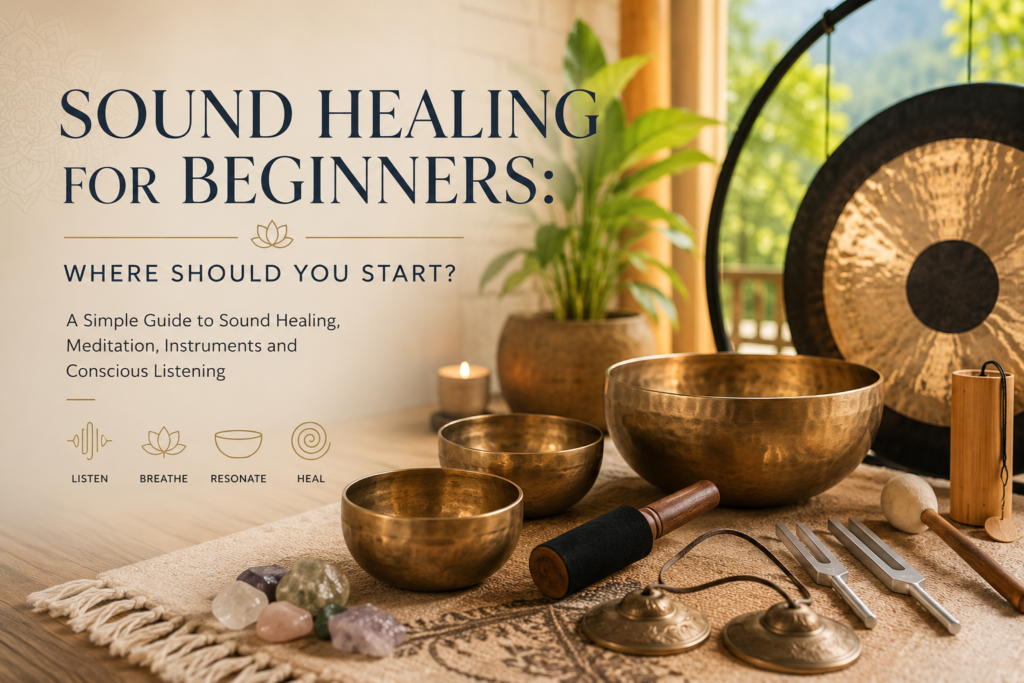
Common sound healing instruments include:
- Singing bowls
- Gongs
- Tuning forks
- Bells and chimes
- Drums
- Tanpura
- The human voice
A sound practice can also take different forms. During a sound bath, for example, participants usually rest while a practitioner plays several instruments. In contrast, a sound meditation may involve listening to one steady tone.
It is also important to keep expectations realistic. Sound can influence relaxation, attention, mood, and sensory experience. However, claims that specific frequencies can cure diseases or repair particular organs are not established by modern medical science.
For beginners, this balanced approach provides plenty of room to explore.
Why Is Sound Useful in Meditation?
One reason sound works well in meditation is its relationship with attention.
When the mind is busy, thoughts can move quickly between memories, plans, worries, and everyday concerns. A steady sound can give the mind a simple point of focus.
Instead of following every thought, you listen.
First, notice when the sound begins. Then, notice its texture and movement. As it becomes quieter, follow the sound until it disappears.
This simple process is closely related to mindfulness.
For sound meditation for beginners, listening can feel more accessible than trying to sit in complete silence. A gentle sound gives the mind something familiar to return to whenever attention wanders.
Start With Listening, Not Instruments
If you are beginning your journey into sound healing, you do not need a special instrument.
Instead, find a quiet place and simply listen.
Close your eyes if that feels comfortable. Then notice the sounds that already surround you.
You might hear:
- Birds
- Wind
- Footsteps
- Distant traffic
- Your own breathing
- Voices
- Fans or other background sounds
- Moments of silence
Try not to label each sound as pleasant or unpleasant. Just observe it.
With regular practice, this becomes active listening. You start noticing details that might normally pass unnoticed.
For someone interested in learning sound healing, this skill is essential. A practitioner needs to recognise changes in pitch, volume, resonance, duration, and tone. More importantly, they need to notice how a sound affects the atmosphere and the people listening to it.
Understanding Frequency
The word “frequency” appears frequently in modern sound healing.
In simple terms, frequency describes the number of vibration cycles that occur each second. It is measured in Hertz (Hz).
For example:
- 100 Hz means 100 cycles per second.
- 440 Hz means 440 cycles per second.
- 528 Hz means 528 cycles per second.
Frequency is closely related to pitch. Higher frequencies generally produce higher pitches, while lower frequencies produce lower pitches.
However, frequency is only one part of a sound.
Two instruments can produce the same fundamental frequency and still sound very different. Their material, shape, harmonics, resonance, and playing method all affect the final sound.
Therefore, understanding basic acoustics is more useful than simply memorising lists of frequencies.
What Are Harmonics?
When an acoustic instrument produces a sound, it usually creates more than one frequency.
The main frequency is called the fundamental frequency. Other frequency components are known as harmonics or overtones.
Together, these elements shape the character of a sound.
They contribute to qualities such as:
- Warmth
- Brightness
- Richness
- Resonance
- Tonal complexity
For example, two singing bowls may have similar fundamental tones but still sound noticeably different. Their construction and harmonic content can create very different listening experiences.
As a result, beginners can learn a great deal simply by comparing instruments carefully and listening to how each one resonates.
Choosing Your First Sound Healing Instrument
You do not need a large collection of instruments to begin.
In fact, learning one instrument well can be more useful than owning many instruments without understanding how they work.
Singing Bowls
Singing bowls are among the most familiar instruments used in sound meditation.
You can strike a bowl gently with a mallet or move the mallet around its rim to create a sustained resonance.
They are commonly used for:
- Meditation
- Relaxation
- Sound baths
- Mindful listening
- Yoga practices
When choosing a beginner singing bowl, focus first on its sound and your ability to play it comfortably. A bowl that feels natural in your hands will give you more opportunity to practise.
Tuning Forks
Tuning forks produce stable pitches and can help beginners explore the relationship between frequency and sound.
There are several types, including musical tuning forks, Solfeggio tuning forks, planetary tuning forks, and other frequency-based systems.
These systems have different histories and purposes. Therefore, it is useful to study their background before assigning specific healing claims to individual frequencies.
Gongs
Gongs produce broad, changing sounds with rich harmonics and long resonance.
They are often used during sound baths and group meditation sessions. However, they require some care because their sound can become intense when played with too much force.
Beginners should learn how different mallets, striking points, volume levels, and playing distances affect the experience.
The Human Voice
Your voice is perhaps the simplest sound healing instrument available.
You can explore humming, vowel sounds, chanting, mantra, and vocal toning without purchasing any equipment.
These practices create a direct connection between:
Breath → Vibration → Sound → Awareness
This relationship is especially important in traditional Indian sound practices.
Sound Healing and the Human Voice
Before musical instruments became widely available, people already had the ability to create sound through the human voice.
Indian traditions developed detailed practices involving mantra and chanting. These practices bring together pronunciation, rhythm, breath, pitch, and repetition.
For beginners, gentle humming can be a simple introduction.
Take a comfortable breath. Then produce a soft humming sound as you exhale. Keep the volume comfortable and pay attention to the vibration.
You may notice sensations around the lips, face, throat, chest, or head.
These sensations show how the body experiences vibration. They do not mean that the sound is physically healing a particular organ.
Instead, the exercise gives you a direct way to explore the relationship between breath, vibration, and attention.
What Is a Sound Bath?
A sound bath is a guided sound experience in which participants usually rest while a practitioner plays one or more instruments.
Common instruments include:
- Singing bowls
- Gongs
- Chimes
- Drums
- Tuning forks
- Bells
- Voice
Usually, participants do not need to perform any particular technique. They simply find a comfortable position, relax, and listen.
As a result, a sound bath can be an approachable introduction to sound-based meditation.
Some people focus on the instruments, while others notice their breathing or the feeling of resting quietly. Each experience can be different.
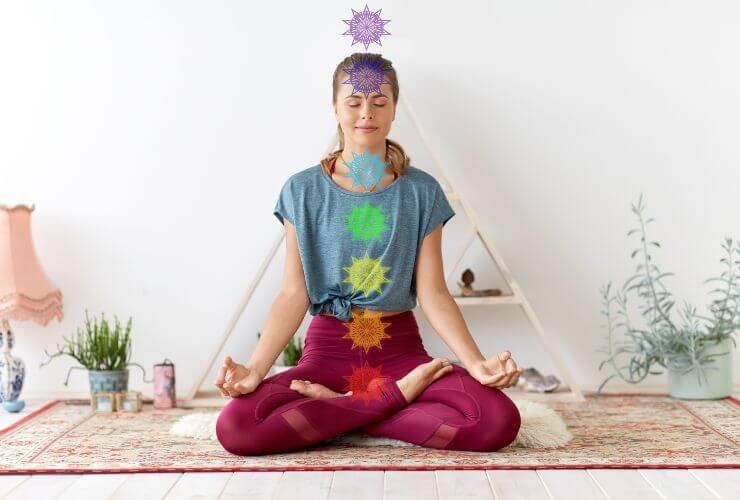
A Simple Sound Meditation for Beginners
You can practise sound meditation for beginners without any special equipment.
Find a comfortable seated position and allow your spine to remain naturally upright. Take several slow breaths before beginning.
Next, choose one sound to listen to.
It could be:
- A singing bowl
- A bell
- A Tanpura drone
- Gentle music
- Your own humming
- Flowing water
- Another natural sound
Spend five to ten minutes listening.
When your attention moves towards a thought, gently return to the sound. There is no need to fight the thought or force your mind to become empty.
Instead, keep returning to listening.
As you practise, notice:
- Where the sound begins.
- How the sound changes.
- How long the resonance continues.
- Which harmonics you can hear.
- What happens when the sound fades.
- What you notice in the silence afterwards.
The goal is not to create a dramatic experience. Rather, the practice helps you become more attentive to sound.
How Sound Relates to Nada Yoga
For anyone interested in the deeper traditions of sound, Nada Yoga provides an important perspective.
The Sanskrit word nāda refers to sound or vibration. Within the yogic tradition, sound can become a means of developing concentration and awareness.
Nada Yoga encourages practitioners to refine their listening. External sounds can become the starting point for a more inward form of attention.
This approach is especially valuable for beginners because it shifts the focus away from searching for a “perfect” frequency.
Instead, the practice asks a simpler question:
How deeply can you listen?
That question can change the way we experience sound.
What Should Beginners Learn About Sound Healing?
Once you have developed basic listening skills, you can begin exploring the wider field of sound healing.
A good foundation includes several areas.
Learn Basic Acoustics
Start with simple concepts such as:
- Frequency
- Pitch
- Amplitude
- Resonance
- Harmonics
- Timbre
- Vibration
These concepts help you understand what is physically happening when an instrument produces sound.
Explore Traditional Sound Practices
Next, learn about the traditions that have used sound for centuries.
These may include:
- Nada Yoga
- Mantra
- Indian classical music
- Sacred chanting
- Temple bells
- Conch shells
- Traditional percussion
Learning the history behind these practices adds context to modern sound healing.
Learn How Instruments Work
Each instrument responds differently to touch and movement.
Pay attention to:
- Striking technique
- Mallet selection
- Playing position
- Distance
- Volume
- Resonance
- Timing
As you become familiar with these details, your playing becomes more intentional.
Learn How to Hold a Session
If your goal is to work with other people, you will need skills beyond playing instruments.
You should also learn how to create a comfortable setting, explain the practice clearly, choose sounds carefully, and observe how participants respond.
For example, one person may find a loud gong deeply relaxing, while another may find the same sound overwhelming.
A responsible practitioner therefore learns to adapt.
What About Sound Healing Frequencies?
Beginners often encounter lists of frequencies connected with particular physical, emotional, or spiritual effects.
Solfeggio frequencies, 432 Hz, 528 Hz, and planetary frequencies are common examples.
These subjects can be interesting from several perspectives. You can study their musical relationships, mathematical basis, historical development, and spiritual interpretations.
However, it helps to separate three different types of claims.
Acoustic fact: A frequency can be measured.
Traditional interpretation: A particular frequency may have symbolic or spiritual meaning within a tradition.
Medical claim: A frequency can directly treat or cure a disease.
These statements are very different.
Therefore, learning sound healing with curiosity and discernment allows you to appreciate traditional ideas while keeping scientific claims in perspective.
How Long Does It Take to Learn Sound Healing?
There is no single timeline for learning sound healing.
You can begin a simple sound meditation immediately. However, developing the skills needed to guide other people takes more time and practice.
A useful learning path might look like this:
- Develop your listening skills.
- Explore one or two instruments.
- Learn basic acoustics.
- Practise sound meditation.
- Study traditional sound practices.
- Learn how to structure a session.
- Practise under experienced guidance.
For those who want a structured approach, a sound healing course in Rishikesh can bring together sound, yoga, meditation, Indian musical traditions, and practical instrument work.
Similarly, sound healing teacher training in Rishikesh can provide deeper study of instruments, session design, conscious listening, and the practical responsibilities involved in guiding others.
Bringing Sound Into Your Yoga Practice
Sound does not need to remain separate from yoga.
Instead, it can become part of an existing practice.
For example, a Tanpura drone can accompany meditation. Mantra can become part of a morning routine. A singing bowl can mark the beginning or end of a practice. Gentle humming can be added to breath awareness.
In this way, sound creates a natural connection between movement, breath, and attention.
This is also where sound-based yoga practice becomes interesting. The focus gradually moves from simply performing physical postures towards developing awareness through several senses.
Traditional Indian music offers a similar lesson. Musicians learn to listen closely to pitch, rhythm, resonance, and subtle changes in tone.
Yoga can cultivate the same quality of attention.
What Should Beginners Avoid?
The growing popularity of sound healing has also created a large amount of misinformation.
It is therefore worth being cautious when you encounter claims that:
- One frequency can cure a specific disease.
- Every organ has one exact healing frequency.
- Sound can replace medical treatment.
- A particular frequency can automatically repair DNA.
- Every ancient sound tradition used the exact frequencies promoted today.
- Louder sound always creates a stronger effect.
Sound can be meaningful and deeply relaxing without relying on extraordinary claims.
A grounded approach also gives traditional practices the respect they deserve. At the same time, it allows us to distinguish cultural and spiritual beliefs from established scientific evidence.
Building Your Own Sound Healing Practice
You do not need a large collection of instruments to begin.
Start with one sound.
Listen carefully.
Learn how the instrument works. Notice how its tone changes when you alter your technique. Spend time understanding its resonance before moving on to something else.
Gradually, you can introduce other instruments and explore how their sounds interact.
Over time, you may discover that the most important part of sound healing is not the instrument itself. It is the attention you bring to the sound.
Final Thoughts
Sound healing for beginners does not need to start with complicated frequency charts or a room filled with instruments.
It can begin with something much simpler: listening.
Listen to a singing bowl as its resonance fades. Notice the steady drone of a Tanpura. Feel the vibration of your own voice during a gentle hum. Sit quietly and notice sounds that you usually overlook.
From there, you can explore the wider world of sound.
You can study singing bowls, tuning forks, gongs, mantra, Indian classical music, sound baths, and the contemplative practice of Nada Yoga. Along the way, learning basic acoustics can help you understand which claims are supported by measurable principles and which belong to spiritual or symbolic traditions.
Most importantly, keep your approach curious and grounded.
You do not need to find the “perfect” frequency.
You need to learn how to listen.
That is where the journey into sound healing truly begins.