The Maha Mrityunjaya Mantra (also spelled Mahamrityunjaya Mantra) is one of the most revered and powerful mantras in the Vedic tradition. Dedicated to Lord Shiva, it is often called the Death-Conquering Mantra, the Rudra Mantra, or the Tryambakam Mantra. For thousands of years, sages, yogis, and spiritual seekers have chanted this sacred mantra to invoke healing, inner strength, protection, and spiritual liberation.
In the tradition of Nada Yoga, the Yoga of Sound, every mantra carries a unique vibrational quality. The Maha Mrityunjaya Mantra is not simply a collection of Sanskrit words—it is a carefully arranged sequence of sacred sounds that have been preserved through centuries of oral tradition. When chanted with proper pronunciation, awareness, and devotion, its vibrations can calm the mind, deepen meditation, and cultivate inner resilience.
Whether you have encountered this mantra during yoga practice, meditation, spiritual study, or are simply curious about its meaning, this guide will help you understand it from both a linguistic and yogic perspective.
By the end of this guide, you will not only understand what the Maha Mrityunjaya Mantra means but also appreciate why it has remained one of the most beloved mantras in yoga and Hindu spirituality for millennia.
What Is the Maha Mrityunjaya Mantra?
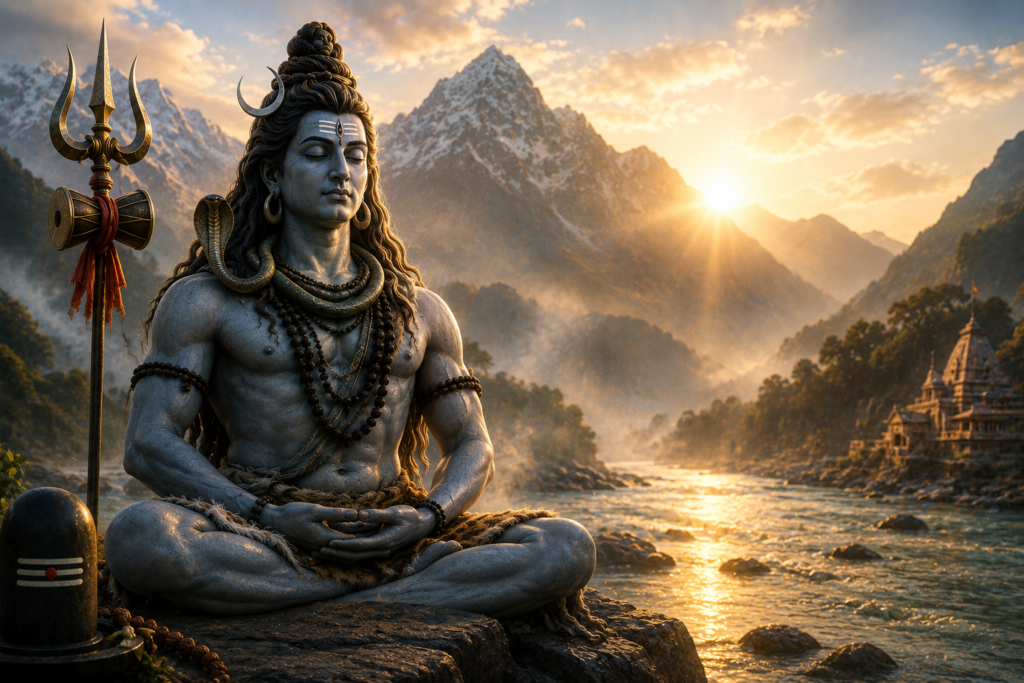
The Maha Mrityunjaya Mantra is an ancient Vedic mantra dedicated to Lord Shiva in his aspect as Tryambaka, the “Three-Eyed One.” It is one of the oldest surviving mantras in the Vedas and has been recited continuously for thousands of years by seekers across India and around the world.
The name itself reveals its purpose:
- Maha means “great.”
- Mrityu means “death.”
- Jaya means “victory” or “conquest.”
Together, the name translates as:
“The Great Mantra That Conquers Death.”
However, understanding this title literally can be misleading. In yogic philosophy, “death” represents much more than the end of physical life. It symbolizes fear, ignorance, attachment, limitation, and the constant cycle of birth and death known as samsara. Chanting this mantra is traditionally understood as a prayer for liberation from these deeper forms of bondage.
Unlike many prayers that ask for material success or worldly achievements, the Maha Mrityunjaya Mantra directs the mind toward inner transformation. It reminds practitioners that true freedom arises not from controlling life but from realizing the immortal essence of consciousness that exists beyond change.
Because of its profound significance, this mantra is commonly recited:
- During meditation and daily spiritual practice
- Before yoga sessions
- During healing ceremonies
- For individuals facing illness or recovery
- During times of emotional difficulty
- On Mondays, a day traditionally associated with Lord Shiva
- During Maha Shivaratri and other sacred observances
- In prayers for peace, strength, and spiritual well-being
Today, the Maha Mrityunjaya Mantra is chanted by millions of people worldwide, regardless of their religious background. Many are drawn to its calming rhythm, uplifting vibration, and timeless message of hope, courage, and inner awakening.
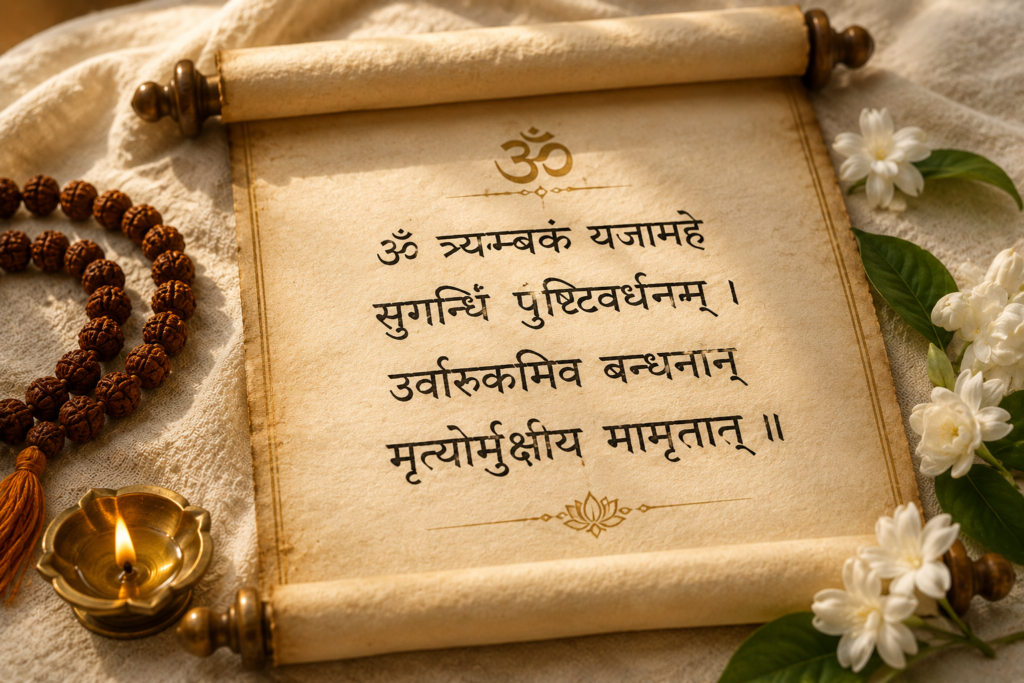
Maha Mrityunjaya Mantra in Sanskrit
Below is the traditional Sanskrit version of the mantra as preserved in the Vedic tradition:

ॐ त्र्य॑म्बकं यजामहे
सुग॒न्धिं पु॑ष्टि॒वर्ध॑नम् ।
उ॒र्वा॒रु॒कमि॑व॒ बन्ध॑नान्
म᳗॒॒त्योर्मु॑क्षीय॒ माऽमृता॑᳚त् ॥
Maha Mrityunjaya Mantra Transliteration (IAST)
Oṁ Tryambakaṁ Yajāmahe
Sugandhiṁ Puṣṭivardhanam
Urvārukamiva Bandhanān
Mṛtyor Mukṣīya Mā’mṛtāt
Maha Mrityunjaya Mantra Pronunciation (Easy Roman Script)
For those unfamiliar with Sanskrit pronunciation, the mantra can also be read as:
Om Tryambakam Yajamahe
Sugandhim Pushtivardhanam
Urvarukamiva Bandhanan
Mrityor Mukshiya Maamritat
While this simplified version is helpful for beginners, learning the correct Sanskrit pronunciation over time helps preserve the mantra’s traditional sound and rhythm.
English Translation of the Maha Mrityunjaya Mantra
A commonly accepted translation is:
“We worship the Three-Eyed Lord Shiva, who is fragrant and nourishes all beings. May He liberate us from the bondage of death, just as a ripe cucumber naturally separates from its vine, but never from immortality.”
This translation beautifully captures the mantra’s central message. Rather than pleading for endless physical life, it is a prayer to awaken to the immortal Self—the eternal consciousness that, according to the yogic tradition, lies beyond birth and death.
The imagery of a ripe cucumber effortlessly detaching from its vine is particularly significant. Just as the fruit separates naturally when it has fully matured, the mantra asks that we be released gracefully from the bonds of fear, attachment, and suffering when the time is right, without losing our connection to the eternal reality.
This is why the Maha Mrityunjaya Mantra is regarded not merely as a prayer for protection, but as a profound meditation on life, transformation, and liberation.
Why Is It Called the Death-Conquering Mantra?
One of the most common misconceptions about the Maha Mrityunjaya Mantra is that it literally prevents death. Traditional teachings present a much deeper understanding.
In Sanskrit philosophy, mrityu (death) is not limited to the physical body. It also represents:
- Fear
- Ignorance (avidyā)
- Attachment
- Ego
- Limitation
- Suffering
- The endless cycle of birth and rebirth (samsara)
The mantra is therefore a prayer to overcome everything that keeps us from recognizing our true nature.
When yogis speak of “conquering death,” they refer to conquering the fear of death. By realizing the immortal Self (Ātman), one no longer identifies solely with the temporary body or mind. This understanding lies at the heart of yoga, Vedanta, and many of the Upanishads.
From this perspective, the Maha Mrityunjaya Mantra becomes much more than a healing chant—it becomes a path toward fearlessness, acceptance, and spiritual freedom.
Maha Mrityunjaya Mantra Word-by-Word Meaning
One of the reasons the Maha Mrityunjaya Mantra has remained timeless is that every Sanskrit word carries layers of meaning. Sanskrit is often described as a language of vibration as much as one of grammar, and each term in this mantra has both a literal and symbolic significance.
Understanding the mantra word by word allows us to move beyond memorization and appreciate the wisdom encoded within its sacred sounds.
The Mantra
ॐ त्र्य॑म्बकं यजामहे
सुग॒न्धिं पु॑ष्टि॒वर्ध॑नम् ।
उ॒र्वा॒रु॒कमि॑व॒ बन्ध॑नान्
म᳗॒॒त्योर्मु॑क्षीय॒ माऽमृता॑᳚त् ॥
Word-by-Word Translation
| Sanskrit Word | Transliteration | Literal Meaning | Deeper Spiritual Meaning |
|---|---|---|---|
| ॐ | Oṁ | The primordial sound | The universal vibration from which all creation arises. |
| त्र्यम्बकम् | Tryambakam | The Three-Eyed One | Lord Shiva, whose third eye symbolizes wisdom, insight, and the ability to perceive beyond ordinary reality. |
| यजामहे | Yajāmahe | We worship, honor, or meditate upon | A heartfelt act of devotion, surrender, and contemplation rather than mere ritual worship. |
| सुगन्धिम् | Sugandhim | Fragrant | Divine presence that naturally spreads goodness, purity, and spiritual influence, just as fragrance fills the air. |
| पुष्टिवर्धनम् | Puṣṭivardhanam | The one who nourishes and strengthens | The sustaining force that nurtures physical health, emotional balance, and spiritual growth. |
| उर्वारुकम् | Urvārukam | A ripe cucumber or melon | A symbol of natural maturity and effortless release from worldly attachments. |
| इव | Iva | Like or as | Introduces the comparison that follows. |
| बन्धनान् | Bandhanān | From bondage | The limitations created by fear, ego, attachment, karma, and ignorance. |
| मृत्योः | Mṛtyor | From death | Not only physical death but also the fear and suffering associated with impermanence. |
| मुक्षीय | Mukṣīya | May we be liberated | A prayer for freedom, release, and spiritual liberation (moksha). |
| मा | Mā | Not | A request to not be separated from what follows. |
| अमृतात् | Amṛtāt | Immortality or the nectar of eternal life | The eternal Self, divine consciousness, and the state beyond birth and death. |
Understanding Each Phrase
ॐ (Oṁ)
The mantra begins with Om, considered the primordial vibration of the universe. In yogic philosophy, Om is not simply a sound but the expression of ultimate reality.
The ancient scriptures describe Om as containing every possible vibration. Chanting it helps bring the mind from distraction toward stillness and prepares the practitioner for meditation.
Beginning the Maha Mrityunjaya Mantra with Om reminds us that healing begins by reconnecting with our deepest nature.
त्र्यम्बकं (Tryambakam)
The word Tryambakam means “the Three-Eyed One” and refers to Lord Shiva.
Shiva’s three eyes represent several profound truths:
- The Sun (action)
- The Moon (compassion)
- Fire (wisdom)
They also symbolize:
- Past
- Present
- Future
And on a spiritual level:
- Physical awareness
- Mental awareness
- Spiritual insight
The third eye represents intuitive wisdom that sees beyond illusion. It burns away ignorance and reveals truth.
By invoking Tryambaka, we are asking for the clarity to perceive life beyond fear and limitation.
यजामहे (Yajāmahe)
This word is often translated simply as “we worship.”
However, Sanskrit conveys a richer meaning.
Yajāmahe implies:
- honoring
- revering
- meditating upon
- dedicating oneself
- offering oneself
The mantra is therefore not merely praise directed outward. It is an inward act of surrender in which the practitioner aligns with divine consciousness.
Rather than asking Shiva to solve life’s problems, the mantra encourages us to awaken the qualities Shiva represents within ourselves—wisdom, stillness, compassion, and fearlessness.
सुगन्धिं (Sugandhim)
Literally, Sugandhim means “fragrant.”
At first glance, this may seem unusual. Why would the Divine be described as fragrant?
In Sanskrit literature, fragrance symbolizes subtle influence.
Just as the scent of a flower spreads naturally without effort, the presence of an awakened being radiates peace, compassion, and wisdom.
A fragrant flower does not choose whom to perfume. It simply expresses its nature.
Likewise, spiritual realization naturally blesses the world.
By describing Shiva as Sugandhim, the mantra reminds us that true spirituality quietly transforms everyone it touches.
पुष्टिवर्धनम् (Puṣṭivardhanam)
This compound word combines two ideas:
- Puṣṭi — nourishment, health, vitality
- Vardhanam — growth, increase, expansion
Together they describe the Divine as the source of all nourishment.
This nourishment extends far beyond physical health.
The mantra speaks of nourishment on many levels:
- Physical vitality
- Emotional resilience
- Mental clarity
- Spiritual maturity
Just as sunlight allows a tree to grow naturally, divine awareness supports every stage of inner development.
उर्वारुकमिव (Urvārukamiva)
This is one of the most poetic expressions in all of Vedic literature.
Urvāruka refers to a ripe cucumber or melon.
The mantra compares liberation to a ripe fruit naturally separating from its vine.
Notice what the mantra does not say.
It does not ask to be cut away violently.
It does not ask to escape life prematurely.
Instead, it asks for a graceful release that comes through maturity.
Just as ripe fruit lets go effortlessly when the time is right, the yogi seeks freedom from attachment through wisdom rather than force.
This image beautifully captures one of yoga’s deepest teachings:
Liberation cannot be rushed.
It blossoms naturally through sustained practice, self-knowledge, and inner transformation.
बन्धनान् (Bandhanān)
Bandhana means bondage, attachment, or limitation.
These bonds may include:
- Fear
- Ego
- Attachment to possessions
- Attachment to identity
- Negative habits
- Ignorance
- Emotional suffering
- Karma
The mantra recognizes that external circumstances are not our greatest prison.
The greatest bondage is often created by the mind itself.
Every spiritual tradition speaks about becoming free—not necessarily from the world, but from the mental patterns that prevent us from experiencing peace.
मृत्योर्मुक्षीय (Mṛtyor Mukṣīya)
This phrase means:
“May I be liberated from death.”
Again, death should not be understood only as the ending of physical life.
In yogic philosophy, death also symbolizes:
- fear of change
- insecurity
- anxiety
- attachment
- identification with the temporary
The prayer asks for liberation from all forms of inner death that keep consciousness confined.
This is why many teachers explain that the mantra helps cultivate courage rather than promising immortality.
मा अमृतात् (Mā Amṛtāt)
This final phrase is often translated as:
“But not from immortality.”
It is a subtle yet profound ending.
The practitioner does not ask to avoid life.
Nor do they ask to escape existence.
Instead, they ask never to lose connection with Amṛta—the immortal essence that yogic philosophy identifies as our true nature.
Amṛta literally means “deathless nectar.”
In the Upanishads and later yogic traditions, it represents eternal consciousness.
Thus the mantra concludes with one of the highest aspirations of yoga:
May we be released from ignorance, but never from the realization of the eternal Self.

The Deeper Spiritual Meaning of the Maha Mrityunjaya Mantra
Many people approach this mantra as a prayer for protection during illness or difficult circumstances. While this is a cherished traditional practice, limiting the mantra to physical healing overlooks its deeper philosophical significance.
The Maha Mrityunjaya Mantra is fundamentally a prayer for awakening.
It teaches that suffering does not arise solely from external events but from our identification with what is temporary.
The body changes.
The mind changes.
Relationships change.
Success and failure come and go.
Yet beneath these experiences, yoga teaches there is an unchanging awareness—the Self (Ātman).
The mantra gently redirects our attention from the changing to the changeless.
When we ask to be liberated from death, we are also asking to be liberated from:
- fear of losing what we love
- fear of failure
- fear of aging
- fear of uncertainty
- fear of the unknown
These fears diminish when we begin to recognize ourselves as something greater than our thoughts and circumstances.
For this reason, many yogis chant the Maha Mrityunjaya Mantra not because they expect miraculous outcomes, but because it cultivates acceptance, courage, equanimity, and inner peace.
Within the tradition of Nada Yoga, this transformation is supported not only by the meaning of the words but also by the vibration of the mantra itself. As practitioners repeat the sacred sounds with attention and devotion, the mind gradually becomes quieter, allowing deeper states of meditation to emerge.
The Origin of the Maha Mrityunjaya Mantra
The Maha Mrityunjaya Mantra is among the oldest surviving sacred mantras in the world. Unlike many later devotional hymns, it originates in the Vedic tradition, making it one of Hinduism’s most ancient and revered prayers.
The mantra first appears in the Rigveda (Mandala 7, Hymn 59, Verse 12), one of the oldest known collections of sacred Sanskrit hymns. It is also preserved in the Yajurveda, where it became an integral part of Vedic rituals and spiritual practice.
Its preservation across multiple Vedic texts reflects the profound importance that ancient sages placed on this mantra. For thousands of years, it has been transmitted orally with extraordinary precision, ensuring that both its pronunciation and vibrational integrity remain intact.
Unlike ordinary speech, Vedic mantras were not viewed merely as meaningful sentences. They were understood as sacred sound formulas whose power lay in both their meaning and their precise vibration. This emphasis on sound is one reason the Maha Mrityunjaya Mantra continues to hold a central place in the tradition of Nada Yoga—the Yoga of Sound.
Which Veda Contains the Maha Mrityunjaya Mantra?
One of the most frequently asked questions is whether the mantra belongs to the Rigveda or the Yajurveda.
The answer is both.
The earliest known appearance of the mantra is found in the Rigveda (7.59.12), making it part of one of humanity’s oldest sacred texts.
It also appears in the Krishna Yajurveda, where it became widely incorporated into Vedic ceremonies, daily recitation, and spiritual rituals.
This dual presence demonstrates how deeply respected the mantra became throughout the Vedic tradition.
Who Composed the Maha Mrityunjaya Mantra?
Like many Vedic mantras, the Maha Mrityunjaya Mantra is not considered to have been “written” in the modern sense.
According to the Vedic tradition, the ancient sages (rishis) did not invent the mantras. Instead, through deep states of meditation and spiritual realization, they “heard” (śruti) these eternal vibrations and transmitted them faithfully.
The seer (ṛṣi) traditionally associated with this mantra is Sage Vasiṣṭha, one of the most revered sages of the Vedic age and one of the legendary Saptarishis (Seven Great Sages).
This distinction is important.
Rather than being viewed as the author, Sage Vasiṣṭha is honored as the enlightened seer through whom the mantra was revealed.
This understanding reflects a central principle of the Vedic tradition: sacred knowledge is discovered through direct realization rather than created through intellectual invention.
Why Is Lord Shiva Called Tryambaka?
The Maha Mrityunjaya Mantra begins by invoking Tryambaka, one of Lord Shiva’s most profound names.
The Sanskrit word can be broken down as follows:
- Tri – three
- Ambaka – eyes
Thus, Tryambaka literally means:
“The Three-Eyed One.”
The image of Shiva’s three eyes is rich in symbolism.
The two ordinary eyes represent our perception of the material world, while the third eye symbolizes awakened consciousness—the wisdom that perceives truth beyond appearances.
In yogic philosophy, the third eye represents:
- Inner vision
- Intuition
- Spiritual knowledge
- Discernment
- Liberation from illusion
When Shiva’s third eye opens in the ancient stories, it burns away ignorance rather than simply destroying external objects.
By invoking Tryambaka, the mantra asks not merely for protection but for the awakening of higher awareness within ourselves.
The Story of Sage Markandeya and the Maha Mrityunjaya Mantra
One of the most beloved stories associated with the Maha Mrityunjaya Mantra is the legend of Sage Markandeya.
Although this story appears in later Hindu literature rather than in the Rigveda itself, it beautifully illustrates the spiritual qualities associated with the mantra.
The Birth of Markandeya
Long ago, there lived a devoted sage named Mrikandu and his wife Marudmati.
Despite years of sincere spiritual practice, they remained childless.
Moved by their devotion, Lord Shiva appeared before them and offered a remarkable choice.
They could have:
- a son of extraordinary wisdom and virtue who would live only sixteen years,
or
- a son of ordinary character who would enjoy a very long life.
Without hesitation, they chose the first.
They believed that a short life lived with wisdom was more meaningful than a long life without purpose.
Their son was born and named Markandeya.
Markandeya’s Devotion
From childhood, Markandeya displayed extraordinary devotion to Lord Shiva.
He spent much of his time meditating, studying the scriptures, and offering prayers.
As his sixteenth birthday approached, his parents became increasingly sorrowful, knowing the prophecy of his early death.
When Markandeya learned of his destiny, he did not respond with fear.
Instead, he deepened his spiritual practice.
He devoted himself completely to the worship of Lord Shiva.
The Arrival of Yama
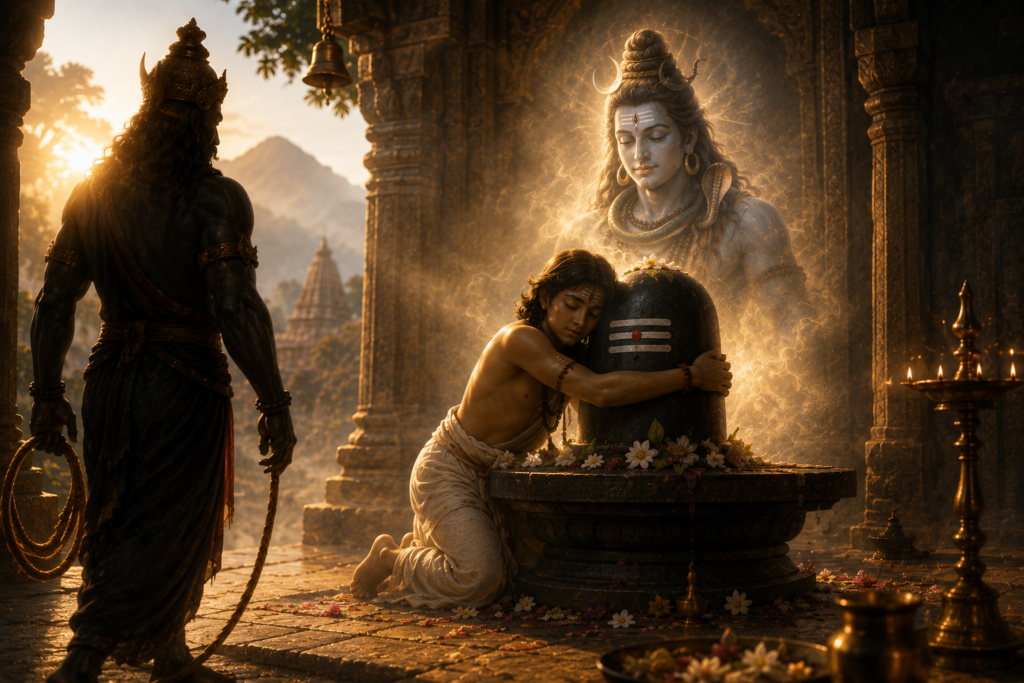
According to the legend, when Markandeya’s destined hour arrived, Yama, the god of death, came to claim his life.
Markandeya remained in deep meditation before a Shiva Linga, refusing to abandon his devotion even as death approached.
Yama cast his noose toward the young sage.
But as the noose encircled Markandeya, it also touched the Shiva Linga.
Shiva Appears
At that moment, Lord Shiva emerged from the Linga in a fierce and radiant form.
He stopped Yama and protected his devoted follower.
In many traditional depictions, Shiva is shown striking Yama to defend Markandeya, symbolizing that divine realization transcends the fear of death.
Shiva then blessed Markandeya with eternal youth and a long life, making him one of the great immortal sages celebrated in Hindu tradition.
The Spiritual Meaning of the Story
Whether understood literally or symbolically, the story of Markandeya offers profound spiritual lessons.
It does not suggest that sincere spiritual practice guarantees physical immortality.
Instead, it teaches that unwavering faith, wisdom, and self-realization free us from the deepest fear—the fear of death itself.
Markandeya represents the ideal seeker:
- steadfast during adversity,
- devoted without expectation,
- fearless in the face of uncertainty,
- and firmly established in spiritual truth.
Shiva represents the awakening of higher consciousness, while Yama symbolizes the inevitability of change.
The story reminds us that although every body is temporary, the Self described in yogic philosophy is eternal.
Why Has This Mantra Been Chanted for Thousands of Years?
Few mantras have remained in continuous use for as long as the Maha Mrityunjaya Mantra.
Its enduring significance comes from the many dimensions it brings together.
It is:
- a Vedic mantra,
- a prayer,
- a meditation,
- a philosophical teaching,
- and a practice of sacred sound.
Across generations, practitioners have chanted it:
- during daily meditation,
- before important life events,
- in times of illness,
- for emotional resilience,
- during rituals,
- for departed loved ones,
- and as part of deeper yogic disciplines.
In the tradition of Nada Yoga, this longevity also reflects the understanding that sound itself can become a vehicle for inner transformation.
Rather than approaching the mantra as a magical formula, yogic practitioners view it as a disciplined practice that gradually refines attention, steadies the breath, and quiets the fluctuations of the mind.
Over time, chanting becomes less about asking for something external and more about recognizing the peace and awareness already present within.
The Maha Mrityunjaya Mantra in the Tradition of Nada Yoga
At Nada Yoga School, we understand the Maha Mrityunjaya Mantra not only through its translation but through its living vibration.
In the yogic tradition, a mantra is much more than poetry. It is a carefully preserved sequence of sounds whose rhythm, pronunciation, and intention work together to influence the practitioner’s state of mind.
Nada Yoga teaches that creation itself arises from vibration (nāda). When we chant with awareness, our breath, voice, and attention become unified. This process naturally calms the nervous system, deepens concentration, and prepares the mind for meditation.
The transformative potential of the Maha Mrityunjaya Mantra therefore lies in both:
- understanding its profound meaning, and
- experiencing its vibration through regular practice.
As the ancient yogis recognized, sound has the unique ability to carry the mind inward—toward stillness, clarity, and ultimately, self-realization.
If you’re ready to go beyond reading and begin experiencing these practices firsthand, we invite you to join our 200 Hour Nada Yoga Teacher Training in Rishikesh. You’ll study with experienced teachers in a traditional setting while immersing yourself in yoga, meditation, Sanskrit, mantra chanting, Indian classical music, and the philosophy of Nada Yoga.
Traditional Benefits of Chanting the Maha Mrityunjaya Mantra
For thousands of years, the Maha Mrityunjaya Mantra has been chanted by yogis, monks, householders, and spiritual seekers during times of joy, uncertainty, illness, and personal transformation. According to the yogic tradition, regular chanting of this sacred mantra can support physical, mental, emotional, and spiritual well-being.
It is important to understand that these benefits come from traditional spiritual teachings and lived practice. While many practitioners report profound personal experiences, the mantra should not be viewed as a substitute for professional medical care or treatment.
Instead, it can be practiced as a complementary spiritual discipline that cultivates peace, resilience, and inner awareness.
1. Cultivates Inner Peace
Modern life often leaves the mind scattered between worries about the future and regrets about the past.
The rhythmic repetition of the Maha Mrityunjaya Mantra gently brings attention back to the present moment.
As the breath slows and the mind becomes absorbed in the mantra, many practitioners experience:
- greater calm
- reduced mental restlessness
- emotional steadiness
- improved concentration
Over time, chanting becomes a form of meditation that helps create space between our thoughts and our reactions.
2. Helps Reduce Fear and Anxiety
One of the deepest themes of the mantra is freedom from fear.
The Sanskrit word mrityu (death) symbolizes not only physical death but also the many fears that shape human experience:
- fear of failure
- fear of loss
- fear of illness
- fear of uncertainty
- fear of change
By repeatedly contemplating liberation from these fears, practitioners often develop greater courage and emotional resilience.
Rather than eliminating difficult situations, the mantra helps cultivate a steadier response to them.
3. Supports Meditation Practice
Many beginners find silent meditation challenging because the mind continually wanders.
Mantra meditation offers a gentle point of focus.
The sacred sound becomes an anchor that naturally draws awareness inward.
Over time, the mantra may:
- improve concentration
- lengthen periods of sustained attention
- reduce mental distractions
- deepen meditative absorption
This is one reason mantra chanting has remained central to yogic practice for thousands of years.
4. Encourages Emotional Healing
Every emotion leaves an impression on the mind.
Grief, anger, guilt, and disappointment can create mental patterns that are difficult to release.
The Maha Mrityunjaya Mantra is traditionally chanted during periods of emotional hardship because it encourages acceptance rather than resistance.
Many practitioners describe experiencing:
- emotional clarity
- greater patience
- forgiveness
- compassion
- renewed hope
While every person’s experience is unique, the consistent rhythm of chanting often creates a sense of stability during life’s challenges.
5. Strengthens Spiritual Awareness
Ultimately, the highest purpose of the Maha Mrityunjaya Mantra is spiritual awakening.
Yoga teaches that beneath our changing thoughts, emotions, and identities lies an unchanging awareness known as the Self (Ātman).
The mantra continually redirects attention toward this deeper reality.
With regular practice, practitioners may experience:
- greater self-awareness
- less attachment to external circumstances
- increased equanimity
- a stronger sense of connection with all life
These qualities reflect the deeper aim of yoga—not simply improving life, but understanding its true nature.
6. Creates a Sacred Daily Ritual
One of the simplest yet most transformative benefits of mantra practice is consistency.
Beginning each day with even five or ten minutes of chanting establishes a rhythm of mindfulness before the demands of daily life begin.
Over weeks and months, this small ritual often becomes a source of grounding, helping practitioners return to a place of balance regardless of external circumstances.
What Does Modern Science Say About Mantra Chanting?
Although scientific research does not evaluate the spiritual claims associated with the Maha Mrityunjaya Mantra specifically, there is growing evidence that mantra meditation and repetitive chanting can have measurable effects on mental well-being.
Researchers have found that practices involving slow, rhythmic repetition may:
- reduce perceived stress
- support emotional regulation
- improve sustained attention
- encourage slower, more regular breathing
- activate the body’s relaxation response
These effects are not unique to one particular mantra but appear across several forms of meditative repetition.
One proposed explanation is that synchronized breathing, vocalization, and focused attention work together to calm the nervous system and reduce mental distraction.
From a yogic perspective, these observations complement rather than replace the traditional understanding of mantra practice.
The spiritual purpose of chanting remains inner transformation, while scientific studies help explain some of the psychological and physiological processes that practitioners may experience.
How to Chant the Maha Mrityunjaya Mantra Correctly
You do not need to be a Sanskrit scholar to begin chanting the Maha Mrityunjaya Mantra.
What matters most is sincerity, consistency, and a willingness to learn.
As your practice develops, refining pronunciation and understanding the meaning of the mantra can deepen your experience.
Step 1: Find a Quiet Space
Choose a peaceful environment where you are unlikely to be interrupted.
Many practitioners create a small meditation space with a cushion, candle, or image that inspires contemplation, although this is entirely optional.
The goal is simply to create an atmosphere that supports focused practice.
Step 2: Sit Comfortably
Maintain a relaxed but upright posture.
You may sit:
- cross-legged on the floor,
- on a meditation cushion,
- or on a chair with both feet resting comfortably on the ground.
Allow the spine to lengthen naturally while keeping the shoulders soft and the face relaxed.
Step 3: Breathe Naturally
Before beginning the mantra, take a few slow, gentle breaths.
Notice the movement of the breath without trying to control it.
This simple pause helps settle the mind and prepares you for chanting.
Step 4: Chant Slowly and Clearly
Recite each syllable with care rather than rushing through the words.
If you are new to Sanskrit, begin with the Roman transliteration and gradually become familiar with the traditional pronunciation.
Quality is more important than speed.
Many practitioners find that chanting slowly also helps synchronize the mantra with the breath.
Step 5: Maintain Awareness
Avoid allowing the repetition to become mechanical.
As you chant, gently keep your attention on:
- the sound,
- the breath,
- and the meaning of the words.
When the mind wanders, simply return to the next repetition without judgment.
Step 6: Sit in Silence Afterwards
When you complete your chanting, remain seated quietly for a few minutes.
Notice any changes in your breathing, body, or mental state.
This silent period allows the effects of the practice to settle more deeply.
Many experienced practitioners consider this silence to be just as important as the chanting itself.
How Many Times Should You Chant the Maha Mrityunjaya Mantra?
There is no universal rule.
Traditionally, practitioners often chant:
- 3 times for a brief daily practice
- 9 times before meditation
- 27 times for focused contemplation
- 54 times as an extended practice
- 108 times using a rudraksha mala for a complete round
Rather than focusing solely on numbers, it is generally more beneficial to maintain regularity.
Five mindful repetitions each day are often more transformative than occasional sessions of hurried chanting.
Best Time to Chant the Maha Mrityunjaya Mantra
Although the mantra may be chanted whenever the mind is calm and attentive, certain times have traditionally been considered especially conducive.
1. Early Morning (Brahma Muhurta)
Approximately 1½ hours before sunrise.
This quiet period has long been regarded as ideal for meditation because the environment is generally peaceful and the mind is naturally more settled.
2. During Sunrise
Many practitioners enjoy chanting shortly after sunrise as a way to begin the day with clarity and intention.
3. Monday
Monday is traditionally associated with Lord Shiva.
For this reason, many devotees choose to dedicate additional time to chanting on this day.
4. During Maha Shivaratri
The annual festival of Maha Shivaratri is one of the most significant occasions for reciting the Maha Mrityunjaya Mantra.
Throughout the night, devotees engage in meditation, prayer, and mantra chanting in honor of Lord Shiva.
5. During Challenging Times
Many people also choose to chant:
- during illness,
- while supporting loved ones,
- during periods of grief,
- before important life events,
- or whenever they seek courage and emotional strength.
These practices reflect long-standing traditions of finding comfort and steadiness through sacred sound.
Common Mistakes Beginners Make
Like any spiritual discipline, mantra practice deepens through patience.
Here are a few common mistakes to avoid.
1. Rushing Through the Words
The mantra is not a race.
Slow, mindful repetition is generally more beneficial than fast recitation.
2. Ignoring Pronunciation
Perfect pronunciation is not required for beginners.
However, gradually learning the correct Sanskrit sounds helps preserve the mantra’s rhythm and traditional form.
3. Focusing Only on Quantity
Some practitioners become preoccupied with completing 108 repetitions as quickly as possible.
Meaningful attention is more valuable than mechanical repetition.
4. Expecting Immediate Results
The Maha Mrityunjaya Mantra is traditionally viewed as a lifelong practice.
Its benefits often unfold gradually through regular, sincere practice rather than dramatic experiences.
5. Forgetting the Meaning
Understanding the philosophy behind the mantra enriches every repetition.
As your familiarity grows, allow the words to become not only sounds but reminders of courage, wisdom, and freedom from fear.
Frequently Asked Questions About the Maha Mrityunjaya Mantra
1. What is the meaning of the Maha Mrityunjaya Mantra?
The Maha Mrityunjaya Mantra is a prayer to Lord Shiva that seeks liberation from fear, suffering, and the bondage of death while remaining connected to the eternal Self. Rather than asking for physical immortality, the mantra expresses the aspiration to overcome ignorance and realize the immortal nature of consciousness.
2. Why is it called the Death-Conquering Mantra?
The name comes from the Sanskrit words:
- Maha – Great
- Mrityu – Death
- Jaya – Victory
In yogic philosophy, “death” symbolizes not only physical death but also fear, attachment, ego, and ignorance. The mantra teaches freedom from these limitations rather than promising everlasting physical life.
3. Which God is the Maha Mrityunjaya Mantra dedicated to?
The mantra is dedicated to Lord Shiva, specifically in his form as Tryambaka, the Three-Eyed One.
The third eye represents spiritual wisdom, inner vision, and the ability to see beyond illusion.
4. What is the difference between the Maha Mrityunjaya Mantra and the Gayatri Mantra?
Although both are among the most revered Vedic mantras, they have different focuses.
The Gayatri Mantra is a universal prayer for wisdom, clarity, and enlightenment, invoking the divine light of Savitr to illuminate the intellect.
The Maha Mrityunjaya Mantra is traditionally associated with Lord Shiva and emphasizes healing, courage, inner transformation, and liberation from fear and suffering.
Rather than one being “better” than the other, each serves a unique purpose within the Vedic tradition.
5. Can anyone chant the Maha Mrityunjaya Mantra?
Yes.
The mantra is widely chanted by people of different ages, backgrounds, and levels of experience.
While learning proper pronunciation and understanding the meaning enriches the practice, beginners can start with sincerity and gradually improve over time.
6. How many times should I chant the Maha Mrityunjaya Mantra?
There is no compulsory number.
Common traditional practices include:
- 3 repetitions
- 9 repetitions
- 27 repetitions
- 54 repetitions
- 108 repetitions using a mala
Consistency and mindful attention are generally considered more important than the number of repetitions.
7. What is the best time to chant the Maha Mrityunjaya Mantra?
Many practitioners prefer:
- Brahma Muhurta (approximately 1½ hours before sunrise)
- Sunrise
- Monday, a day associated with Lord Shiva
- Maha Shivaratri
- Before meditation
- During times of emotional or physical challenge
That said, the mantra may be chanted whenever you can practice with calmness and attention.
8. Can the Maha Mrityunjaya Mantra be chanted at night?
Yes.
There is no universal prohibition against chanting it at night.
Many practitioners find evening chanting helpful for calming the mind after a busy day or before meditation.
9. Is this mantra only for healing?
No.
Although it is often recited during illness or recovery, its deeper purpose extends far beyond physical healing.
The mantra is ultimately a prayer for:
- inner freedom,
- courage,
- wisdom,
- self-realization,
- and liberation from fear.
10. Is it necessary to know Sanskrit?
No.
Understanding Sanskrit certainly deepens appreciation for the mantra, but it is not a requirement.
Many practitioners begin by learning the transliteration and gradually become familiar with the original pronunciation.
11. Does the Maha Mrityunjaya Mantra remove fear?
Traditional teachings describe the mantra as a means of cultivating fearlessness by reminding practitioners of the eternal nature of the Self.
Rather than eliminating life’s uncertainties, regular chanting may help develop greater resilience, acceptance, and emotional balance.
12. Can I listen to the mantra instead of chanting it?
Listening attentively can be a meaningful practice, especially for those learning pronunciation or seeking a meditative atmosphere.
However, many teachers suggest that actively chanting engages the breath, voice, and awareness more fully, making it a deeper personal practice.
13. Can I chant the mantra for someone else?
Many people dedicate their chanting to the well-being of loved ones.
While traditions differ in their explanations, offering prayers with compassion and sincere intention has long been part of Hindu spiritual practice.
14. Does chanting require initiation?
The Maha Mrityunjaya Mantra is widely available and commonly practiced without formal initiation.
However, learning from a knowledgeable teacher can help refine pronunciation, understand its philosophical depth, and establish a consistent practice.
15. How long does it take to experience benefits?
Every practitioner is different.
Some people notice greater calm after a single session, while deeper changes often develop gradually through regular, patient practice.
Like any form of meditation, the benefits tend to accumulate with consistency rather than intensity.
Final Reflection
The Maha Mrityunjaya Mantra has echoed through the Vedic tradition for thousands of years, not because it promises extraordinary powers, but because it speaks to one of humanity’s deepest aspirations: freedom from fear.
Its timeless wisdom reminds us that true healing is more than the absence of illness. It is the cultivation of clarity, courage, compassion, and the recognition of the eternal awareness that yoga describes as our true nature.
Whether you chant the mantra during meditation, in moments of uncertainty, or as part of your daily spiritual practice, its greatest gift may be the quiet transformation that unfolds over time. Each repetition invites the mind to soften, the breath to deepen, and the heart to rest in a space beyond anxiety and attachment.
In the tradition of Nada Yoga, sacred sound is not merely heard—it is experienced. Every mantra is an opportunity to move inward, where vibration becomes meditation and meditation becomes self-discovery.
May your practice of the Maha Mrityunjaya Mantra bring steadiness in difficult moments, gratitude in joyful ones, and a deeper connection with the silence from which all sacred sound arises.
Continue Your Journey with Nada Yoga School
If the Maha Mrityunjaya Mantra has inspired you to explore the transformative power of sacred sound, consider deepening your understanding through the study of Nada Yoga.
At Nada Yoga School in Rishikesh, students experience the ancient science of sound through:
- Traditional mantra chanting
- Sanskrit pronunciation
- Meditation practices
- Kirtan and devotional singing
- Pranayama
- Sound healing
- Classical Hatha Yoga
Rooted in authentic yogic traditions and guided by experienced teachers, our programs are designed for practitioners who wish to experience sound not only as music, but as a profound path of inner transformation.
Whether you are beginning your spiritual journey or are already an experienced yoga practitioner, Nada Yoga offers a unique opportunity to discover the deeper relationship between vibration, consciousness, and meditation.