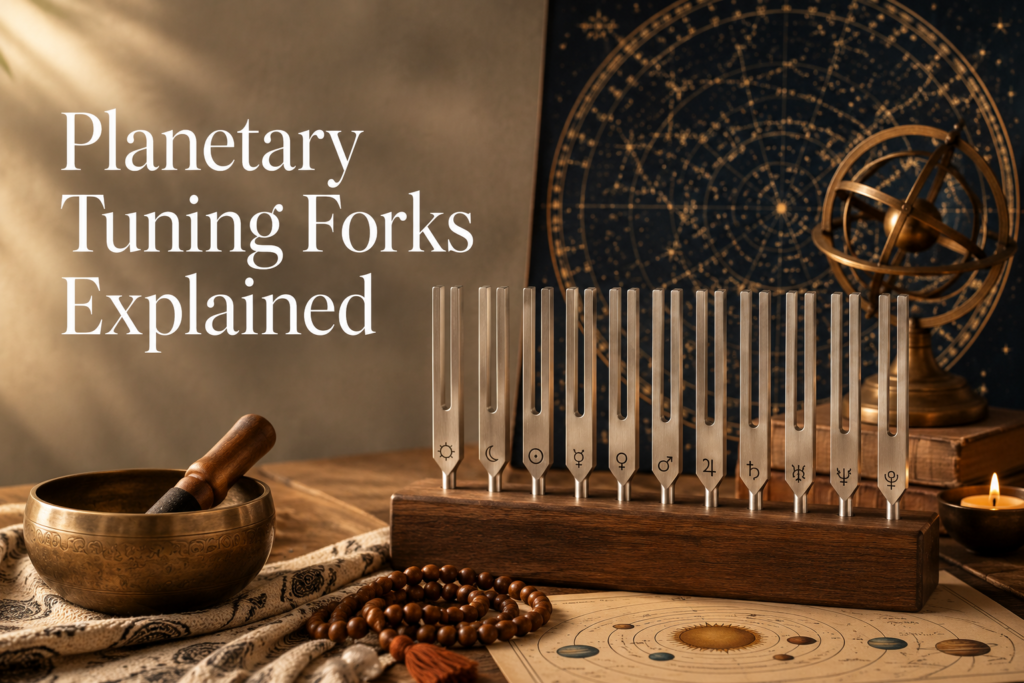
Have you ever noticed a tuning fork labelled Earth OM 136.10 Hz, Venus, or Moon and wondered what these names actually mean?
Unlike Solfeggio tuning forks, which are associated with specific symbolic frequencies, Planetary Tuning Forks are based on a mathematical idea known as the Cosmic Octave. Their frequencies are derived from measurable astronomical cycles, such as the Earth’s orbit around the Sun or the Moon’s revolution around the Earth, and then converted into audible sound through a process called octave reduction.
To many practitioners, these forks represent a beautiful connection between mathematics, music, and meditation. At the same time, they have also inspired many misconceptions, with claims that planetary frequencies directly heal organs or channel cosmic energies.
So what are planetary tuning forks really based on? How are their frequencies calculated? And what does science actually support?
Let’s explore the fascinating intersection of astronomy, acoustics, music theory, and spiritual tradition.
What Are Planetary Tuning Forks?
Planetary Tuning Forks, often called Cosmic Octave Tuning Forks, are a collection of 11 unweighted tuning forks inspired by the work of Swiss mathematician and music researcher Hans Cousto.
Each tuning fork represents the mathematical conversion of a celestial cycle into an audible frequency.
A typical set includes frequencies associated with:
- Sun
- Moon
- Earth
- Mercury
- Venus
- Mars
- Jupiter
- Saturn
- Uranus
- Neptune
- Pluto
Unlike ordinary musical tuning forks that are designed around concert pitch, these instruments begin with the actual orbital or rotational periods of celestial bodies before converting them into sounds that humans can hear.
This unique mathematical approach is what distinguishes Planetary Tuning Forks from other tuning systems.
Understanding the Cosmic Octave Theory
The foundation of these tuning forks comes from Hans Cousto’s concept known as the Law of the Cosmic Octave.
His theory proposes that natural cycles, whether planetary or musical, can be connected through the universal relationship of octaves.
In music, an octave simply means doubling a frequency.
For example:
- 136 Hz
- 272 Hz
- 544 Hz
These are different octaves of the same note.
Hans Cousto applied this same mathematical principle to astronomy.
Because planetary movements occur extremely slowly, their natural frequencies are far below the range of human hearing. By repeatedly doubling these frequencies, they eventually enter the audible spectrum while maintaining the same octave relationship.
This process is known as octave reduction or octave multiplication.
The resulting tones become the basis for Planetary Tuning Forks.
The Famous Earth Frequency: 136.10 Hz
Among all Planetary Tuning Forks, one frequency has become especially well known.
The Earth Year Tone, approximately 136.10 Hz, is often called the Cosmic OM Frequency.
This frequency begins with a simple astronomical fact.
The Earth takes approximately:
365.256 days
to complete one orbit around the Sun.
To calculate the audible tone:
- Convert one year into seconds.
- Calculate its cycles per second.
- Double the frequency repeatedly through octaves until it becomes audible.
The result is approximately 136.10 Hz.
Many practitioners associate this frequency with:
- Grounding
- Stability
- Balance
- Connection with nature
These symbolic meanings have become popular within meditation and sound healing communities, although they should not be confused with scientific findings.
Common Planetary Frequencies
Different manufacturers may calculate or tune their forks slightly differently, but a commonly used Cosmic Octave system includes:
| Celestial Body | Common Frequency |
|---|---|
| Sun | ~126.22 Hz |
| Earth (OM) | ~136.10 Hz |
| Pluto | ~140.25 Hz |
| Mercury | ~141.27 Hz |
| Mars | ~144.72 Hz |
| Saturn | ~147.85 Hz |
| Jupiter | ~183.58 Hz |
| Uranus | ~207.36 Hz |
| Moon | ~210.42 Hz |
| Neptune | ~211.44 Hz |
| Venus | ~221.23 Hz |
Although small variations exist between manufacturers, the mathematical approach remains essentially the same.
Why Can’t We Hear Planets Naturally?
A common misconception is that these tuning forks reproduce sounds actually travelling through space.
In reality, ordinary sound cannot travel through the vacuum of space because there are almost no air molecules to carry sound waves.
Planetary motion does produce measurable cycles, but these exist at frequencies far below human hearing.
For example:
The Earth’s orbit occurs approximately once every year.
That corresponds to a frequency of roughly:
0.0000000317 Hz
This is millions of times lower than the lowest sound humans can hear.
By repeatedly doubling this value through octaves, it eventually reaches the audible frequency of approximately 136.10 Hz.
The audible tone is therefore a mathematical representation of Earth’s orbital cycle rather than a recording of sound travelling through space.
Why Are Planetary Tuning Forks Usually Unweighted?
Most planetary tuning forks are designed as unweighted forks.
Unlike weighted forks that deliver stronger physical vibration through direct body contact, unweighted forks are primarily intended for listening.
Their characteristics include:
- Clear audible tones
- Precise pitch
- Rich harmonic overtones
- Longer resonance
- Gentle sound projection
They are commonly used:
- During meditation
- Around the body
- In sound baths
- For contemplative listening
- In yoga and mindfulness sessions
Because these forks emphasise listening rather than physical vibration, they are especially popular in meditation-based sound practices.
Every Planetary Fork Produces Harmonics
Although each tuning fork is identified by a single frequency, no tuning fork produces only one vibration.
Every Planetary Tuning Fork generates:
A fundamental frequency
The primary pitch that we hear.
Harmonic overtones
Additional frequencies that give the sound greater depth and richness.
The quality of these harmonics depends on several factors:
- Metal composition
- Manufacturing precision
- Fork dimensions
- Playing technique
- The surrounding environment
These overtones are one reason why two tuning forks labelled with the same frequency may still sound slightly different.
The Symbolic Meaning of Planetary Frequencies
Over time, many practitioners have associated different planetary tones with symbolic qualities inspired by astrology, mythology, and philosophy.
Examples include:
Earth (136.10 Hz)
Often associated with:
- Grounding
- Stability
- Nature
- Balance
Moon
Often associated with:
- Reflection
- Cycles
- Emotional awareness
Sun
Often associated with:
- Vitality
- Energy
- Consciousness
These interpretations have become an important part of many contemporary meditation practices.
However, it is important to recognise that these meanings arise from spiritual and cultural traditions rather than astronomy itself.
Possible Benefits of Listening
Many practitioners enjoy using Planetary Tuning Forks during meditation because they encourage focused attention and deep listening.
Like other forms of sound meditation, these instruments may support:
- Relaxation
- Mindfulness
- Concentration
- Emotional reflection
- Breath awareness
These experiences are thought to arise through the interaction between:
- Sound
- Attention
- The nervous system
- Personal meaning
- Emotional response
Different people may experience the same sound differently, which is why modern sound healing emphasises individual experience rather than universal outcomes.
What Science Supports and What Remains Symbolic
One of the strengths of Planetary Tuning Forks is that their mathematical foundation is clear and measurable.
Supported by science
- Planetary orbital periods can be measured accurately.
- Frequencies can be calculated mathematically.
- Octave relationships are genuine physical relationships.
- Tuning forks produce stable acoustic frequencies.
- Music and sound can influence mood, attention, and relaxation.
Not scientifically established
- Planetary frequencies directly heal organs.
- Individual planetary tones uniquely alter human biology.
- Celestial vibrations cure disease.
- The human body is physically tuned to planets.
Recognising this distinction allows practitioners to appreciate both the mathematics behind these instruments and the symbolic traditions that have grown around them.
Learning About Planetary Tuning Forks Through Authentic Practice
Understanding Planetary Tuning Forks involves much more than memorising frequencies. Their true value emerges through listening, observation, and thoughtful practice alongside other traditional sound healing methods.
During a Sound Healing Course in Rishikesh, students learn how Planetary Tuning Forks fit within a broader framework that includes singing bowls, mantra, meditation, breathwork, and the philosophy of Nada Yoga. Rather than focusing on extraordinary claims, authentic training emphasises acoustic principles, responsible application, and the role of sound in supporting relaxation and mindful awareness.
Students who continue with a Sound Healing Teacher Training in Rishikesh gain practical experience using a wide variety of therapeutic instruments while exploring how mathematics, music, and contemplative practice come together within the tradition of sound yoga in India.
Final Thoughts
Planetary Tuning Forks offer a fascinating meeting point between astronomy, mathematics, acoustics, and contemplative practice. Their frequencies are grounded in measurable celestial cycles and translated into the audible range through the elegant mathematical relationship of octaves. While the symbolic meanings associated with the Sun, Moon, Earth, and planets belong to spiritual traditions rather than established science, many practitioners continue to find these tones valuable for meditation, focused listening, and personal reflection.
Approaching these instruments with both curiosity and discernment allows us to appreciate their true strengths. Rather than viewing them as mystical shortcuts, we can recognise them as beautifully crafted acoustic tools that invite deeper awareness of sound, rhythm, and silence. Within an authentic practice, planetary tuning forks become part of a broader journey into Nada Yoga, mindful listening, and the timeless traditions of sound yoga in India, where ancient wisdom and modern understanding meet.
Frequently Asked Questions
Who developed Planetary Tuning Forks?
The Cosmic Octave concept was developed by Swiss mathematician and music researcher Hans Cousto, who mathematically converted astronomical cycles into audible frequencies using octave relationships.
Why is 136.10 Hz called the Earth OM Frequency?
This frequency is derived from the Earth’s orbital period around the Sun using repeated octave doubling until the frequency becomes audible.
Can planets actually be heard in space?
No. Ordinary sound cannot travel through the vacuum of space. Planetary Tuning Fork frequencies are mathematical conversions of astronomical cycles rather than recordings of sounds produced by planets.
Are Planetary Tuning Forks scientifically proven to heal?
Current scientific evidence supports the mathematics of frequency calculation and the measurable effects of sound on relaxation and perception. However, claims that specific planetary frequencies directly heal organs or cure disease have not been scientifically established.