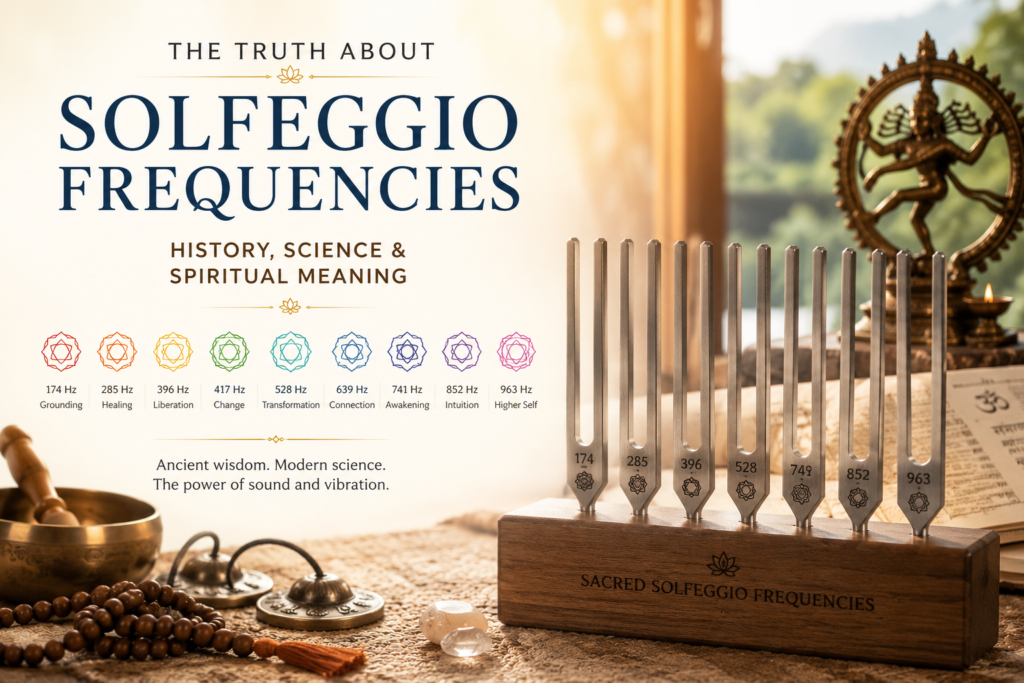
Search for Solfeggio frequencies online, and you’ll quickly come across remarkable claims. Some people describe them as the “frequencies of creation.” Others believe specific tones can repair DNA, balance chakras, or unlock higher states of consciousness. Videos featuring 528 Hz or 963 Hz have attracted millions of listeners, making Solfeggio frequencies one of the most discussed topics in modern sound healing.
But where did these frequencies come from? Are they truly ancient? And what does science actually tell us about how they work?
The answers are more nuanced than many headlines suggest.
Solfeggio frequencies represent an interesting meeting point between medieval music, modern acoustics, spirituality, and contemporary sound healing practices. While some traditional claims remain symbolic rather than scientifically verified, these frequencies continue to play an important role in meditation, relaxation, and personal practice for many people around the world.
If you’re studying sound healing or considering a Sound Healing Course in Rishikesh, understanding both the historical background and the scientific perspective helps build a deeper appreciation of these widely used tuning forks.
What Are Solfeggio Frequencies?
Solfeggio frequencies are a collection of specific tones that are widely used in modern sound healing, meditation, and tuning fork therapy. Each frequency is often associated with symbolic meanings such as harmony, transformation, intuition, or emotional balance.
Today, the most commonly recognised Solfeggio frequencies include:
- 174 Hz
- 285 Hz
- 396 Hz
- 417 Hz
- 528 Hz
- 639 Hz
- 741 Hz
- 852 Hz
- 963 Hz
These tones appear in meditation recordings, sound baths, tuning fork sets, and wellness practices across the world.
However, their modern popularity has led many people to assume that this exact frequency system has existed unchanged for thousands of years. The historical story is more complex.
The Original Solfeggio Scale
The word Solfeggio originally referred to a method of teaching music rather than a system of healing frequencies.
During the medieval period, musicians learned melodies using six syllables:
- Ut
- Re
- Mi
- Fa
- Sol
- La
These syllables helped students understand musical intervals and vocal training long before modern notation became widespread.
Importantly, these original syllables were not assigned the numerical frequencies that are commonly seen today.
The modern Solfeggio frequency system became popular much later, when researchers and authors in the twentieth century associated specific Hertz values with these traditional syllables.
While this framework has become influential within contemporary sound healing, historians continue to debate whether the exact frequencies themselves were used in ancient musical traditions.
The Three Additional Frequencies
Many modern Solfeggio tuning fork sets include three additional frequencies:
- 174 Hz
- 285 Hz
- 963 Hz
These are sometimes described as “lost,” “hidden,” or “rediscovered” frequencies.
Although these descriptions are common within spiritual communities, there is limited historical evidence showing that these exact frequencies formed part of an ancient tuning system.
Instead, they are generally understood as modern additions that expand the symbolic and meditative framework of Solfeggio practice.
For many practitioners, these frequencies remain valuable tools for meditation and contemplation, even though their historical origins differ from some popular narratives.
How Do Solfeggio Tuning Forks Work?
Regardless of their symbolic associations, Solfeggio tuning forks operate according to the same principles as every other tuning fork.
When a tuning fork is struck, its metal prongs vibrate back and forth at a specific frequency.
These vibrations:
- Compress and expand surrounding air molecules.
- Create sound waves that travel through the air.
- Reach the ears, where they are interpreted as pitch by the brain.
Frequency simply describes the number of vibrations that occur every second.
For example:
- A 528 Hz tuning fork vibrates 528 times each second.
- A 963 Hz tuning fork vibrates 963 times each second.
These are measurable physical properties governed by the laws of acoustics.
Why Are Most Solfeggio Tuning Forks Unweighted?
If you’ve seen a Solfeggio tuning fork set, you may have noticed that most are unweighted.
Unlike weighted tuning forks, which are often applied directly to the body, unweighted forks are primarily designed for listening.
They are characterised by:
- Clear, sustained tones
- Stronger higher harmonics
- Longer audible resonance
- Use around the ears or within the surrounding sound field
Because of these characteristics, they are especially suited for meditation, focused listening, and sound-based relaxation practices.
Harmonics: Every Tuning Fork Produces More Than One Tone
Although we usually identify a tuning fork by its primary frequency, the sound is rarely limited to a single vibration.
A 528 Hz tuning fork, for example, produces:
- A fundamental frequency of 528 Hz.
- Additional harmonic overtones at higher frequencies.
These overtones contribute to the richness and character of the sound.
The exact harmonic profile depends on several factors, including:
- The material used
- Manufacturing precision
- The shape of the fork
- How it is struck
- The surrounding environment
This combination of fundamental frequency and harmonics gives each tuning fork its unique acoustic quality.
What Does “Creation Frequency” Mean?
Some Solfeggio traditions describe certain tones as:
- Frequencies of creation
- Divine vibrations
- Cosmic frequencies
- Universal mathematical harmonies
These expressions carry profound symbolic meaning for many practitioners.
From the perspective of modern physics, however, there is no accepted scientific evidence that any audible frequency played a literal role in creating the universe.
Physics explains the evolution of the universe through principles such as:
- Gravity
- Electromagnetism
- Nuclear forces
- Quantum fields
Rather than through specific audible sound frequencies.
Understanding this distinction allows us to appreciate spiritual symbolism without confusing it with established scientific theory.
The Story Behind 528 Hz
Among all Solfeggio frequencies, 528 Hz has received the greatest attention.
It is often called the “Miracle Frequency” and is frequently associated with claims of DNA repair or profound biological transformation.
From a scientific perspective:
- 528 Hz is a precisely measurable sound frequency.
- Music and sound can influence mood, attention, and relaxation.
- There is no accepted scientific evidence showing that listening to 528 Hz repairs human DNA.
That does not mean the frequency lacks value.
Many people find it deeply calming, inspiring, or supportive during meditation. These experiences are genuine personal responses, even though some extraordinary biological claims remain unverified.
Why Doesn’t the Solfeggio System Match the Western Musical Scale?
Another common misconception is that Solfeggio frequencies form a complete musical scale.
In reality, they do not follow the same mathematical relationships as standard Western tuning systems.
For example:
- 528 Hz doubled equals 1056 Hz, one octave higher.
- 528 Hz divided by two equals 264 Hz, one octave lower.
Although some Solfeggio frequencies may correspond closely to musical notes depending on the chosen tuning reference, they do not create a conventional scale based on standard musical intervals.
Instead, they function as a collection of individual reference tones within modern sound healing practice.
How Can Listening to Solfeggio Frequencies Affect Us?
Scientific research into music and sound suggests that listening to pleasant, meaningful sounds may support:
- Relaxation
- Improved mood
- Focus and attention
- Slower breathing patterns
- Reduced perception of stress
These responses arise through the interaction between:
- The auditory system
- The nervous system
- Emotional processing
- Memory
- Personal associations
Different people respond differently to the same sounds, which is why sound healing often emphasises personal experience rather than universal outcomes.
What Science Supports and What Remains Unproven
One of the most important aspects of learning sound healing is understanding the distinction between established science and spiritual belief.
Supported by current scientific understanding
- Frequencies can be measured precisely.
- Tuning forks produce stable mechanical vibrations.
- Sound influences the auditory system and nervous system.
- Music can affect mood, relaxation, and attention.
Not scientifically established
- Solfeggio frequencies created the universe.
- Specific frequencies directly repair DNA.
- Individual frequencies possess supernatural physical properties.
- Listening to a single frequency can heal specific organs.
Recognising these distinctions allows practitioners to approach sound healing with both curiosity and integrity.
Learning About Solfeggio Frequencies Through Authentic Training
Reading about Solfeggio frequencies is an excellent starting point, but practical experience brings these concepts to life.
During a Sound Healing Course in Rishikesh, students explore how tuning forks are used alongside singing bowls, mantra, meditation, breathwork, and other traditional sound practices. Rather than focusing on isolated frequency claims, comprehensive training emphasises careful listening, responsible application, and an understanding of both acoustic science and yogic philosophy.
Those who wish to teach professionally often continue with a Sound Healing Teacher Training in Rishikesh, where they gain hands-on experience with tuning forks, learn how sound interacts with relaxation and meditation practices, and develop the skills to facilitate sessions with confidence. By studying in Rishikesh, students also experience sound yoga in India, where ancient traditions such as Nada Yoga provide the broader context for working with sound as a tool for awareness and personal growth.
Final Thoughts
Solfeggio frequencies continue to fascinate people because they sit at the intersection of history, acoustics, spirituality, and modern wellness. While the exact numerical frequencies commonly used today are best understood as part of a contemporary sound healing framework rather than a documented ancient tuning system, they remain meaningful tools for meditation, focused listening, and personal reflection.
Understanding both their historical background and their scientific context allows practitioners to appreciate these tuning forks with clarity and respect. Rather than relying on sensational claims, we can recognise their real value in supporting mindful listening, relaxation, and contemplative practice. For anyone exploring the transformative potential of sound, learning through an authentic Sound Healing Course in Rishikesh offers the opportunity to experience Solfeggio frequencies within the broader traditions of Nada Yoga, meditation, and the timeless practice of sound yoga in India.
Frequently Asked Questions
Are Solfeggio frequencies ancient?
The original Solfeggio system was a medieval method of teaching musical intervals using syllables such as Ut, Re, Mi, Fa, Sol, and La. The numerical frequencies commonly used today became popular much later and are not universally accepted as part of the original historical system.
What is the most popular Solfeggio frequency?
528 Hz is the best-known Solfeggio frequency and is widely used in meditation, music, and sound healing practices.
Do Solfeggio frequencies have scientific support?
Science supports the measurable properties of sound, vibration, and their influence on mood and relaxation. However, many extraordinary claims associated with specific Solfeggio frequencies have not been established through scientific evidence.
Why are Solfeggio tuning forks usually unweighted?
Unweighted forks produce clear, sustained tones with rich harmonic overtones, making them ideal for listening-based practices such as meditation and sound baths.