Have you ever paused to think about the people who have shaped your life? Beyond family and friends, there are those rare individuals whose words change the way we see the world. A single lesson from them can replace confusion with clarity, fear with confidence, and curiosity with purpose. In the Indian spiritual tradition, such a person is known as a Guru.
Every year, on the full moon of the lunar month of Āṣāḍha, seekers, students, yogis, artists, and spiritual practitioners gather to celebrate Guru Purnima. More than a festival, it is a heartfelt expression of gratitude towards the teachers who illuminate the path of knowledge, wisdom, and self-discovery.
While modern education often focuses on acquiring information, Guru Purnima reminds us that true learning is far deeper. It is about transformation. It is about discovering not only how to think but also how to live with awareness, compassion, and purpose.
Whether you study Yoga, Indian classical music, Ayurveda, meditation, or philosophy, the spirit of Guru Purnima continues to inspire one timeless truth: knowledge becomes wisdom when it is guided by an enlightened teacher.
What Is Guru Purnima?
Guru Purnima is one of the most sacred observances in the Indian spiritual calendar. It falls on the full moon (Purnima) of the Hindu month of Āṣāḍha, which usually occurs during June or July.
Across India and many parts of the world, this day is dedicated to expressing gratitude towards teachers, spiritual masters, mentors, and everyone who has contributed to our personal growth.
Although deeply rooted in Hindu tradition, Guru Purnima is also honored in several other Indian knowledge systems, including:
- Yoga
- Vedānta
- Buddhism
- Jainism
- Indian classical music
- Sanskrit learning
- Ayurveda
- Meditation traditions
What unites these diverse traditions is their recognition that wisdom is best transmitted through a living teacher rather than books alone.
For thousands of years, India’s greatest knowledge systems have survived because every generation received teachings directly from those who had mastered them. Guru Purnima celebrates this uninterrupted flow of wisdom.
The Meaning of Guru
The word Guru carries profound significance in Sanskrit.
Traditionally, it is explained by dividing the word into two syllables:
- Gu (गु) – darkness or ignorance
- Ru (रु) – remover or dispeller
Together, Guru means:
“The one who removes the darkness of ignorance.”
This definition extends far beyond the modern understanding of a teacher.
A Guru does not simply provide information or answer questions. Instead, a Guru helps the student develop clarity, discrimination, discipline, and inner wisdom. Through guidance and personal example, the Guru encourages the student to discover truth through direct experience rather than blind belief.
A true Guru nurtures qualities such as:
- Self-awareness
- Humility
- Discipline
- Compassion
- Patience
- Inner strength
- Discernment
Rather than creating dependence, a Guru empowers the student to grow into an independent seeker.
Why Is Guru Purnima Celebrated?
Guru Purnima is traditionally celebrated in honour of Bhagavān Vedavyāsa, one of the greatest sages in Indian history.
Because of his extraordinary contribution to preserving India’s spiritual heritage, this day is also known as Vyāsa Purnima.
Long before printing presses or digital libraries existed, sacred knowledge was transmitted orally from teacher to student. Vedavyāsa recognized the importance of preserving this immense body of wisdom for future generations.
His contributions include:
- Compiling the four Vedas into an organised form.
- Composing the Mahābhārata, the longest epic ever written.
- Authoring the Brahma Sūtras.
- Preserving numerous Purāṇas.
- Systematising Vedic knowledge for future generations.
Without his work, much of India’s philosophical and spiritual heritage may have been lost over time.
For this reason, Vedavyāsa is honoured as one of the greatest Gurus in Indian history, and Guru Purnima is celebrated as a tribute to his enduring legacy.
Sage Vedavyāsa’s Lasting Influence
It is difficult to overstate Vedavyāsa’s impact on Indian philosophy.
His writings continue to shape the study of:
- Yoga philosophy
- Vedānta
- Dharma
- Meditation
- Bhakti
- Ethics
- Spiritual practice
Perhaps his most influential work, the Mahābhārata, contains the Bhagavad Gītā, one of the world’s most revered spiritual texts. Even today, seekers turn to its teachings for guidance on duty, devotion, self-knowledge, and inner freedom.
By organising and preserving sacred knowledge, Vedavyāsa ensured that countless generations could continue learning from India’s timeless wisdom traditions.
Every Guru who teaches Yoga, Sanskrit, Vedānta, or meditation today stands within the lineage that his work helped preserve.
More Than Remembering One Teacher
Although Guru Purnima honours Vedavyāsa, the celebration extends far beyond a single historical figure.
It is an opportunity to express gratitude towards everyone who has illuminated our path.
These teachers may include:
- A spiritual Guru
- A Yoga teacher
- A music teacher
- A school teacher
- Parents
- Mentors
- Guides
- Elders
Each one contributes something unique to our growth.
Some teach knowledge.
Others teach discipline.
Some inspire courage.
Others quietly transform our lives through kindness and example.
Guru Purnima reminds us that every meaningful lesson carries the imprint of someone willing to share their wisdom.
This understanding lies at the heart of the Indian tradition, where learning has always been viewed as a sacred relationship rather than a simple transfer of information.
The Guru in the Upanishads
The importance of the Guru is beautifully described throughout the Upanishads, the ancient philosophical texts that explore the nature of the Self and ultimate reality. These scriptures repeatedly remind us that spiritual wisdom cannot be gained through intellectual effort alone. It requires guidance, humility, and a willingness to learn from someone who has personally realised the truth.
One of the most well-known verses appears in the Muṇḍaka Upaniṣad.
Sanskrit
तद्विज्ञानार्थं स गुरुमेवाभिगच्छेत्
समित्पाणिः श्रोत्रियं ब्रह्मनिष्ठम् ॥
Transliteration
Tad-vijñānārthaṃ sa gurum evābhigacchet
Samit-pāṇiḥ śrotriyaṃ brahma-niṣṭham.
Translation
“To realise the highest Truth, one should approach a Guru who is well versed in the scriptures and firmly established in the knowledge of Brahman.”
This verse offers a profound insight into the Indian understanding of education. Knowledge is not seen as something collected through books alone. Instead, it is transmitted through a teacher who has integrated that wisdom into every aspect of life.
The Upanishads describe two qualities of an ideal Guru.
A true Guru is:
- Śrotriya – deeply learned in the scriptures.
- Brahma-niṣṭha – firmly established in direct spiritual realisation.
These two qualities complement one another. Scholarship without experience can remain theoretical, while experience without proper understanding may lack clarity. The Guru represents the union of both.
The Guru–Shishya Paramparā
For thousands of years, India’s greatest knowledge traditions have flourished through the Guru–Śiṣya Paramparā, the sacred teacher-disciple lineage.
Long before universities and printed books became common, students lived with their teachers in Gurukulas, where learning extended far beyond formal lessons. Education became part of daily life.
A disciple learned through:
- Observation
- Daily practice
- Service (Sevā)
- Reflection
- Personal guidance
- Direct experience
This method ensured that knowledge was not merely memorised but lived.
Whether studying Yoga, Ayurveda, Sanskrit, Indian classical music, meditation, or philosophy, students gradually absorbed the teacher’s wisdom through years of close association. Every conversation, practice session, and daily responsibility became an opportunity to learn.
Perhaps the most beautiful aspect of this tradition is that it emphasises transformation over information. The Guru does not simply teach techniques; the Guru helps shape the student’s character.
The disciple, in turn, brings qualities that make learning possible.
These include:
- Humility
- Discipline
- Patience
- Dedication
- Respect
- Sincerity
- Openness to learning
When these qualities come together, education becomes a journey of inner growth rather than the accumulation of facts.
Why This Tradition Still Matters Today
Although the world has changed dramatically, the Guru–Shishya tradition remains remarkably relevant.
Today, information is available everywhere. Books, videos, and online courses provide instant access to knowledge that previous generations could scarcely imagine. Yet information alone rarely leads to wisdom.
Many people can explain the theory of meditation without ever sitting quietly.
Others understand the philosophy of Yoga but struggle to apply it in daily life.
The Guru bridges this gap between knowing and experiencing.
Instead of simply answering questions, a teacher helps students develop awareness, refine their practice, and avoid misunderstandings that can arise through self-study alone.
This is why authentic Yoga education continues to value direct learning from experienced teachers. Whether someone studies asana, pranayama, mantra, meditation, or Indian philosophy, personal guidance remains one of the most valuable aspects of the journey.
The Guru Stotram
Among the many verses dedicated to the Guru, one has become especially beloved across India. It is recited in yoga schools, temples, ashrams, and spiritual gatherings, particularly during Guru Purnima.
Sanskrit
गुरुर्ब्रह्मा गुरुर्विष्णुः
गुरुर्देवो महेश्वरः ।
गुरुः साक्षात् परं ब्रह्म
तस्मै श्रीगुरवे नमः ॥
Transliteration
Gurur Brahmā Gurur Viṣṇuḥ
Gurur Devo Maheśvaraḥ
Guruḥ Sākṣāt Paraṃ Brahma
Tasmai Śrī Gurave Namaḥ.
Translation
“The Guru is Brahmā, the Guru is Viṣṇu, the Guru is Maheśvara. The Guru is truly the Supreme Reality itself. Salutations to that revered Guru.”
At first glance, this verse may appear to describe the Guru as a deity. However, its deeper meaning is symbolic.
It recognises the Guru as the one who performs three essential functions in the life of a student.
Like Brahmā, the Guru gives birth to knowledge.
Like Viṣṇu, the Guru nurtures and protects that knowledge through patient guidance.
Like Maheśvara (Śiva), the Guru destroys ignorance, false understanding, and limiting beliefs.
Ultimately, the verse reminds us that the highest purpose of a Guru is not to create followers but to help students discover the truth within themselves.
How Guru Purnima Is Celebrated
Guru Purnima is observed in many different ways depending on family traditions, yoga lineages, and spiritual communities. While customs may vary, the essence of the celebration remains the same: expressing gratitude with sincerity.
Common observances include:
- Offering flowers, fruits, or symbolic gifts to one’s Guru.
- Chanting Guru Stotras and sacred mantras.
- Practising meditation and silent reflection.
- Reading spiritual scriptures.
- Performing Sevā, or selfless service.
- Participating in satsangs and spiritual discussions.
- Singing devotional bhajans and kirtans.
- Spending time reflecting on the lessons received from teachers.
Many yoga schools and ashrams also organise special gatherings where students come together to meditate, chant, and honour the lineage of teachers who have preserved these traditions across generations.
Although the rituals themselves differ from place to place, they all express the same timeless message.
Gratitude is one of the highest forms of learning.
The Inner Meaning of Guru Purnima
While Guru Purnima is often celebrated through rituals and ceremonies, its deepest message lies within. It invites us to pause, reflect, and recognise that learning is not confined to classrooms or scriptures. Every stage of life offers opportunities to grow, provided we remain open to guidance.
The full moon itself carries a beautiful symbolism in Indian philosophy. Just as the moon reflects the light of the sun, the disciple reflects the wisdom received from the Guru through sincere practice and right understanding.
This symbolism reminds us that spiritual growth is not about becoming someone else. It is about removing the layers of ignorance that hide our true nature.
Guru Purnima therefore encourages us to cultivate qualities that make learning possible, including:
- Humility
- Gratitude
- Patience
- Self-discipline
- Openness to correction
- Commitment to daily practice
These qualities are not developed overnight. They grow gradually through consistent effort and the willingness to learn from both success and failure.
In many ways, Guru Purnima becomes a celebration of the student as much as the teacher. It reminds us that wisdom blossoms only when knowledge is received with sincerity.
Guru Purnima and the Path of Yoga
The Guru holds a central place in every authentic yogic tradition. While modern yoga is often associated with physical postures, its original purpose extends far beyond flexibility or fitness. Yoga is a journey towards self-understanding, and such a journey benefits greatly from the guidance of an experienced teacher.
Ancient yogic texts repeatedly emphasise that progress comes not only through study but through disciplined practice under proper guidance.
A Guru helps the student to:
- Understand yogic philosophy beyond intellectual concepts.
- Develop a safe and consistent practice.
- Refine meditation and pranayama techniques.
- Recognise personal limitations and strengths.
- Apply spiritual teachings in everyday life.
The relationship is built upon mutual respect rather than dependence. A sincere teacher encourages students to ask questions, observe carefully, and discover truth through their own experience.
This is why traditional Yoga has always valued direct transmission. A posture can be demonstrated in a book, but subtle aspects of breath, awareness, and meditation are often best understood through personal guidance.
The Guru in Nada Yoga
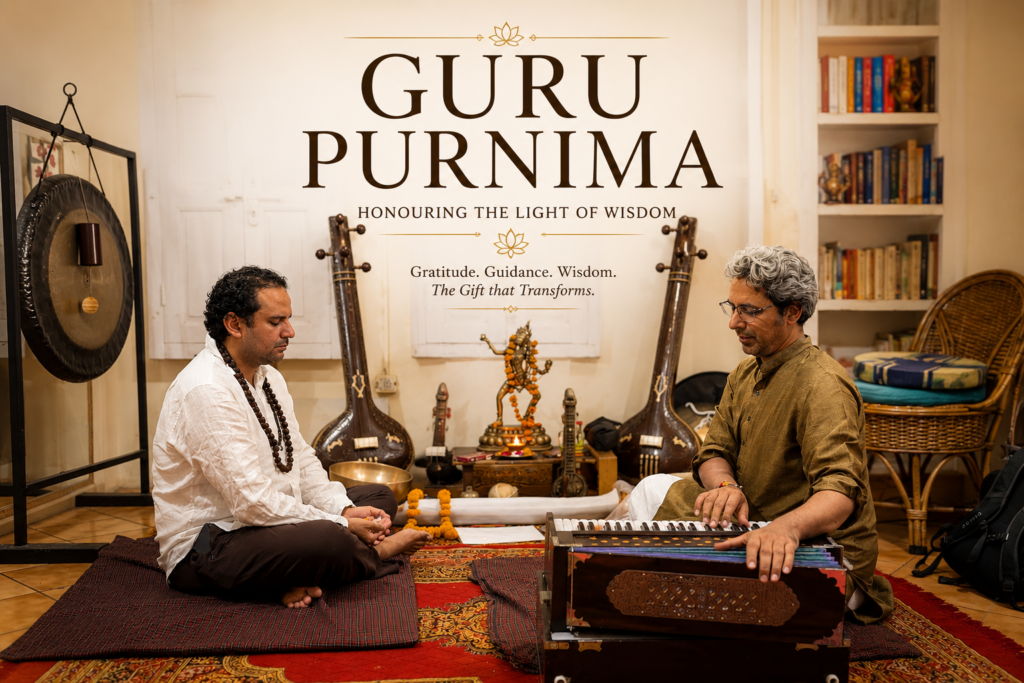
At Nada Yoga School, Guru Purnima holds a particularly special significance because the tradition of Nāda Yoga has always been preserved through the Guru–Shishya Paramparā.
The word Nāda refers to sound, vibration, and the subtle current that yogic philosophy describes as underlying creation itself. Learning Nada Yoga is therefore not simply about singing mantras or playing instruments. It is about refining one’s ability to listen, both outwardly and inwardly.
Traditionally, students learned directly from experienced teachers who transmitted knowledge through years of shared practice. Lessons unfolded through:
- Mantra chanting
- Indian classical music
- Breath awareness
- Meditation
- Silence
- Careful listening
- Daily discipline
Much of this wisdom cannot be fully captured in written instructions. The finer aspects of voice, rhythm, resonance, and awareness develop gradually through observation and regular practice with a teacher.
This living tradition continues today. Students who undertake a Nada Yoga Teacher Training in Rishikesh experience far more than a structured curriculum. They become part of a lineage that values personal guidance, disciplined practice, and the transformative power of sound.
Carrying the Spirit of Guru Purnima Throughout the Year
Although Guru Purnima is celebrated on a single full moon each year, its message extends far beyond one day.
Gratitude is not meant to be seasonal.
Every practice session, every lesson, and every moment of self-reflection offers an opportunity to honour those who have guided us.
One meaningful way to celebrate Guru Purnima is to renew our own commitment to learning.
You might choose to:
- Begin a daily meditation practice.
- Study a chapter of a sacred text.
- Spend time reflecting on your teacher’s guidance.
- Offer selfless service to others.
- Practise with greater consistency and awareness.
- Express gratitude to someone who has positively influenced your life.
These simple actions embody the true spirit of the festival far more than outward ceremonies alone.
Conclusion
Guru Purnima is far more than a traditional festival. It is a celebration of the timeless relationship between wisdom and the sincere seeker. It reminds us that every meaningful journey begins with the willingness to learn and that true knowledge is not measured by how much we know, but by how deeply it transforms our lives.
From the teachings of Bhagavān Vedavyāsa to the living Guru–Shishya tradition that continues in yoga schools and spiritual communities around the world, Guru Purnima honours those who dedicate their lives to preserving and sharing wisdom.
For students of Yoga, meditation, and Nada Yoga, this day carries an even deeper meaning. It encourages us to approach our practice with humility, gratitude, and discipline while recognising the invaluable role of authentic teachers in guiding our growth.
Whether your Guru is a spiritual master, a yoga teacher, a parent, a mentor, or anyone who has helped illuminate your path, Guru Purnima offers an opportunity to pause and say thank you.
May we continue to honour our teachers not only through words, but through sincere practice, compassionate action, and a lifelong commitment to learning.
ॐ श्री गुरुभ्यो नमः।
Om Śrī Gurubhyo Namaḥ।
Salutations to all revered Gurus, past and present, who illuminate the path of knowledge, wisdom, and truth.