Sound has been part of healing, meditation, and spiritual practice for thousands of years. Long before the invention of modern wellness therapies, cultures around the world used chanting, bells, drums, gongs, conch shells, and other acoustic instruments to create spaces for contemplation and inner stillness. Today, one of the most popular ways to experience these traditions is through a sound bath.
Despite its name, a sound bath has nothing to do with water. Instead, participants are “bathed” in layers of soothing sound and vibration created by carefully selected instruments. The experience is designed to encourage deep relaxation, mindful awareness, and a temporary pause from the constant stimulation of everyday life.
Over the past decade, sound baths have become increasingly popular in yoga studios, wellness retreats, meditation centres, and holistic health spaces. While many people attend simply because they enjoy the experience, others are curious about the science behind sound healing and how these sessions may influence the mind and body.
So what exactly is a sound bath, what happens during a session, and what can you realistically expect?
Let’s explore both the ancient traditions and the modern understanding of this fascinating practice.
What Is a Sound Bath?
A sound bath is a guided relaxation experience in which participants listen to a variety of resonant instruments while resting comfortably, usually in a lying-down position.
Unlike a musical performance, the goal is not entertainment. There is no melody to follow or lyrics to remember. Instead, the sounds gradually create an immersive environment that encourages the mind to slow down and the body to relax.
Most sound baths include a combination of instruments such as:
- Tibetan singing bowls
- Crystal singing bowls
- Gongs
- Chimes
- Bells
- Ocean drums
- Rain sticks
- Tuning forks
- Shruti box or tanpura
- Gentle vocal toning or mantra chanting
Each instrument contributes its own unique texture, creating layers of sound that continuously evolve throughout the session.
Rather than actively doing something, participants simply listen.
Where Did Sound Baths Originate?
Although the phrase sound bath is relatively modern, the use of sound for meditation and spiritual practice is ancient.
In India, traditions such as Nada Yoga have explored the relationship between sound, vibration, and consciousness for centuries. Sacred mantras, the Shankha (conch shell), temple bells, Indian classical music, and the continuous drone of the tanpura have long been used to prepare the mind for meditation.
Similarly, cultures across Tibet, Nepal, China, Japan, and Southeast Asia developed their own traditions involving bells, bowls, and ceremonial instruments.
While today’s sound baths often combine instruments from different traditions, their underlying purpose remains remarkably similar: using sound as a support for presence, relaxation, and mindful awareness.
What Happens During a Sound Bath?
Every facilitator has their own style, but most sessions follow a similar structure.
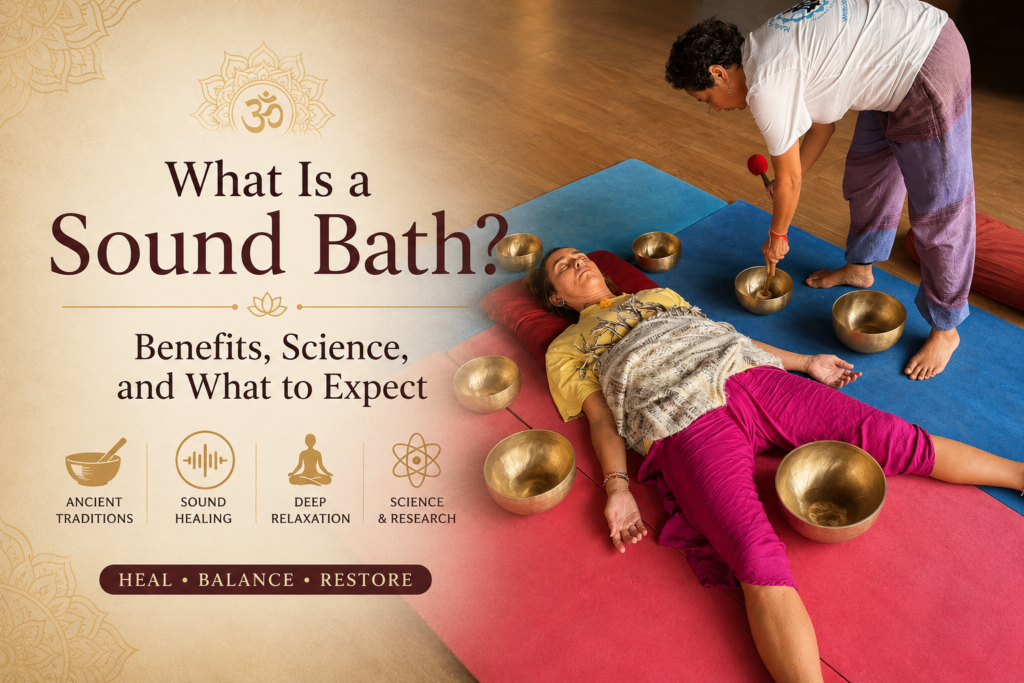
Participants usually lie comfortably on a yoga mat with a blanket and cushion to support the body. The lights are often dimmed, creating a calm and peaceful environment.
The session may begin with:
- Gentle breathing
- A short meditation
- Setting an intention
- A few moments of silence
The practitioner then introduces different instruments one at a time.
The sounds gradually overlap, creating waves of vibration that fill the room. Some tones are deep and grounding, while others are bright, spacious, or gently shimmering.
Unlike listening to recorded music through headphones, the experience unfolds within a shared acoustic space where sound naturally interacts with the environment.
As the session draws to a close, the sounds gradually become softer before giving way to silence, allowing participants a few moments to simply observe their experience before returning to normal activity.
Why Do People Enjoy Sound Baths?
Every person’s experience is unique.
Some people feel deeply relaxed within a few minutes.
Others notice that their breathing naturally slows.
Some become more aware of physical sensations throughout the body, while others simply enjoy spending time in quiet stillness without external demands.
Practitioners commonly describe experiences such as:
- Feeling calm and grounded
- Increased body awareness
- Easier meditation
- Mental clarity
- A sense of spaciousness
- Emotional relaxation
- Improved ability to unwind after a busy day
These experiences vary considerably from person to person, which is why sound healing is often approached as a personal practice rather than a one-size-fits-all experience.
How Does a Sound Bath Affect the Body?
One reason sound baths feel immersive is that sound is experienced through more than hearing alone.
Every instrument produces vibrations that travel through the air before reaching the ears. These sound waves are processed by the auditory system while also contributing to the overall sensory environment.
Many participants become more aware of:
- Their breathing
- Muscle tension
- Heartbeat
- Body position
- The rhythm of the sounds
As attention shifts away from everyday concerns and towards listening, the body often begins to relax naturally.
Rather than forcing relaxation, a sound bath creates conditions that encourage it.
The Science Behind Sound Baths
Modern research into sound healing is still developing, but several well-established scientific principles help explain why many people find sound baths enjoyable and relaxing.
Studies have shown that:
- Music can influence mood and emotional experience.
- Slow, calming sounds may encourage relaxation.
- Focused listening can support mindfulness and sustained attention.
- Deep breathing and meditation can influence the autonomic nervous system.
These effects arise through the interaction between sound, attention, emotion, and the nervous system.
However, it is equally important to recognise what current science has not established.
There is currently no strong scientific evidence showing that sound baths:
- Cure diseases
- Repair organs
- Replace medical treatment
- Produce guaranteed therapeutic outcomes for every individual
Approaching sound baths with realistic expectations allows us to appreciate their genuine strengths without relying on exaggerated claims.
The Role of Vibration
Many people associate sound baths with vibration.
Every acoustic instrument creates vibration because sound itself is a form of mechanical energy travelling through air.
Different instruments produce different qualities of resonance.
For example:
- Singing bowls generate long, sustained tones rich in harmonics.
- Gongs create broad, evolving soundscapes.
- Tuning forks produce stable and precise frequencies.
- Bells create bright, clear overtones.
These acoustic characteristics shape how we perceive the overall sound environment, contributing to the immersive quality of a sound bath.
Sound Baths and Meditation
Although some people attend sound baths purely for relaxation, many practitioners view them as a form of meditation.
Listening becomes the focus.
Instead of following thoughts, attention gently returns to sound whenever the mind begins wandering.
Within Nada Yoga, this approach has long been recognised as a path towards deeper awareness.
The practice encourages listening not only to external sound but also to the silence that naturally follows it.
For many participants, this shift in attention becomes one of the most valuable aspects of the entire experience.
Who Can Benefit from a Sound Bath?
One reason sound baths have become so popular is their accessibility.
Unlike some meditation techniques, they require very little previous experience.
Most sessions are suitable for:
- Beginners
- Yoga practitioners
- Meditation students
- Busy professionals
- Older adults
- Anyone interested in mindful relaxation
Participants simply need a comfortable place to lie down and a willingness to listen.
How Are Sound Baths Different from Music Therapy?
Although the two are sometimes confused, they are not the same.
Music therapy is a recognised healthcare profession conducted by qualified music therapists who work with specific therapeutic goals.
Sound baths, on the other hand, are generally wellness and meditation experiences that encourage relaxation through immersive listening.
Both involve sound, but their training, objectives, and professional scope are different.
Understanding this distinction helps participants choose the experience that best suits their needs.
Learning More About Sound Healing
Attending a sound bath offers a wonderful introduction to the world of therapeutic sound, but it represents only one part of a much broader tradition.
Practices such as Nada Yoga, mantra chanting, Yoga Nidra, breathwork, and mindful listening all explore different ways in which sound can support meditation and self-awareness.
Students who choose to explore a Sound Healing Course in Rishikesh often discover that sound healing extends far beyond playing instruments. Traditional training introduces the philosophy of sound, the science of vibration, meditation techniques, breath practices, and the cultural roots of India’s sound healing traditions. For those who continue with a Sound Healing Teacher Training in Rishikesh, this deeper understanding provides the knowledge needed to guide others while appreciating both the ancient wisdom and the modern research surrounding sound.
Final Thoughts
In a world filled with constant noise and distraction, a sound bath offers something refreshingly simple: an opportunity to pause and listen. Whether experienced through the resonant tones of singing bowls, the gentle shimmer of chimes, or the deep vibrations of a gong, the practice invites us to slow our breathing, soften our attention, and reconnect with the present moment.
While modern science continues to investigate the effects of sound on the nervous system, traditions such as Nada Yoga have long recognised the value of mindful listening as a path towards greater awareness. Seen through this lens, a sound bath is not simply a collection of beautiful instruments but an invitation to experience sound with intention, curiosity, and stillness. It is this timeless relationship between sound, silence, and presence that continues to make sound baths meaningful for practitioners around the world.
Frequently Asked Questions
What is a sound bath?
A sound bath is a guided relaxation session where participants listen to instruments such as singing bowls, gongs, chimes, and tuning forks to support meditation and relaxation.
Do you sleep during a sound bath?
Some people fall asleep, while others remain awake throughout the session. Both experiences are common.
What should I wear to a sound bath?
Wear comfortable clothing that allows you to lie down and relax without restriction.
Are sound baths scientifically proven?
Research supports the effects of music, relaxation, mindfulness, and focused listening on well-being. However, many extraordinary healing claims associated with sound baths have not been scientifically established.
Can beginners attend a sound bath?
Yes. Sound baths are suitable for beginners and require no previous experience with meditation or yoga.