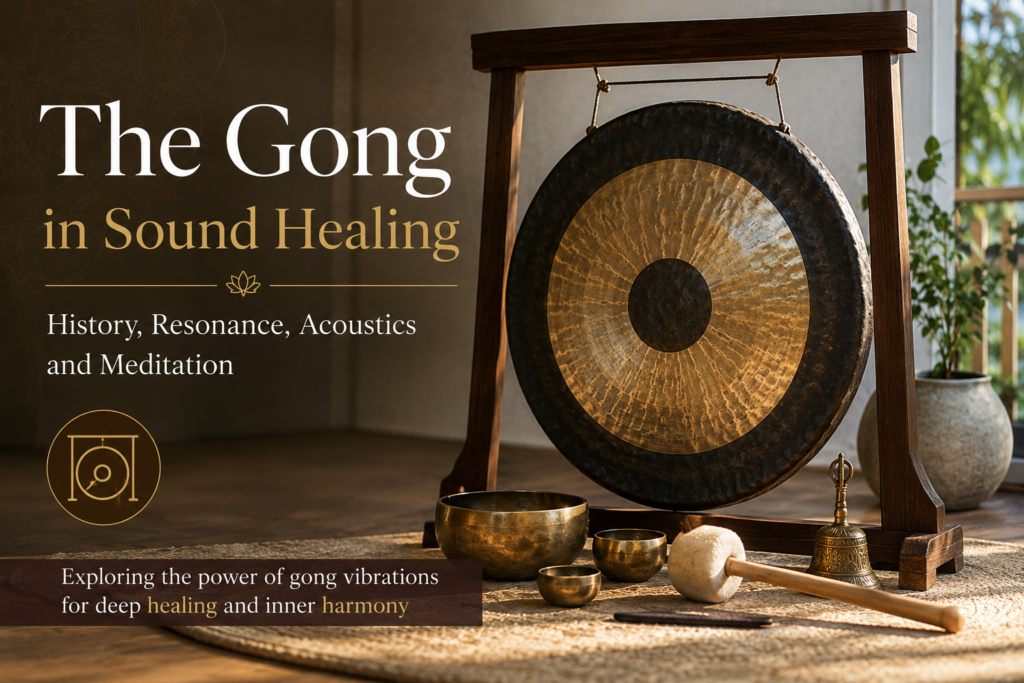
The gong has a sound that is difficult to ignore.
A single strike can begin with a clear impact and then expand into a complex field of resonance. Instead of producing one simple tone, a gong can generate multiple vibrational modes that evolve over time. The sound may seem to move, shimmer, deepen, and gradually disappear into silence.
This quality has made the gong an important instrument in musical and ceremonial traditions across Asia. In recent decades, it has also become one of the most recognisable sound healing instruments, particularly in sound baths, meditation sessions, yoga spaces, and contemporary wellness practices.
Yet the gong is much older and culturally broader than its modern use in sound healing suggests.
To understand why gongs have such a powerful presence, it helps to look at their history, construction, acoustics, relationship with resonance, and the way they are used in meditation.
What Is a Gong?
A gong is a metal percussion instrument that produces sound when its surface is struck with a mallet.
Gongs come in many shapes and sizes. Some are relatively flat, while others have a raised central area known as a boss. Different gong traditions also use different alloys, dimensions, manufacturing methods, and playing techniques.
These physical differences have a major influence on the resulting sound.
A gong is therefore not defined by one particular frequency or sound. Each instrument has its own combination of vibrational modes and acoustic characteristics.
Research into gong acoustics has shown that their sounds can contain complex spectra with multiple partials and changing decay characteristics. Studies of gong vibration examine how the instrument’s shape, material, and construction influence its natural modes of vibration and the sound that reaches the listener.
A Brief History of the Gong
Gongs have a long history across Asia, particularly in Southeast and East Asian musical cultures.
Historical and archaeological evidence connects gong traditions with regions including China, Java, Burma, Vietnam, and other parts of maritime Asia. Gongs have been used in musical ensembles, court traditions, religious ceremonies, ritual settings, signalling, and community gatherings.
Their history cannot be reduced to a single place of origin because different gong traditions developed across different regions and periods.
Research into the archaeological record of maritime Asia also shows how trade and cultural exchange helped musical instruments move between regions. Gongs were part of these wider networks of musical and ritual exchange.
This history is important when discussing the modern gong sound bath.
The instrument has cultural histories that existed long before the contemporary wellness industry began using the term “sound healing.”
Gongs in Asian Musical Traditions
One of the most important contexts for understanding the gong is its role in traditional music.
In Java and Bali, for example, gongs form an important part of gamelan ensembles. Large gongs can mark structural points within musical cycles, while other gong-like instruments contribute rhythmic and melodic patterns.
Other Asian traditions use gongs in different ways.
Some instruments are tuned to specific pitches. Others produce complex, less clearly pitched sounds. Some are used primarily for rhythmic punctuation, while others can create sustained resonance.
This variety demonstrates why the word “gong” describes a broad family of instruments rather than one standard design.
How Does a Gong Produce Sound?
When a mallet strikes a gong, the impact transfers energy into the metal.
That energy causes the gong’s surface to vibrate.
The vibration then interacts with the surrounding air and produces sound waves.
What makes a gong particularly interesting is that the metal does not vibrate in only one simple pattern.
Different areas of the surface can move in different ways. These are known as vibrational modes.
Each mode contributes to the overall acoustic character of the instrument.
Acoustic research on percussion instruments examines these modes and how they radiate sound. Gong studies similarly analyse the relationship between the instrument’s geometry, natural frequencies, vibration patterns, and resulting sound spectrum.
Why Does a Gong Sound So Complex?
A piano string or tuning fork can produce a relatively clear fundamental frequency with identifiable harmonics.
A gong behaves differently.
Its vibrational modes can create a much more complex combination of partials. Some of these relationships may not correspond neatly to the conventional harmonic series associated with simple musical tones.
Research examining the overtone spectra of gongs found that individual gongs can have distinctive spectra and decay characteristics, with overtone relationships that may include both consonant and dissonant intervals.
This complexity contributes to the characteristic “wash” of sound associated with many gongs.
Rather than hearing one stable pitch, the listener experiences a changing acoustic landscape.
Gong Resonance and Decay
One of the defining qualities of a gong is resonance.
After the initial strike, the gong continues vibrating.
The sound changes as different vibrational components rise and fall in intensity. Some frequencies may become more noticeable while others fade.
Eventually, the energy decreases and the sound disappears.
This gradual process is called decay.
For meditation, this can be particularly interesting.
A practitioner can follow the sound from its initial impact through its changing resonance and finally into silence.
The meditation therefore involves the entire life of the sound rather than simply the moment when the gong is struck.
Does a Gong Have One Frequency?
This is one of the most common misunderstandings about gongs.
A gong does not necessarily produce one single frequency that explains its entire sound.
Although particular gongs may be designed or described in relation to certain pitches or frequency ranges, their acoustic output usually contains multiple vibrational components.
The physical dimensions, thickness, material, shaping, and manufacturing process all influence the resulting spectrum.
Research on gong acoustics has demonstrated that changes in geometry and material properties affect vibrational modes and radiated sound.
This is why reducing a gong to one number in Hertz does not capture the full experience of the instrument.
What Makes Each Gong Sound Different?
Two gongs of similar size can still sound noticeably different.
Several factors contribute to this.
Size
Larger gongs can produce deeper and more expansive sounds, although size alone does not determine the complete frequency spectrum.
Thickness
The thickness and distribution of metal influence how the surface vibrates.
Shape
Curvature, central bosses, edges, and other geometric features affect the vibrational modes.
Material
The alloy used to manufacture the gong influences its acoustic behaviour.
Manufacturing
Hammering, shaping, tuning, grinding, and other processes can alter the final sound.
Playing Technique
The mallet, striking position, force, and movement of the practitioner all influence the sound produced.
This combination is why experienced gong practitioners spend time learning the individual character of each instrument.
How to Play a Gong
Playing a gong involves much more than hitting it as hard as possible.
A practitioner needs to understand how the instrument responds to different levels of force and different areas of the surface.
A gentle strike can produce a subtle beginning.
A stronger strike can introduce more energy and a larger sound.
Moving around different areas of the gong can also change the character of the resulting resonance.
The goal is to learn how much energy the instrument needs to produce the desired sound.
Start With Listening
One of the most useful skills for a beginner is simply listening.
Strike the gong gently.
Allow the sound to develop.
Notice the initial attack.
Listen for emerging tones.
Observe how the sound changes.
Then wait until it disappears.
This process teaches you more about the instrument than repeatedly striking it at maximum volume.
The Role of the Mallet
The mallet has a significant influence on the sound of a gong.
Different mallets vary in size, weight, shape, and covering material.
A harder mallet can create a more pronounced attack, while a softer mallet can produce a gentler onset.
The choice depends on the gong and the sound the practitioner wants to create.
This is particularly important in meditation and sound healing sessions, where excessive volume can become uncomfortable for participants.
What Is a Gong Bath?
A gong bath is a type of sound-based meditation in which participants usually lie or sit comfortably while a practitioner plays one or more gongs.
The term “bath” refers to the immersive experience of being surrounded by sound rather than an actual bath.
Gongs may be combined with singing bowls, chimes, drums, voice, or other instruments.
The sound develops continuously throughout the session, creating an evolving acoustic environment.
Contemporary gong baths are generally presented as relaxation or meditation practices. Research into sound baths and gong-based practices is still limited, so claims about specific therapeutic effects should be made carefully.
What Happens During a Gong Meditation?
A gong meditation usually begins with participants settling into a comfortable position.
The practitioner may introduce the gong gradually, beginning with softer sounds before developing a more complex soundscape.
As the session continues, the gong can move between different levels of intensity.
The listener may notice changes in volume, pitch, texture, rhythm, and resonance.
There is no requirement to analyse every sound.
Instead, the listener can simply observe what is happening.
This approach has similarities with other forms of sound meditation, where sound becomes an anchor for attention.
Why Can Gong Sound Feel So Immersive?
The immersive quality of a gong comes partly from its complex acoustic spectrum.
Unlike a simple sustained tone, a gong can produce many frequencies at once. These components can also change over time.
The listener therefore receives a continuously evolving sound rather than a static tone.
The physical environment contributes as well.
Room size, reflections, walls, floors, and other surfaces affect how the sound reaches the listener.
A gong played in a small room can feel very different from the same instrument played in a large studio.
Gong Sound Healing: What Does the Research Say?
The popularity of gong sound healing has grown considerably, but scientific research specifically focused on gongs remains relatively limited.
Some research has examined sound meditation involving combinations of singing bowls, gongs, and bells. One observational study reported improvements in participants’ self-reported tension, mood, and well-being following a sound meditation session.
However, studies involving multiple instruments cannot automatically tell us what effect came specifically from the gong.
This distinction matters.
It is reasonable to explore gong meditation as a relaxation and contemplative practice. It is much harder to claim that a particular gong frequency or vibration produces a specific medical outcome.
A grounded approach to gong sound healing recognises the difference between personal experience, traditional belief, and established scientific evidence.
Gong Meditation and Relaxation
Many people use gong meditation because they find the sound immersive and conducive to relaxation.
The extended resonance gives attention something to follow without requiring active participation from the listener.
For someone who finds silent meditation difficult, listening to an evolving sound can provide an accessible starting point.
At the same time, responses vary.
Some people find the intensity of a gong deeply relaxing. Others may find loud or low-frequency sounds uncomfortable.
The practitioner therefore needs to consider volume, distance, room acoustics, and individual sensitivity.
The Gong and Nāda Yoga
The gong can also be explored through the broader philosophy of Nāda Yoga.
Nāda Yoga places importance on sound and attentive listening. The practitioner can use external sound as an object through which concentration develops.
A gong offers an interesting example because its sound is constantly changing.
Instead of holding attention on one fixed pitch, the listener can observe the evolution of resonance.
The sound begins.
It expands.
Its character changes.
It gradually becomes quieter.
Eventually, silence remains.
This makes gong listening an interesting exercise in impermanence and attentive awareness.
Gong, Singing Bowl, and Tanpura: Different Sound Experiences
Gongs are often grouped together with other sound healing instruments, but each produces a very different acoustic experience.
Gong
The gong produces a broad, evolving sound spectrum with complex resonance and long decay.
Singing Bowl
A singing bowl generally offers a more identifiable tonal centre alongside multiple partials and sustained resonance.
Tanpura
The Tanpura creates a continuous drone that provides a stable tonal foundation.
Shankha
The Shankha produces a sustained sound generated through breath and carries strong ritual significance within Indian traditions.
Damaru
The Damaru is primarily rhythmic, producing short repeated sounds rather than a long sustained resonance.
Understanding these differences helps practitioners choose instruments according to the purpose of a practice rather than treating every sound healing instrument as interchangeable.
The Gong in a Sound Healing Session
A gong can play several different roles within a sound healing session.
It can establish the beginning of a practice, create a transition between instruments, provide a sustained layer of sound, or bring a session toward completion.
The practitioner can also vary intensity throughout the session.
A quieter opening may allow participants to settle.
Gradually introducing more complex resonance can create movement.
A softer ending can then allow the sound to return to silence.
This kind of structure requires sensitivity rather than simply playing continuously.
Why Silence Matters After the Gong
The silence following a gong strike is an important part of the experience.
When the sound disappears, the listener suddenly becomes aware of the absence of sound.
This contrast can make the final resonance feel even more noticeable.
For sound meditation, this creates an opportunity to shift attention from external sound toward internal awareness.
The gong therefore teaches something that applies to many instruments:
Silence is part of the sound experience.
Learning to Work With a Gong
Learning the gong requires both technical and listening skills.
A practitioner needs to understand how the instrument responds to different mallets, striking positions, force levels, and playing patterns.
However, technique alone is not enough.
A good gong practitioner also needs to understand the people listening to the sound.
Volume matters.
Distance matters.
The acoustic environment matters.
The duration of the session matters.
So does the transition into and out of silence.
This broader perspective is especially important for anyone considering professional sound healing teacher training.
Studying Gong in a Sound Healing Teacher Training
A structured sound healing teacher training can provide an opportunity to study gong technique alongside other sound healing instruments and practices.
Rather than learning only how to produce sound, students can explore how instruments function within a complete session.
This can include understanding:
- Gong construction and acoustics
- Mallet selection
- Striking techniques
- Resonance and decay
- Sound meditation
- Session structure
- Working with multiple instruments
- Listening skills
- Safe volume and positioning
- Traditional sound practices
For students interested in studying these practices in India, a sound healing teacher training in Rishikesh can also provide cultural context through exposure to yoga, meditation, mantra, Indian music, and traditional approaches to sound.
Gong and the Broader Sound Healing Tradition
Modern sound healing includes many different influences.
Some practices draw from contemporary meditation and wellness. Others incorporate instruments that have long histories in Asian musical and ritual traditions.
The gong sits within this complex landscape.
Its use in modern sound baths should not erase its older musical and cultural histories.
Learning about the instrument’s origins and traditional uses can help practitioners approach it with greater respect and understanding.
This is especially relevant when sound healing incorporates instruments from cultures outside the practitioner’s own background.
How to Choose a Gong for Sound Healing
Someone purchasing a gong for meditation or sound healing should consider more than its advertised frequency.
Pay attention to:
- Size
- Weight
- Construction
- Material
- Tonal character
- Resonance
- Decay
- Mallet compatibility
- Playing environment
- Intended use
Whenever possible, listen to the actual instrument before purchasing it.
Two gongs with similar specifications can have very different personalities.
The right instrument is ultimately the one whose sound fits the practitioner, space, and purpose.
Common Mistakes When Using a Gong
Beginners often assume that a larger strike produces a better gong sound.
In practice, excessive force can create an overly aggressive attack and overwhelm the resonance that follows.
Other common mistakes include:
- Striking too hard
- Using an unsuitable mallet
- Playing continuously without allowing the gong to breathe
- Ignoring room acoustics
- Focusing only on volume
- Introducing intense sounds too quickly in a meditation
- Treating the gong as though every instrument responds in exactly the same way
A gong rewards patience.
The more carefully you listen, the more clearly you begin to understand how it responds.
Gong Practice in Rishikesh
Rishikesh has become an important destination for people exploring yoga, meditation, mantra, Indian music, and sound-based practices.
The city’s broader yoga culture also creates an interesting environment for studying the relationship between traditional Indian practices and contemporary sound healing.
Students attending a sound healing course in Rishikesh may encounter gongs alongside singing bowls, tuning forks, drums, chimes, voice, and other instruments.
For students interested in the philosophical side of sound, Nada Yoga teacher training offers another perspective by placing greater emphasis on listening, Nāda, mantra, Indian music, and contemplative awareness.
These approaches can complement one another while retaining their distinct traditions and purposes.
Final Thoughts
The gong is a remarkable instrument because its sound cannot easily be reduced to a single note or frequency.
Its surface contains multiple vibrational modes. Its sound changes continuously after the initial strike. Its resonance interacts with the room, the mallet, the player, and the listener.
This complexity explains much of its appeal in meditation and sound-based practices.
For modern sound healing, the gong can provide an immersive auditory environment that encourages relaxation and attentive listening. At the same time, its history reminds us that the instrument existed within musical, ceremonial, and cultural traditions long before the contemporary idea of the sound bath.
Approached with knowledge and respect, the gong becomes more than an instrument for creating a dramatic sound.
It becomes a study in vibration, resonance, rhythm, perception, and silence.
And for anyone learning sound healing, perhaps the most valuable lesson is the simplest one: before trying to create a particular experience for someone else, learn to listen carefully to the instrument itself.