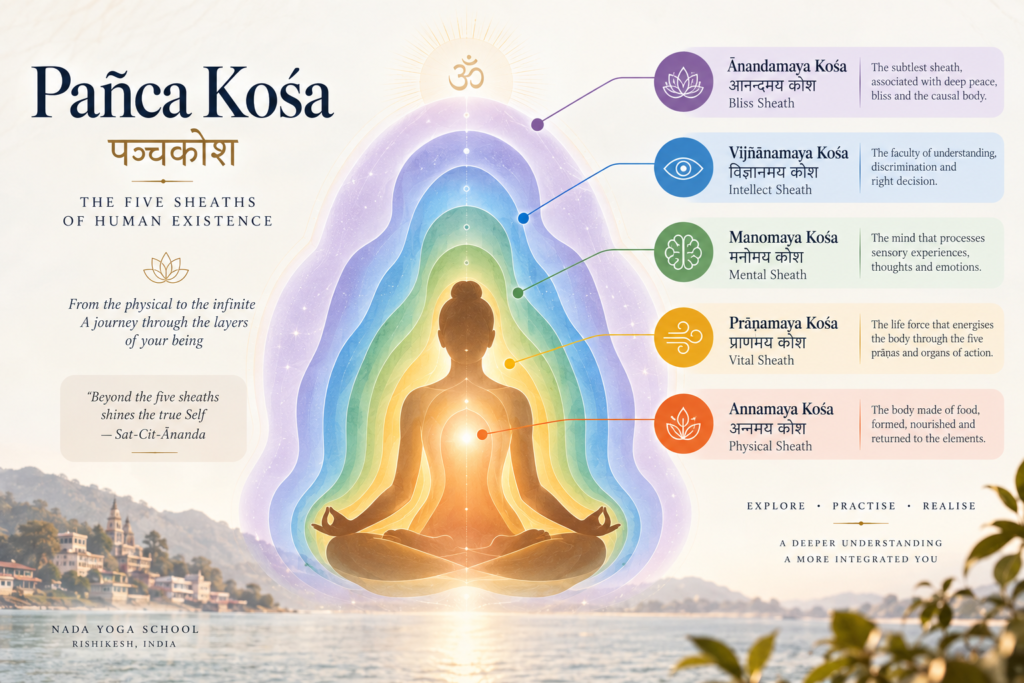
The human being can be understood through several layers of experience, ranging from the physical body to increasingly subtle aspects of existence. In the traditional teaching of Vedānta, this framework is known as Pañca Kośa, meaning the five sheaths or coverings.
The word kośa refers to a sheath, covering, container, or enclosing layer. The five kośas provide a method for examining embodied existence through the physical body, vital force, mind, intellect, and bliss.
The primary source of this teaching is the Taittirīya Upaniṣad, particularly the Brahmānanda Vallī of the Kṛṣṇa Yajurveda. The teaching presents a progressive movement from Annamaya to Ānandamaya. A concise later explanation is also found in the Tattvabodha, traditionally attributed to Ādi Śaṅkarācārya.
The Tattvabodha asks:
पञ्च कोशाः के ?
pañca kośāḥ ke?
“What are the five sheaths?”
It answers:
अन्नमयः प्राणमयः मनोमयः विज्ञानमयः आनन्दमयश्चेति ।
annamayaḥ prāṇamayaḥ manomayaḥ vijñānamayaḥ ānandamayaś ceti.
“They are Annamaya, Prāṇamaya, Manomaya, Vijñānamaya and Ānandamaya.”
The five kośas are:
- Annamaya Kośa
- Prāṇamaya Kośa
- Manomaya Kośa
- Vijñānamaya Kośa
- Ānandamaya Kośa
These are understood as progressively subtler dimensions of embodied existence. Vedānta ultimately uses this framework to distinguish the Self, or Ātman, from all five sheaths.
1. Annamaya Kośa: The physical sheath
Annamaya — अन्नमय
The teaching begins with the most tangible dimension of human existence: the physical body.
The Upaniṣadic teaching
The Taittirīya Upaniṣad begins its discussion of the physical dimension with food:
अन्नाद्वै प्रजाः प्रजायन्ते ।
जाताः अन्नेन जीवन्ति ।
अथ यन्त्यन्ततः अन्नम् ॥
annād vai prajāḥ prajāyante
jātāḥ annena jīvanti
atha yanty antataḥ annam
“From food, indeed, beings are born; having been born, they live by food; and ultimately they enter into food.”
The Upaniṣad further states:
स वा एष पुरुषोऽन्नरसमयः ।
sa vā eṣa puruṣo’nnarasamayaḥ
“This person is constituted of the essence of food.”
The Tattvabodha gives a more specific definition:
अन्नमयः कः ?
annamayaḥ kaḥ?
“That which is born from the essence of food, grows through the essence of food and finally dissolves into the earth, which is of the nature of food, is the Annamaya Kośa, the gross body.”
What is Annamaya Kośa?
Anna means food, while Annamaya refers to that which is constituted of or dependent upon food.
Annamaya Kośa refers to the gross physical body, the material dimension of embodied existence. The body develops through nourishment, is maintained through nourishment, and eventually returns to the material elements.
It includes the physical structures through which human existence is expressed, including the tissues, organs, limbs, and other gross constituents of the body.
From the perspective of Vedānta, the physical body is experienced as “my body.” Since it can be known by the experiencer, it is treated as something distinct from the ultimate Self.
Annamaya Kośa = the physical, food-constituted sheath.
2. Prāṇamaya Kośa: The vital sheath
Prāṇamaya — प्राणमय
Moving inward from the physical body, the teaching describes the dimension of prāṇa, the vital principle associated with the functioning of the living organism.
The Upaniṣadic teaching
The Taittirīya Upaniṣad states:
अन्योऽन्तर आत्मा प्राणमयः ।
anyo’ntara ātmā prāṇamayaḥ
“There is another inner self, constituted of prāṇa.”
The Upaniṣad describes Prāṇamaya through its principal functions:
प्राण एव शिरः ।
व्यानो दक्षिणः पक्षः ।
अपान उत्तरः पक्षः ।
आकाश आत्मा ।
पृथिवी पुच्छं प्रतिष्ठा ॥
prāṇa eva śiraḥ
vyāno dakṣiṇaḥ pakṣaḥ
apāna uttaraḥ pakṣaḥ
ākāśa ātmā
pṛthivī pucchaṃ pratiṣṭhā
The Tattvabodha provides the following definition:
प्राणमयः कः ?
prāṇamayaḥ kaḥ?
“The five vital airs beginning with Prāṇa, together with the five organs of action beginning with speech, constitute the Prāṇamaya Kośa.”
The five prāṇas
The five principal divisions of prāṇa are traditionally described as:
- Prāṇa
- Apāna
- Vyāna
- Udāna
- Samāna
The five organs of action
The five organs of action are:
- Vāk — speech
- Pāṇi — hands
- Pāda — feet
- Pāyu — organ of excretion
- Upastha — organ of generation
What is Prāṇamaya Kośa?
Prāṇamaya Kośa represents the vital principle of the living organism. It concerns the functions through which life operates in the embodied condition.
It is subtler than Annamaya because the physical structure alone does not account for the functions associated with a living organism. Traditional Vedānta understands these vital activities through prāṇa and its five principal divisions.
Prāṇa-śakti also extends beyond the physical act of breathing. Breath serves as an important expression of prāṇa, while the traditional concept encompasses a broader range of vital activities.
Prāṇamaya Kośa = the vital sheath constituted of the five prāṇas and the five organs of action.
3. Manomaya Kośa: The mental sheath
Manomaya — मनोमय
The next level is Manomaya Kośa, associated with manas, the mental faculty involved in sensory reception, thought, desire, doubt, reaction, and emotional response.
The Upaniṣadic teaching
The Taittirīya Upaniṣad states:
अन्योऽन्तर आत्मा मनोमयः ।
anyo’ntara ātmā manomayaḥ
“There is another inner self, constituted of manas.”
The Tattvabodha defines Manomaya as follows:
मनोमयः कोशः कः ?
manomayaḥ kośaḥ kaḥ?
“That which is formed by the combination of the mind and the five organs of knowledge is called the Manomaya Kośa.”
The five organs of knowledge
The five jñānendriyas are:
- Śrotra — hearing
- Tvak — touch
- Cakṣus — sight
- Jihvā — taste
- Ghrāṇa — smell
What is Manomaya Kośa?
Manas is the mental faculty associated with receiving and processing sensory information. It is also associated with thoughts, desires, doubts, reactions, and emotional responses.
The five organs of knowledge provide sensory information, while manas receives, coordinates, and processes that information.
For example, an object is perceived through the senses. The mind recognizes it, develops attraction or aversion, and produces an appropriate mental response. These processes belong to the domain represented by Manomaya.
Manomaya is subtler than Prāṇamaya because it concerns the inner mental processing through which sensory experiences become conscious mental experiences.
Manomaya Kośa = the mental sheath constituted of manas and the five organs of knowledge.
4. Vijñānamaya Kośa: The sheath of intellect and discrimination
Vijñānamaya — विज्ञानमय
Beyond the mental faculty lies Vijñānamaya Kośa, associated principally with buddhi, the faculty of understanding, discrimination, determination, and decision-making.
The Upaniṣadic teaching
The Taittirīya Upaniṣad states:
अन्योऽन्तर आत्मा विज्ञानमयः ।
anyo’ntara ātmā vijñānamayaḥ
“There is another inner self, constituted of vijñāna.”
The Tattvabodha defines it as:
विज्ञानमयः कः ?
vijñānamayaḥ kaḥ?
“That which is formed by the combination of the intellect and the five organs of knowledge is called the Vijñānamaya Kośa.”
Manas and buddhi
The distinction between manas and buddhi is important in this teaching.
Manas receives information, considers possibilities, and responds to experiences.
Buddhi determines, discriminates, judges, and makes decisions.
Consider the thought:
“I am angry.”
This represents a mental experience associated with Manomaya.
The recognition:
“I am angry, but acting according to this anger will be harmful.”
involves discrimination and determination. This illustrates the function represented by Vijñānamaya.
What is Vijñānamaya Kośa?
Vijñāna refers to discriminative knowledge, understanding, or particularized knowledge. In this context, it is principally associated with buddhi.
Vijñānamaya is subtler than Manomaya because it represents the faculty through which the individual understands, judges, discriminates, and makes decisions.
Vedānta still regards buddhi as something that can be known. Therefore, Vijñānamaya remains a sheath rather than the ultimate Self.
Vijñānamaya Kośa = the sheath constituted of buddhi and the five organs of knowledge.
5. Ānandamaya Kośa: The bliss sheath
Ānandamaya — आनन्दमय
The fifth and innermost sheath in the Pañca Kośa analysis is Ānandamaya Kośa, associated with bliss and the causal condition.
The Upaniṣadic teaching
The Taittirīya Upaniṣad states:
अन्योऽन्तर आत्मानन्दमयः ।
anyo’ntara ātmānandamayaḥ
“There is another inner self, constituted of bliss.”
The Upaniṣad describes Ānandamaya through the following terms:
प्रियमेव शिरः ।
मोदो दक्षिणः पक्षः ।
प्रमोद उत्तरः पक्षः ।
आनन्द आत्मा ।
ब्रह्म पुच्छं प्रतिष्ठा ॥
priyam eva śiraḥ
modo dakṣiṇaḥ pakṣaḥ
pramoda uttaraḥ pakṣaḥ
ānanda ātmā
brahma pucchaṃ pratiṣṭhā
The Tattvabodha gives its definition:
आनन्दमयः कः ?
ānandamayaḥ kaḥ?
“That which consists of the impure aspect of sattva associated with avidyā, which constitutes the causal body, together with modifications beginning with priya, is called the Ānandamaya Kośa.”
What is Ānandamaya Kośa?
Ānanda means bliss or profound happiness.
Ānandamaya represents the innermost of the five sheaths in this analysis. The Tattvabodha associates it with the causal body, or kāraṇa śarīra, and avidyā. The Taittirīya Upaniṣad describes it through priya, moda, and pramoda, culminating in ānanda.
This sheath is subtler than the physical, vital, mental, and intellectual dimensions.
However, Ānandamaya remains a kośa, a sheath. The Vedāntic analysis therefore distinguishes it from the ultimate Ātman.
Ānandamaya Kośa = the bliss sheath associated with the causal condition.
The five kośas in sequence
The Pañca Kośa teaching presents a movement from the gross toward increasingly subtle dimensions of embodied existence:
अन्नमय → प्राणमय → मनोमय → विज्ञानमय → आनन्दमय
Annamaya → Prāṇamaya → Manomaya → Vijñānamaya → Ānandamaya
They can be understood as:
| Kośa | Sanskrit | Primary dimension |
|---|---|---|
| Annamaya | अन्नमय | Physical existence |
| Prāṇamaya | प्राणमय | Vital functions |
| Manomaya | मनोमय | Mind and sensory processing |
| Vijñānamaya | विज्ञानमय | Intellect and discrimination |
| Ānandamaya | आनन्दमय | Bliss and causal condition |
The sequence provides a framework for examining different dimensions of human experience, beginning with the tangible physical body and moving toward subtler aspects of existence.
The Ātman is beyond the five kośas
The central purpose of the Pañca Kośa teaching lies in the distinction between the Self and the five sheaths.
Vedānta uses the five kośas to examine what is experienced as the body, vital force, mind, intellect, and bliss. Each can be known by the experiencer.
The Tattvabodha explains:
मदीयं शरीरं मदीयाः प्राणाः मदीयं मनश्च
मदीया बुद्धिर्मदीयमज्ञानमिति स्वेनैव ज्ञायते ।
madīyaṃ śarīraṃ madīyāḥ prāṇāḥ madīyaṃ manaś ca
madīyā buddhiḥ madīyam ajñānam iti svenaiva jñāyate.
“One knows directly: ‘my body, my prāṇas, my mind, my intellect and my ignorance.’”
The text then gives an analogy. Things recognized as “mine”, such as a bracelet, earring, or house, are understood as distinct from oneself. In the same way, the five kośas are understood as distinct from the Self.
The conclusion is expressed as:
मदीयत्वेन ज्ञातमात्मा न भवति ।
madīyatvena jñātam ātmā na bhavati.
“That which is known as ‘mine’ is not the Ātman.”
This forms the essential Vedāntic principle of the Pañca Kośa teaching. The body, prāṇa, mind, intellect, and causal bliss are objects of awareness. The Self is distinguished from them.
Ātman: The Self beyond the sheaths
After distinguishing the Self from the five kośas, the Tattvabodha asks:
आत्मा तर्हि कः ?
ātmā tarhi kaḥ?
“Then what is the Ātman?”
The answer is:
सच्चिदानन्दस्वरूपः ।
sac-cid-ānanda-svarūpaḥ
“It is of the nature of Sat-Cit-Ānanda.”
The teaching concludes:
एवं सच्चिदानन्दस्वरूपं स्वात्मानं विजानीयात् ।
evaṃ sac-cid-ānanda-svarūpaṃ svātmānaṃ vijānīyāt.
“Thus one should know one’s own Self as being of the nature of Sat-Cit-Ānanda.”
Here, the Pañca Kośa analysis reaches its central point. The five sheaths provide a way of examining embodied experience, while Ātman is described as distinct from these layers.
Why the Pañca Kośa teaching matters
The Pañca Kośa framework gives Vedānta a systematic way to examine human existence.
The journey begins with Annamaya, the physical body sustained by food. It then moves through Prāṇamaya, associated with vital functions, followed by Manomaya, associated with mind and sensory processing.
The analysis continues into Vijñānamaya, associated with intellect and discrimination, and reaches Ānandamaya, associated with bliss and the causal condition.
Each sheath represents a progressively subtler dimension of embodied existence. The final teaching directs attention beyond these five layers toward the nature of Ātman as Sat-Cit-Ānanda.
Conclusion
The Pañca Kośa teaching presents five sheaths through which the embodied human being can be examined:
Annamaya represents physical existence.
Prāṇamaya represents vital functions.
Manomaya represents the mind and sensory processing.
Vijñānamaya represents intellect and discrimination.
Ānandamaya represents bliss and the causal condition.
The Taittirīya Upaniṣad serves as the primary Upaniṣadic source of this teaching, while the Tattvabodha provides a concise and systematic Advaita Vedānta explanation of the five kośas.
The progression from Annamaya to Ānandamaya moves through increasingly subtle dimensions of embodied existence. The teaching ultimately distinguishes all five sheaths from Ātman, which is described as Sat-Cit-Ānanda, existence, consciousness, and bliss.
Understanding the five kośas therefore provides a traditional Vedāntic framework for investigating a fundamental question: What is the Self beyond everything that can be experienced and known?