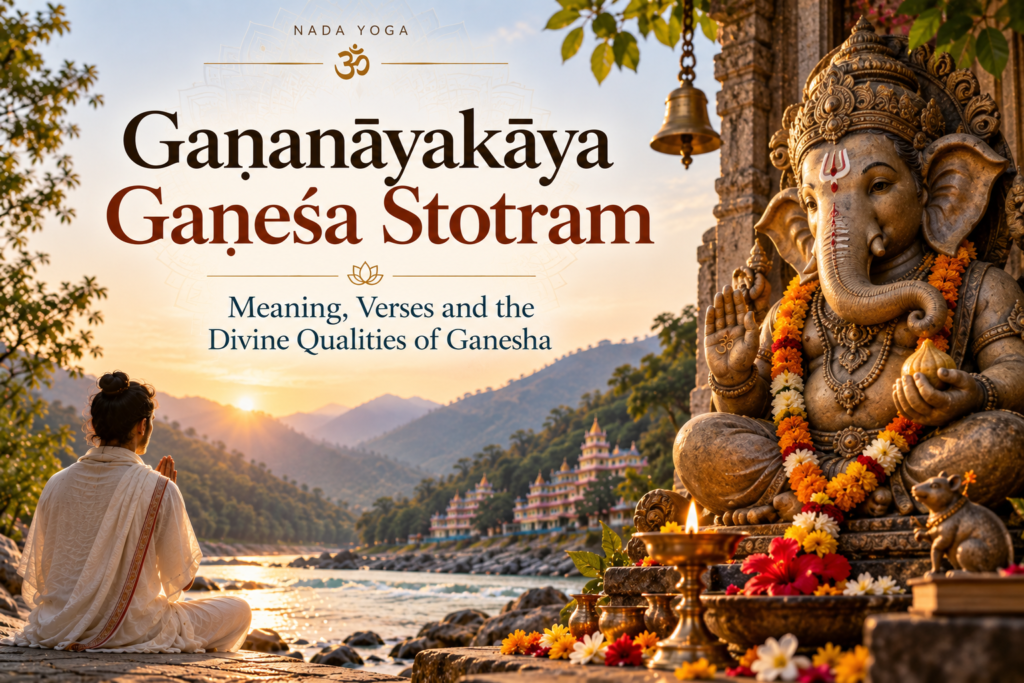
The name of Ganesha carries many meanings across the traditions of Hindu prayer, devotion and sacred music. He is worshipped as Gaṇanāyaka, the leader of the gaṇas, Ekadanta, the one with a single tusk, and Vakratuṇḍa, the one with the curved trunk. The Gaṇanāyakāya Gaṇeśa Stotram brings together these names while exploring Ganesha through devotion, music, knowledge, the guru tradition and spiritual practice.
The stotram has a distinctive emphasis on gāna, meaning song or singing. Several verses describe Ganesha through music, singing, instruments and the inner essence of song. Alongside these musical references, the hymn presents Ganesha through qualities such as wisdom, devotion, purity, guidance and spiritual understanding.
A recurring section returns to the familiar invocation of Ganesha as Guṇātīta, Guṇādhīśa, Ekadanta, Vakratuṇḍa, Gaurī-tanaya, Gajeśāna and Bhālacandra. Through these repeated names, the stotram creates a devotional meditation on the many dimensions of Ganesha.
What is the Gaṇanāyakāya Gaṇeśa Stotram?
The Gaṇanāyakāya Gaṇeśa Stotram is a Sanskrit devotional hymn dedicated to Lord Ganesha. Its verses praise Ganesha through a rich collection of names and attributes, moving through themes of divine qualities, music, the guru, sacred knowledge, devotion and spiritual identity.
The opening lines begin with:
Gaṇa-nāyakāya gaṇa-devatāya
gaṇādhyakṣāya dhīmahi
The hymn then continues through several names and qualities before returning repeatedly to the central invocation of Ganesha.
The word dhīmahi carries the sense of contemplation. Throughout the stotram, the repeated structure therefore creates a devotional movement in which different aspects of Ganesha become subjects of contemplation.
Gaṇanāyakāya Gaṇeśa Stotram pronunciation
The opening section can be recited as follows:
Gaṇa-nāyakāya gaṇa-devatāya
gaṇādhyakṣāya dhīmahi
Guṇa-śarīrāya guṇa-maṇḍitāya
guṇeśānāya dhīmahi
Guṇātītāya guṇādhīśāya
guṇa-praviṣṭāya dhīmahi
Ekadantāya vakratuṇḍāya
Gaurī-tanayāya dhīmahi
Gajeśānāya bhālacandrāya
Śrī-Gaṇeśāya dhīmahi
The pronunciation can be approached slowly, with attention to the Sanskrit sounds and the repeated rhythm of the verses. Since the hymn contains many names of Ganesha, careful pronunciation also allows the meaning of each name to remain connected with the chanting.
The opening names of Ganesha
The opening verse presents Ganesha through several names that describe his position and qualities.
Gaṇa-nāyakāya refers to Ganesha as the leader of the gaṇas.
Gaṇa-devatāya presents him as the deity associated with the gaṇas.
Gaṇādhyakṣāya describes him as their overseer.
The verse then moves toward guṇa, the qualities or attributes through which Ganesha is contemplated. He is described as Guṇa-śarīra, Guṇa-maṇḍita and Guṇeśāna, bringing the idea of divine qualities into the devotional focus of the hymn.
The repeated word dhīmahi gives the verse a contemplative character. The practitioner recites the names while directing the mind toward the qualities they express.
Guṇātīta, Guṇādhīśa and Guṇa-praviṣṭa
The next passage develops the theme of guṇa further:
Guṇātītāya guṇādhīśāya
guṇa-praviṣṭāya dhīmahi
Here Ganesha is described as Guṇātīta, associated with that which transcends the guṇas, Guṇādhīśa, the lord of the guṇas, and Guṇa-praviṣṭa, described through the idea of being present within the guṇas.
These names create a layered picture of Ganesha. The hymn moves between transcendence, lordship and presence, giving the practitioner several ways to contemplate the divine.
The passage then returns to familiar forms of Ganesha:
Ekadantāya vakratuṇḍāya
Gaurī-tanayāya dhīmahi
Ekadanta refers to the single tusk, while Vakratuṇḍa refers to the curved trunk. Gaurī-tanaya identifies Ganesha as the son of Gaurī.
The verse closes with:
Gajeśānāya bhālacandrāya
Śrī-Gaṇeśāya dhīmahi
Here Ganesha is praised as Gajeśāna, the lord associated with the elephant form, and Bhālacandra, the one associated with the moon upon the forehead.
Ganesha and the power of music
One of the most distinctive features of this Ganesha Stotram is its extensive focus on music.
The hymn says:
Gāna-caturāya gāna-prāṇāya
gānāntarātmane
Gānotsukāya gāna-mattāya
gānotsuka-manase
The repeated appearance of gāna, song or singing, gives this section a strong musical character. Ganesha is described through skill in song, the life of song and the inner essence of song.
The hymn also describes an enthusiasm for music and a mind drawn toward singing. These expressions present music as an important part of devotional experience.
For a practitioner, this section can be approached through the act of singing itself. The voice becomes a means of expressing devotion, while the repeated names of Ganesha provide the structure for contemplation.
Gāna and the inner essence of song
The phrase gānāntarātmane brings particular depth to the musical section. It presents Ganesha in relation to the inner essence of song.
This idea fits naturally within a devotional approach to sacred music. Singing becomes an expressive practice through which attention, voice and devotion come together.
The hymn continues to describe Ganesha as Gānotsuka, enthusiastic about song, and Gāna-matta, absorbed in song. The language creates an image of deep involvement with music and devotional expression.
For students interested in Ganesha mantra chanting, this musical emphasis offers an important perspective. Chanting can be experienced through pronunciation, rhythm, repetition and attentive listening, while devotion gives the practice its deeper direction.
Ganesha and the guru
The next section turns from music toward the guru tradition:
Guru-pūjitāya guru-daivatāya
guru-kulasthāyine
Guru-vikramāya guhya-pravarāya
gurave guṇa-gurave
Ganesha is described as Guru-pūjita, honored by the guru, and Guru-daivata, associated with the guru as a divine principle. The hymn also uses expressions connected with the guru lineage and sacred knowledge.
This section places Ganesha within a wider atmosphere of learning and spiritual guidance. The guru represents a source of knowledge and direction, while Ganesha is praised through names associated with this sacred relationship.
The following lines continue the theme:
Guru-daitya-gala-cchetre
guru-dharma-sadārādhyāya
Guru-putra-paritrātre
guru-pākhaṇḍa-khaṇḍakāya
The hymn continues to describe Ganesha through protection, spiritual discipline and the preservation of the guru’s teaching.
Ganesha, sacred knowledge and song
Another section brings together gīta, song, and knowledge:
Gīta-sārāya gīta-tattvāya
gīta-gotrāya dhīmahi
Ganesha is contemplated through the essence and principle of song. The hymn continues:
Gūḍha-gulphāya gandha-mattāya
go-jaya-pradāya dhīmahi
The devotional language moves through physical imagery, fragrance and divine qualities while maintaining the rhythm of repeated contemplation.
The passage then returns to the central refrain of Ganesha’s names:
Guṇātītāya guṇādhīśāya
guṇa-praviṣṭāya dhīmahi
Ekadantāya vakratuṇḍāya
Gaurī-tanayāya dhīmahi
Gajeśānāya bhālacandrāya
Śrī-Gaṇeśāya dhīmahi
This repetition gives the stotram a cyclical quality. Different aspects of Ganesha are introduced, and the chanting returns to the central devotional focus.
Grantha, Gīta and Gāna
The next section develops the connection between Ganesha, sacred texts and music:
Grantha-gītāya grantha-geyāya
granthāntarātmane
Gīta-līnāya gītāśrayāya
gīta-vādya-paṭave
The words grantha and gīta bring together text and song. Ganesha is contemplated through the essence of sacred literature as well as the expressive world of music.
The phrase gīta-vādya-paṭave also introduces musical instruments into the hymn. This makes the stotram especially interesting for those who approach Ganesha through music, chanting and devotional singing.
The hymn then describes Ganesha through qualities associated with singing:
Geya-caritāya gāyaka-varāya
gandharva-priya-kṛte
His story is described as worthy of song, while the verse also connects him with singers and the gandharva tradition.
Ganesha and the voice of the singer
The next line presents another striking image:
Gāyakādhīna-vigrahāya
Gaṅgā-jala-praṇayavate
The hymn continues its movement through music, singing and sacred imagery. Ganesha’s form is described in relation to the singer, while the following expression introduces the sacred waters of the Ganga.
This combination gives the passage a devotional atmosphere in which music, sacred geography and divine imagery meet.
For someone exploring Ganesha chanting, these verses offer an opportunity to experience the stotram as a musical form rather than reading it only as written Sanskrit. Rhythm, repetition and pronunciation become part of the devotional practice.
Ganesha as the son of Gaurī
The hymn then returns to Ganesha’s relationship with Gaurī:
Gaurī-stanandhayāya
Gaurī-hṛdaya-nandanāya
Ganesha is described through his relationship with his mother. The expression Gaurī-hṛdaya-nandana presents him as one who delights the heart of Gaurī.
The following lines continue:
Gaura-bhānu-sutāya
Gaurī-gaṇeśvarāya
The repeated references to Gaurī keep the maternal and devotional dimensions of Ganesha present within the hymn.
These verses also remind the practitioner that the stotram moves through many dimensions of Ganesha. He appears through music, sacred knowledge, the guru, divine qualities and his relationship with Gaurī.
Gaurī-pranaya and devotional feeling
The next passage deepens this devotional relationship:
Gaurī-praṇayāya Gaurī-pravaṇāya
Gaura-bhāvāya dhīmahi
The words express love, devotion and an orientation toward Gaurī. The hymn therefore presents Ganesha through a devotional relationship that carries emotional warmth and reverence.
The word bhāva is particularly significant in devotional practice because it points toward an inner feeling or devotional disposition. Here it forms part of the contemplation of Ganesha.
The passage then moves into another group of names:
Go-sahasrāya Govardhanāya
Gopa-gopāya dhīmahi
The hymn continues its broad movement through sacred names and imagery before returning once again to the central Ganesha invocation.
The recurring Ganesha invocation
The repeated passage appears several times throughout the stotram:
Guṇātītāya guṇādhīśāya
guṇa-praviṣṭāya dhīmahi
Ekadantāya vakratuṇḍāya
Gaurī-tanayāya dhīmahi
Gajeśānāya bhālacandrāya
Śrī-Gaṇeśāya dhīmahi
This repetition gives the Gaṇanāyakāya Gaṇeśa Stotram a strong structural rhythm. The hymn can move through long sequences of names and descriptions, then return to these familiar forms.
For chanting, repetition can help stabilize attention. The practitioner becomes familiar with the sounds and names while gradually becoming more comfortable with the rhythm of the Sanskrit.
The musical character of the Gaṇanāyakāya Gaṇeśa Stotram
Music forms one of the strongest themes in this stotram. Words related to gāna, gīta, gāyaka and vādya appear throughout the verses.
Gāna relates to song or singing.
Gīta refers to song.
Gāyaka refers to the singer.
Vādya relates to musical instruments.
The hymn therefore gives considerable attention to the relationship between Ganesha and musical expression. Song becomes a recurring language through which devotion and contemplation are expressed.
This makes the stotram particularly suitable for those who approach spiritual practice through mantra chanting, devotional music and sacred sound.
How to practice Ganesha Stotram chanting
The Ganesha Stotram can be approached gradually, especially for practitioners who are becoming familiar with Sanskrit chanting.
Begin by learning the pronunciation of each section. Once the words become familiar, maintain a steady rhythm while keeping attention on the meaning of the names being recited.
The recurring Ganesha passage can provide a natural anchor during practice. After moving through a longer section of the hymn, returning to Ekadantāya vakratuṇḍāya and Śrī-Gaṇeśāya dhīmahi brings attention back to the central devotional focus.
Listening also has an important role in chanting. The practitioner can pay attention to the sound of each syllable, the rhythm of the Sanskrit and the way one phrase flows into the next.
This approach allows Ganesha mantra chanting to become both a devotional and attentive practice.
The role of sound in the stotram
The emphasis on song and singing makes sound central to the experience of this hymn. Several sections explicitly describe Ganesha through gāna, while other verses refer to gīta, singers and musical instruments.
For practitioners of Nada Yoga, this musical language offers an interesting point of contemplation. Sound can be approached through careful pronunciation, sustained attention and listening, while the devotional meaning of the words gives the practice a clear focus.
The stotram itself remains a devotional hymn dedicated to Ganesha. Its references to music and singing provide the foundation for exploring how sacred sound functions within the practice of chanting.
Gaṇanāyakāya Gaṇeśa Stotram lyrics
The complete pronunciation text provided for this stotram is:
Gaṇa-nāyakāya gaṇa-devatāya
gaṇādhyakṣāya dhīmahi।
Guṇa-śarīrāya guṇa-maṇḍitāya
guṇeśānāya dhīmahi॥
Guṇātītāya guṇādhīśāya
guṇa-praviṣṭāya dhīmahi।
Ekadantāya vakratuṇḍāya
Gaurī-tanayāya dhīmahi॥
Gajeśānāya bhālacandrāya
Śrī-Gaṇeśāya dhīmahi॥
Gāna-caturāya gāna-prāṇāya
gānāntarātmane।
Gānotsukāya gāna-mattāya
gānotsuka-manase॥
Guru-pūjitāya guru-daivatāya
guru-kulasthāyine।
Guru-vikramāya guhya-pravarāya
gurave guṇa-gurave॥
Guru-daitya-gala-cchetre
guru-dharma-sadārādhyāya।
Guru-putra-paritrātre
guru-pākhaṇḍa-khaṇḍakāya॥
Gīta-sārāya gīta-tattvāya
gīta-gotrāya dhīmahi।
Gūḍha-gulphāya gandha-mattāya
go-jaya-pradāya dhīmahi॥
Guṇātītāya guṇādhīśāya
guṇa-praviṣṭāya dhīmahi।
Ekadantāya vakratuṇḍāya
Gaurī-tanayāya dhīmahi॥
Gajeśānāya bhālacandrāya
Śrī-Gaṇeśāya dhīmahi॥
Grantha-gītāya grantha-geyāya
granthāntarātmane।
Gīta-līnāya gītāśrayāya
gīta-vādya-paṭave॥
Geya-caritāya gāyaka-varāya
gandharva-priya-kṛte।
Gāyakādhīna-vigrahāya
Gaṅgā-jala-praṇayavate॥
Gaurī-stanandhayāya
Gaurī-hṛdaya-nandanāya।
Gaura-bhānu-sutāya
Gaurī-gaṇeśvarāya॥
Gaurī-praṇayāya Gaurī-pravaṇāya
Gaura-bhāvāya dhīmahi।
Go-sahasrāya Govardhanāya
Gopa-gopāya dhīmahi॥
Guṇātītāya guṇādhīśāya
guṇa-praviṣṭāya dhīmahi।
Ekadantāya vakratuṇḍāya
Gaurī-tanayāya dhīmahi॥
Gajeśānāya bhālacandrāya
Śrī-Gaṇeśāya dhīmahi॥
Frequently asked questions
What is the Gaṇanāyakāya Gaṇeśa Stotram?
The Gaṇanāyakāya Gaṇeśa Stotram is a Sanskrit devotional hymn dedicated to Ganesha. It praises him through numerous names and qualities while giving particular attention to music, singing, the guru tradition and sacred knowledge.
What does Gaṇanāyakāya mean?
Gaṇanāyakāya refers to Ganesha as Gaṇa-nāyaka, the leader of the gaṇas. The opening verse places this name at the beginning of the devotional contemplation.
What are the main themes of the Ganesha Stotram?
The hymn explores Ganesha through divine qualities, music, song, the guru, sacred knowledge, devotion, his relationship with Gaurī and several traditional names such as Ekadanta, Vakratuṇḍa and Gajeśāna.
Why does the stotram mention music so frequently?
Music is a major theme throughout the hymn. Expressions connected with gāna, gīta, singers and musical instruments appear in several sections, presenting Ganesha through the world of song and musical devotion.
What does Ekadantāya mean?
Ekadantāya refers to Ganesha as Ekadanta, the one with a single tusk. The name appears alongside Vakratuṇḍa, referring to his curved trunk.
What does Gaurī-tanayāya mean?
Gaurī-tanayāya describes Ganesha as the son of Gaurī. Later sections of the hymn continue this relationship through several names connected with Gaurī.
Can the Gaṇanāyakāya Gaṇeśa Stotram be used for meditation?
The repeated names and the recurring dhīmahi provide a contemplative structure. Practitioners can chant slowly while bringing attention to the meaning of each name and to the sound and rhythm of the Sanskrit.
How is this Ganesha Stotram connected with sacred sound?
The hymn repeatedly refers to song, singing, musical instruments and the inner essence of song. This gives sound a central place in the devotional experience of the stotram.
From the name of Ganesha to the sound of devotion
The Gaṇanāyakāya Gaṇeśa Stotram moves through a remarkable range of names and qualities while maintaining a clear devotional focus. Ganesha appears as Gaṇanāyaka, Ekadanta, Vakratuṇḍa, Gaurī-tanaya, Gajeśāna and Bhālacandra, while the hymn also explores his relationship with song, the guru, sacred knowledge and devotion.
Music gives the stotram a particularly distinctive character. The repeated references to gāna, gīta, singers and musical instruments make the hymn naturally suited to chanting and attentive listening.
At the heart of the practice is the repeated dhīmahi, an invitation to contemplate. Each name becomes part of the meditation, each phrase becomes part of the rhythm, and each repetition brings attention back to Śrī Gaṇeśa.
For anyone exploring Ganesha mantra chanting, Ganesha Stotram, Sanskrit chanting or sacred sound, this hymn offers a rich devotional text in which meaning and sound remain closely connected.