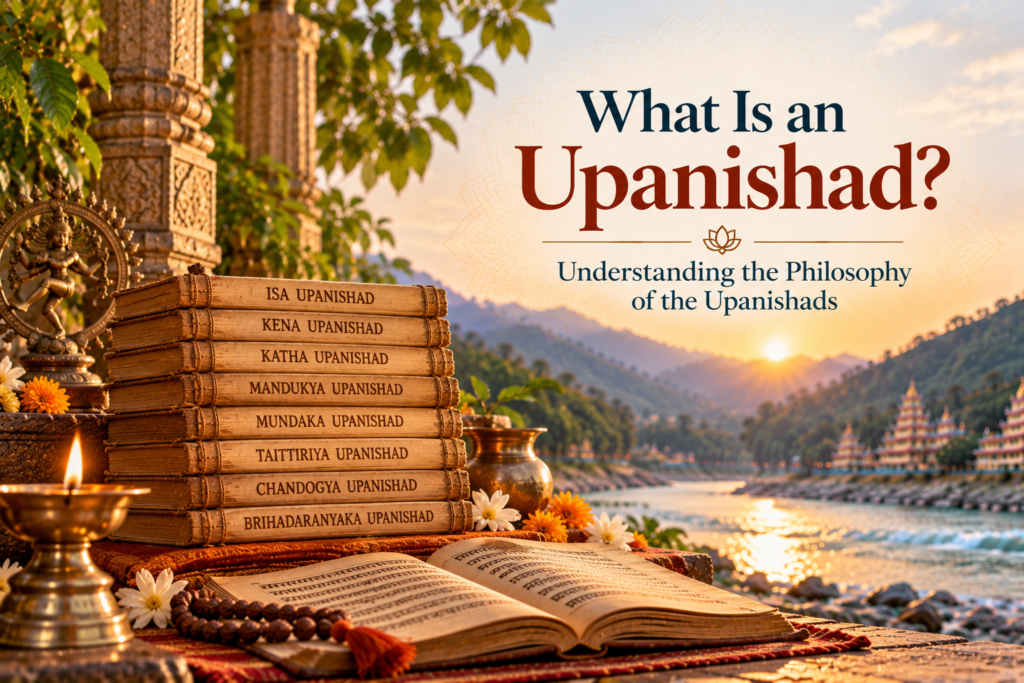
The Upanishads occupy a central place in Indian philosophy. They explore questions about the nature of the Self, the meaning of consciousness and the reality behind our everyday experiences. Their teachings have influenced Vedanta, yoga, meditation and several other Indian philosophical traditions.
The word Upanishad appears alongside terms such as Veda, Brahman, Atman and Vedanta. Understanding these connections helps explain why the Upanishads remain important to students of Indian philosophy and spiritual practice. Their teachings explore subjects such as knowledge, death, meditation, Om, karma, rebirth and liberation through dialogues, stories and contemplative instructions.
Traditionally, the Upanishads form the concluding portion of Vedic literature. This position explains their close relationship with Vedanta, which literally means “end of the Veda.” Over time, the Upanishads became foundational texts for several schools of Indian philosophy, each offering its own interpretation of their teachings.
For students of yoga, meditation, mantra and Nada Yoga, studying the Upanishads provides valuable context for understanding the philosophical ideas behind many familiar practices.
What does the word Upanishad mean?
The Sanskrit word Upanishad traditionally relates to the act of sitting near a teacher to receive deeper knowledge. This interpretation reflects the teaching methods found throughout the Upanishadic literature, where teachers guide students through questions, explanations and contemplation.
Traditional explanations connect the word with three Sanskrit elements: upa, meaning near; ni, meaning down; and shad, meaning to sit. Together, these elements produce the familiar interpretation of sitting close to a teacher for instruction.
The term also carries associations with knowledge that removes ignorance. This understanding highlights the transformative purpose of Upanishadic teaching, which encourages students to examine their assumptions and investigate the nature of reality.
Many Upanishads present their ideas through conversations. A student raises a question, the teacher responds, and further questions lead the discussion toward deeper philosophical understanding. Through this process, the texts explore subjects that require careful reflection and sustained inquiry.
Are the Upanishads part of the Vedas?
Yes. The Upanishads belong to the broader Vedic tradition and traditionally form the concluding portion of Vedic literature. Their position explains the connection between the Upanishads and Vedanta.
Traditional descriptions often organise Vedic literature into four broad categories:
Samhita → Brahmana → Aranyaka → Upanishad
The Samhitas contain collections of Vedic hymns and mantras. Brahmana texts explain ritual procedures and their significance, while Aranyakas explore symbolic interpretations of Vedic practices. The Upanishads turn attention increasingly toward philosophical questions concerning the Self, consciousness and ultimate reality.
This framework offers a useful introduction to Vedic literature, although individual Vedic branches developed their own textual arrangements. The categories also overlap in some traditions.
Why are the Upanishads important?
The Upanishads explore some of the most enduring questions in Indian philosophy. They examine the nature of the Self, the source of consciousness, the meaning of ultimate reality and the possibility of liberation.
Different texts approach these questions through different methods. Some use dialogues between teachers and students, while others present stories, analogies or instructions for meditation. Several Upanishads also explore the significance of Om and the relationship between Atman and Brahman.
This diversity gives the Upanishadic tradition its philosophical depth. Readers encounter different perspectives on knowledge, experience and liberation, creating opportunities for reflection across several schools of Indian thought.
What is Atman?
Atman is one of the central concepts in the Upanishads. The Sanskrit term often translates as “Self,” although its philosophical meaning extends beyond personality, social identity or an individual’s changing thoughts and emotions.
Many Upanishadic teachings encourage seekers to examine the difference between changing experiences and the deeper Self explored through philosophical inquiry. The body changes over time, thoughts arise and disappear, emotions shift, and memories develop. These observations lead to a deeper question: what is the nature of the awareness through which we experience these changes?
Different Upanishads approach this question in different ways. Their teachings later influenced several schools of Indian philosophy, particularly Vedanta, which developed detailed explanations of the relationship between Atman, Brahman and the world.
What is Brahman?
Brahman refers to ultimate reality in the philosophical traditions associated with the Upanishads and Vedanta. It represents a central subject of inquiry concerning the nature of existence and the foundation of reality.
Readers should distinguish Brahman from Brahma, the deity associated with creation in Hindu traditions. Although the names share a linguistic relationship, they refer to different concepts.
The Upanishads describe Brahman through several approaches. Some teachings emphasise the limits of ordinary language when discussing ultimate reality, while others use expressions such as Sat, Chit and Ananda, commonly translated as existence, consciousness and bliss.
The Taittiriya Upanishad offers another well-known description through the phrase Satyam Jnanam Anantam Brahma, which expresses Brahman through truth, knowledge and infinity. These teachings illustrate the variety of ways Upanishadic texts explore ultimate reality.
Atman and Brahman: Understanding the relationship
The relationship between Atman and Brahman became one of the major subjects of Vedantic philosophy. Several famous statements, known as Mahavakyas or “great statements,” express key ideas within the Upanishadic tradition.
Prajnanam Brahma
Prajnanam Brahma means “Consciousness is Brahman.” The Aitareya Upanishad contains this statement, which directs attention toward consciousness as a fundamental aspect of reality.
Aham Brahmasmi
Aham Brahmasmi means “I am Brahman.” The Brihadaranyaka Upanishad contains this statement, which became especially important in Advaita Vedanta. Within that philosophical tradition, it expresses the essential identity of the Self and ultimate reality.
Tat Tvam Asi
Tat Tvam Asi means “That thou art,” often expressed in modern English as “You are That.” The Chandogya Upanishad presents this teaching repeatedly through a dialogue between the teacher Uddalaka and his son Shvetaketu.
The teaching encourages Shvetaketu to investigate the relationship between individual existence and the deeper reality referred to as “That.”
Ayam Atma Brahma
Ayam Atma Brahma means “This Self is Brahman.” The Mandukya Upanishad contains this Mahavakya, which connects the inquiry into Atman with the philosophical understanding of Brahman.
Together, these four Mahavakyas became particularly influential within Vedanta. Different schools interpret their meaning according to their own philosophical positions.
What are the principal Upanishads?
The Upanishadic tradition contains a large number of texts, and different lists identify different groups as principal or major Upanishads. A widely recognised group includes the following texts:
- Isha Upanishad
- Kena Upanishad
- Katha Upanishad
- Prashna Upanishad
- Mundaka Upanishad
- Mandukya Upanishad
- Taittiriya Upanishad
- Aitareya Upanishad
- Chandogya Upanishad
- Brihadaranyaka Upanishad
- Shvetashvatara Upanishad
These texts explore a wide range of philosophical subjects, from the nature of consciousness to the relationship between action, knowledge and liberation. Their writing styles also vary, with some using concise verses and others presenting extended dialogues.
The following examples introduce several well-known Upanishads and their central themes.
The Isha Upanishad
The Isha Upanishad is a short text associated with the Shukla Yajurveda. Its opening words, Īśāvāsyam idaṃ sarvam, introduce a teaching concerning the presence of the divine throughout the universe.
The text explores action, renunciation, knowledge and the relationship between the individual and the whole. Its concise verses invite readers to consider how a person can engage with life while developing a deeper understanding of reality.
Because of its compact form and philosophical depth, the Isha Upanishad often serves as an introduction to Upanishadic thought.
The Kena Upanishad
The Kena Upanishad begins with a question about the force that directs the mind toward its objects. It asks what enables the mind, speech, sight and hearing to function.
Through this inquiry, the text directs attention toward the source behind ordinary perception and cognition. It encourages the seeker to investigate the principle that makes experience possible, even as the senses and mind attempt to understand the world.
The Kena Upanishad therefore offers a valuable exploration of consciousness and the limits of ordinary knowledge.
The Katha Upanishad
The Katha Upanishad presents a famous dialogue between a young boy named Nachiketa and Yama, the Lord of Death. Nachiketa seeks answers about death and the possibility of a reality beyond mortality, choosing these questions over ordinary rewards.
Yama teaches him about the Self, spiritual discipline and the path toward knowledge. Their conversation explores the difference between immediate desires and the pursuit of lasting understanding.
The text also contains the well-known chariot analogy. It compares the body to a chariot, the senses to horses, the mind to the reins and the intellect to the charioteer. The analogy illustrates the importance of guiding the senses and mind through disciplined awareness.
The Mundaka Upanishad
The Mundaka Upanishad distinguishes between different forms of knowledge and directs the seeker toward knowledge of Brahman. Its teachings explore the nature of reality and the relationship between knowledge and liberation.
One of its best-known images describes two birds sitting on the same tree. One bird eats the fruits, while the other watches. Vedantic traditions have interpreted this image in different ways, often relating the experiencing individual to the witnessing Self.
The Mundaka Upanishad also contains the phrase Satyameva Jayate, meaning “Truth alone triumphs.” India adopted this phrase as its national motto, giving the ancient statement a prominent place in modern public life.
The Mandukya Upanishad
The Mandukya Upanishad is among the shortest principal Upanishads, yet it has had a major influence on Vedantic philosophy. Its central subject is Om and its relationship with four states of consciousness.
The text discusses waking, dreaming, deep sleep and Turiya, meaning “the fourth.” The first three states describe familiar forms of experience, while Turiya points toward a deeper principle explored through the Upanishad’s philosophical framework.
This teaching makes the Mandukya Upanishad especially relevant to readers interested in consciousness, meditation and the significance of Om. Its concise presentation also encourages careful study and reflection.
The Taittiriya Upanishad
The Taittiriya Upanishad belongs to the Krishna Yajurveda tradition. It explores Brahman, bliss, knowledge and the five koshas, traditionally described as sheaths or layers of human experience.
These five koshas are:
- Annamaya Kosha
- Pranamaya Kosha
- Manomaya Kosha
- Vijnanamaya Kosha
- Anandamaya Kosha
The kosha teaching offers a framework for examining progressively subtler aspects of experience. Yoga traditions have drawn on this model in different ways when discussing the relationship between the body, breath, mind, discernment and bliss.
The Taittiriya Upanishad also contains the Ananda Valli, which explores bliss and the nature of Brahman. These teachings have made the text important in discussions of Indian philosophy and contemplative practice.
The Chandogya Upanishad
The Chandogya Upanishad belongs to the Samaveda tradition and contains numerous teachings concerning reality, meditation, Om, ethics and the Self.
Its most famous teaching is Tat Tvam Asi, which Uddalaka gives to his son Shvetaketu through a series of examples and explanations. The dialogue encourages Shvetaketu to look beyond surface appearances and investigate the deeper reality underlying existence.
The Chandogya Upanishad also holds particular interest for students of sound because of its relationship with the Samaveda. Its teachings provide a broader philosophical context for exploring chanting, meditation and the meaning of sacred syllables.
The Brihadaranyaka Upanishad
The Brihadaranyaka Upanishad is one of the largest and most philosophically significant Upanishads. Its name is commonly translated as “the Great Forest Upanishad.”
The text includes dialogues involving Yajnavalkya, Gargi and Maitreyi. Through these discussions, it examines Atman, Brahman, consciousness, death, knowledge and liberation.
The Brihadaranyaka Upanishad contains the Mahavakya Aham Brahmasmi, meaning “I am Brahman.” It also presents the teaching Neti Neti, meaning “not this, not this,” which later philosophical traditions use to discuss the limits of describing ultimate reality through ordinary concepts.
The Shvetashvatara Upanishad
The Shvetashvatara Upanishad combines philosophical inquiry with a strong devotional and theistic orientation. It explores Brahman, the Self, nature, consciousness and the divine.
The text includes important references to Rudra, who holds a close relationship with Shiva in later Hindu traditions. These teachings make the Shvetashvatara Upanishad especially interesting for readers exploring the connections between philosophical reflection and devotion.
Its approach illustrates the range of perspectives within the Upanishadic tradition.
Are the Upanishads about yoga?
Several Upanishads discuss meditation, concentration, breath and contemplative practice. The principal Upanishads also provide philosophical foundations that later influenced different yoga traditions.
Alongside the major early Upanishads, a later group known as the Yoga Upanishads focuses specifically on yogic subjects. Examples include the Yoga Tattva Upanishad, Nada-Bindu Upanishad, Dhyana-Bindu Upanishad, Hamsa Upanishad and Amrita-Bindu Upanishad.
These texts belong to a broader Upanishadic corpus that developed over time. When studying the Upanishads, it helps to distinguish the principal early texts from later Yoga, Shaiva, Vaishnava, Shakta and other Upanishadic works.
This distinction gives readers a clearer understanding of the historical development of Indian philosophical and contemplative literature.
The Upanishads and Om
Om occupies an important place in several Upanishadic teachings. The Mandukya Upanishad provides one of the clearest examples by examining Om as a symbol connected with consciousness and its different states.
The syllable also appears at the beginning or end of many traditional Sanskrit recitations. Practitioners use Om in prayer, chanting and meditation, while philosophical texts explore its deeper significance.
For Nada Yoga practitioners, these teachings provide a foundation for contemplating sound. A person may approach Om through vocal chanting, attentive listening or silent meditation, depending on the practice and tradition.
The Upanishadic treatment of Om demonstrates how sacred sound can carry philosophical meaning alongside its place in ritual and prayer.
The Upanishads and Nada Yoga
The relationship between the Upanishads and Nada Yoga develops through several strands of Indian thought. Vedic traditions place great importance on sound, pronunciation, meter and chanting, while the Samaveda offers a particularly important context for melodic Vedic recitation.
Later Upanishadic traditions explore the relationship between sound, consciousness and meditation in different ways. The Nada-Bindu Upanishad, for example, focuses on Nada-oriented meditation and includes teachings associated with inner sound.
These connections make the Upanishadic tradition relevant to anyone studying mantra, attentive listening and contemplative practice. They also show how different texts developed distinct approaches to sound and spiritual inquiry.
At Nada Yoga teacher training in Rishikesh, students can explore these themes through Sanskrit chanting, mantra, Indian classical music, meditation and Nada Yoga practices. Learning about the Upanishads helps place these activities within the wider history of Indian philosophy.
What is Vedanta?
Vedanta literally means “end of the Veda.” The term traditionally refers to the Upanishads as the concluding portion of Vedic literature and also names philosophical systems that developed around their teachings.
Three major Vedanta traditions are Advaita Vedanta, associated especially with Adi Shankaracharya; Vishishtadvaita, associated with Ramanuja; and Dvaita, associated with Madhva.
These schools offer different explanations of the relationship between Brahman, Atman and the world. Advaita emphasises non-duality, Vishishtadvaita presents a qualified non-dual understanding, and Dvaita maintains a distinction between the individual soul and the supreme reality.
The Upanishads therefore serve as foundational texts for several philosophical traditions. Their teachings continue to inspire discussion, interpretation and study across different schools of Vedanta.
Shruti and the Upanishads
The Upanishads belong to Shruti, the category of Hindu sacred literature traditionally understood as “that which is heard.” This classification places them within the same broad sacred tradition as the Vedas.
By contrast, the Ramayana, Mahabharata and Puranas generally belong to Smriti, meaning “that which is remembered.” These bodies of literature preserve religious narratives, philosophical teachings and cultural traditions through different literary forms.
The distinction between Shruti and Smriti helps explain the place of the Upanishads within Indian sacred literature. It also gives readers a useful starting point for understanding the different genres that shaped Hindu philosophy and devotional practice.
How should someone begin studying the Upanishads?
The Upanishads can feel abstract when readers approach them as philosophy alone. A helpful starting point is to choose one text and follow its central question.
The Katha Upanishad offers an engaging introduction to death, the Self and spiritual discipline through the story of Nachiketa. Readers interested in Om and consciousness may begin with the Mandukya Upanishad, while the Isha Upanishad provides a concise exploration of action and renunciation. The Taittiriya Upanishad offers another starting point for studying the koshas, bliss and Brahman.
Reading a reliable translation alongside Sanskrit text or transliteration can add another dimension to the experience. Readers who study the original language may also benefit from learning pronunciation and the meaning of key Sanskrit terms.
Above all, the Upanishads invite contemplation. Their teachings encourage readers to examine questions carefully, revisit important passages and consider how the ideas relate to their own understanding.
The Upanishads and self-inquiry
Self-inquiry forms an important part of several Upanishadic teachings. The seeker begins by examining familiar ideas about identity and gradually investigates the nature of the Self.
For example, a person may identify closely with the body, thoughts or emotions. Careful reflection reveals that the body changes, thoughts come and go, and emotions arise and pass. This observation leads to a deeper question: who is aware of these changing experiences?
Different Upanishads approach this inquiry through distinct teachings and methods. Advaita Vedanta later developed detailed philosophical approaches to investigating the Self and understanding its relationship with Brahman.
Within these traditions, self-inquiry serves a deeper purpose than intellectual curiosity. The pursuit of knowledge connects with liberation from ignorance, although different schools explain liberation and the nature of the Self in different ways.
What is the main teaching of the Upanishads?
The Upanishads contain a diverse range of teachings, so no single statement represents every text or philosophical school. Nevertheless, several recurring questions appear throughout the tradition.
These include the nature of Atman, the meaning of Brahman, the relationship between individual existence and ultimate reality, and the role of knowledge in overcoming ignorance. Many Upanishads also examine consciousness, meditation and the possibility of liberation.
Different texts approach these subjects through dialogues, metaphors, sacred syllables and philosophical arguments. Their varied approaches helped shape the later development of Vedanta and other Indian contemplative traditions.
Frequently asked questions
What is an Upanishad?
An Upanishad is a philosophical and contemplative text belonging to the Vedic tradition. These texts explore subjects such as Atman, Brahman, consciousness, knowledge and liberation.
How many Upanishads are there?
Traditional lists vary. The Muktika tradition identifies 108 Upanishads, while scholars and other traditional classifications distinguish different groups as principal or major Upanishads.
Are the Upanishads part of the Vedas?
Yes. The Upanishads belong to the broader Vedic tradition and traditionally form the concluding portion of Vedic literature.
What does Upanishad mean?
Traditional explanations associate the word with sitting near a teacher to receive deeper instruction. The term also carries associations with profound or liberating knowledge.
What is the difference between a Veda and an Upanishad?
The Vedas refer to the larger Vedic corpus and tradition. The Upanishads form a philosophical and contemplative part of that tradition, focusing on questions about the Self, ultimate reality and liberation.
What is the connection between the Upanishads and Vedanta?
Vedanta means “end of the Veda” and traditionally refers to the Upanishads as the concluding portion of Vedic literature. The term also describes philosophical systems based on the Upanishads, the Bhagavad Gita and the Brahma Sutras.
Which Upanishad is best for beginners?
The Katha, Isha, Mandukya and Taittiriya Upanishads each offer a useful starting point. The best choice depends on whether the reader wants to explore the Self, consciousness, Om, the koshas or philosophical questions about action and knowledge.
Which Upanishad is connected with Nada Yoga?
The Nada-Bindu Upanishad has a particular connection with Nada-oriented meditation and inner sound. It belongs to the broader group of Yoga Upanishads.
Final thoughts
The Upanishads represent a profound philosophical dimension of the Vedic tradition. Their teachings explore Atman, Brahman, consciousness, knowledge, meditation and liberation through dialogues, stories, metaphors and contemplative instructions.
Each text offers a different way to approach these subjects. The Katha Upanishad examines death through the story of Nachiketa, while the Mandukya explores Om and consciousness. The Taittiriya discusses the koshas and bliss, the Chandogya presents Tat Tvam Asi, and the Brihadaranyaka contains Aham Brahmasmi and Neti Neti.
For students of yoga and Nada Yoga, these texts provide valuable philosophical context for studying mantra, sound and meditation. Their central questions also continue to invite reflection on the nature of experience and the Self.
Ultimately, the Upanishads encourage readers to look closely at what they take for granted and investigate the awareness that underlies their changing experiences.