There are moments when confidence feels natural. You make a decision, take action, and trust yourself enough to move forward. At other times, even simple choices can feel difficult. You may hesitate, lose motivation, or feel disconnected from your sense of direction.
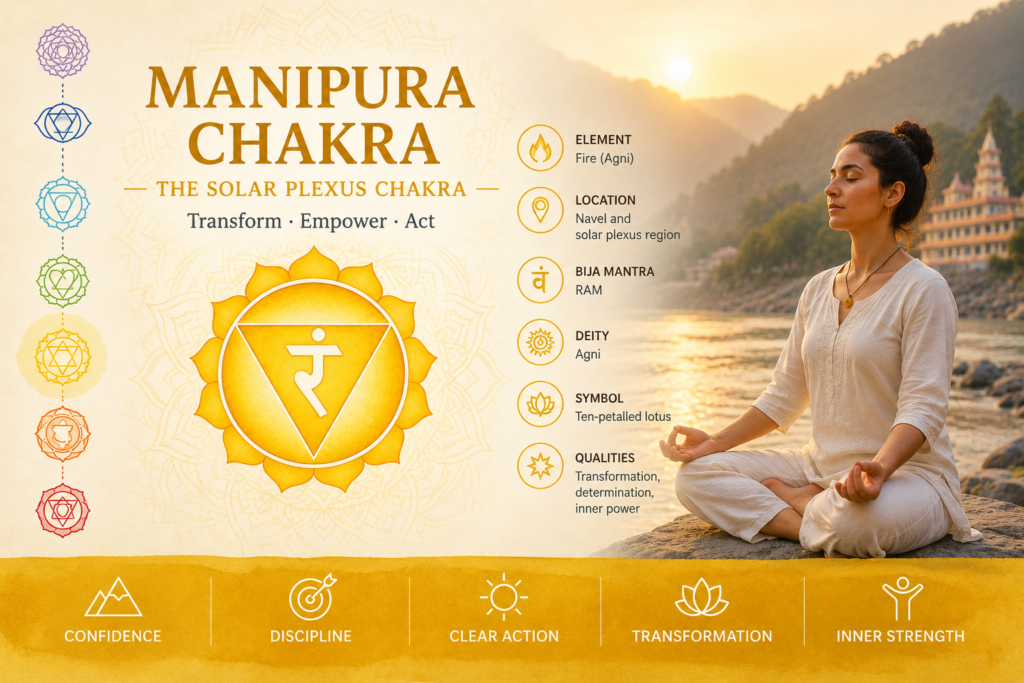
In the traditional chakra system, these experiences connect with Manipura Chakra, the third of the seven major chakras. Located around the navel and solar plexus region, Manipura relates to the element of fire and carries themes of transformation, determination, personal strength, and purposeful action.
Yoga traditions use the chakra system as a framework for understanding subtle aspects of human experience. Within this framework, Manipura represents the inner fire that supports digestion, transformation, discipline, and the ability to act with clarity.
Practices such as yoga asana, pranayama, meditation, mantra, and Nada Yoga can provide ways to explore these qualities through direct experience.
What is Manipura Chakra?
Manipura Chakra is traditionally described as the third chakra in the seven-chakra system. The word Manipura comes from Sanskrit and is commonly translated as “city of jewels” or “abode of jewels.”
Traditional yogic teachings place Manipura in the region of the navel and solar plexus. Its position between the lower chakras and the heart chakra gives it an important place within the traditional chakra system.
The first chakra relates to grounding and stability, while the second relates to movement, emotion, and creativity. Manipura introduces transformation and directed action.
This makes Manipura especially relevant to themes such as willpower, discipline, confidence, motivation, and personal responsibility.
Manipura Chakra at a glance
| Aspect | Traditional understanding |
|---|---|
| Name | Maṇipūra Chakra |
| Meaning | City of jewels, abode of jewels |
| Position | Third chakra |
| Location | Navel and solar plexus region |
| Element | Fire, Agni |
| Quality | Transformation, inner power, determination |
| Symbol | Ten-petalled lotus |
| Bija mantra | RAM |
| Deity | Agni |
| When balanced | Confidence, clarity, determination, healthy discipline, purposeful action |
| When imbalanced | Anger, excessive control, low confidence, indecision, lack of motivation |
These qualities belong to the traditional subtle-body framework of yoga. The chakra system provides a contemplative map for practice and self-observation.
What does Manipura mean?
The Sanskrit name Maṇipūra combines maṇi, meaning jewel, with pūra, meaning city or fullness. The name therefore carries the imagery of a place filled with jewels.
This symbolism points to the value and potential of inner strength. Just as a jewel has brightness and clarity, Manipura represents qualities that can bring greater direction and purpose to one’s actions.
The chakra also connects with the idea of Agni, the traditional principle of fire. In yoga and Ayurveda, fire carries associations with transformation and digestion. On a subtler level, the same imagery describes the capacity to process experiences, develop discipline, and transform intention into action.
Where is the Solar Plexus Chakra located?
Traditional chakra teachings place Manipura around the navel and solar plexus region.
The exact descriptions can vary between yoga and tantra traditions. For meditation, practitioners commonly bring their awareness toward the area around the navel or upper abdomen.
This region also plays an important role in many yoga practices. Core engagement, twists, forward folds, and pranayama can naturally bring attention toward the abdomen.
When practicing, awareness matters more than trying to locate the chakra as a physical structure. The chakra belongs to the traditional subtle-body model used in yogic practice.
Manipura and the fire element
Each of the traditional chakras connects with one of the five great elements. Manipura corresponds with fire, or Agni.
Fire transforms. It changes one substance into another and provides warmth and energy. Yogic traditions use this quality as a symbolic way to understand Manipura.
The fire of Manipura can represent:
- determination
- transformation
- discipline
- clarity
- purposeful action
- inner strength
This symbolism also connects Manipura with the process of turning intention into action.
For example, deciding to establish a daily meditation practice requires intention. Continuing that practice requires discipline. Manipura represents the inner quality that helps carry intention into consistent action.
What does Manipura Chakra represent?
Manipura traditionally relates to personal power and purposeful action.
Personal power here refers to the ability to make conscious choices and take responsibility for one’s actions. It involves developing confidence while maintaining awareness of how one’s actions affect others.
A healthy sense of personal power can support clear decision-making. It can also help a person stay committed to meaningful practices when motivation changes.
At the same time, traditional teachings associate an excessive expression of Manipura with qualities such as anger, aggression, domination, and excessive control.
The practice therefore involves developing strength with awareness.
The symbolism of Manipura Chakra
Manipura has a ten-petalled lotus as its traditional symbol. The lotus appears throughout yogic symbolism and represents the unfolding of consciousness through practice.
The fire element forms another important part of Manipura symbolism. Its imagery reflects heat, transformation, energy, and purification.
The bija mantra RAM also belongs to this chakra in traditional practice.
When used during meditation or mantra practice, RAM provides a sound focus for attention. Practitioners can combine the mantra with awareness of the navel region and steady breathing.
Manipura and the seven chakras
Manipura occupies the third position in the traditional seven-chakra system.
The sequence begins with:
- Muladhara, associated with grounding and stability
- Svadhisthana, associated with flow, emotion, and creativity
- Manipura, associated with transformation and inner power
- Anahata, associated with the heart and compassion
- Vishuddha, associated with expression and communication
- Ajna, associated with inner awareness
- Sahasrara, associated with spiritual awareness
This progression provides a framework for contemplative practice. Each chakra carries its own symbolism, qualities, practices, and traditional associations.
Signs of balanced Manipura
Within the traditional chakra framework, balanced Manipura expresses through a steady sense of confidence and direction.
A person may find it easier to make decisions and follow through with commitments. They can also develop discipline while remaining flexible when circumstances change.
Traditional descriptions of balanced Manipura include:
- healthy confidence
- determination
- clear decision-making
- purposeful action
- steady motivation
- personal responsibility
- disciplined effort
These qualities can become useful during yoga practice as well. Holding a challenging posture requires focus and effort. Maintaining a regular practice requires commitment.
Manipura can therefore serve as a useful contemplative theme when working with discipline and personal direction.
Signs of imbalanced Manipura
Traditional yoga teachings describe several patterns that can arise when Manipura becomes excessive or deficient.
An excess may express through anger, aggression, the need for control, or an intense desire to dominate situations. A deficiency may appear as low confidence, indecision, passivity, or difficulty taking action.
Common traditional associations include:
- lack of confidence
- difficulty making decisions
- low motivation
- excessive anger
- controlling behaviour
- frustration
- difficulty following through
These descriptions belong to the traditional chakra model. They can serve as prompts for self-reflection during practice.
Yoga poses for Manipura Chakra
Yoga asana can help develop awareness around the abdomen, breath, posture, and physical effort. Several postures are commonly used when exploring Manipura-related themes.
Navasana
Navasana, or Boat Pose, engages the abdominal region and requires concentration and steady effort.
Stay aware of the breath while holding the posture. The aim is to develop steadiness rather than force.
Dhanurasana
Dhanurasana, or Bow Pose, creates a strong opening through the front body while engaging the back and abdominal regions.
Practice gradually and respect the natural range of your body.
Parivrtta Trikonasana
Revolved Triangle Pose introduces a twisting movement that brings awareness toward the torso and abdominal region.
Keep the breath smooth as you move into the twist.
Ustrasana
Ustrasana, or Camel Pose, opens the front of the body and requires stability through the legs and core.
Approach the posture progressively and maintain steady breathing.
Phalakasana
Phalakasana, or Plank Pose, develops physical steadiness and focused effort.
It can work well as a simple practice for observing how the mind responds to sustained effort.
Pranayama and Manipura
Breath practices can provide another way to explore the qualities traditionally connected with Manipura.
Practices that involve conscious abdominal movement can bring awareness toward the navel region. Kapalabhati and Bhastrika are traditionally associated with heat and energetic activation, although they require appropriate instruction and preparation.
Beginners should learn stronger pranayama techniques from a qualified teacher. A gentle, steady breathing practice can provide a suitable starting point for developing awareness.
The purpose of pranayama extends beyond creating physical heat. Breath awareness can also help practitioners observe effort, attention, and mental response.
Manipura meditation
A simple Manipura meditation can begin with a comfortable seated position.
Close the eyes and allow the breath to settle. Bring gentle attention toward the area around the navel and upper abdomen.
Observe the natural movement of the breath. Then introduce the traditional bija mantra RAM.
You can repeat RAM silently or chant it aloud at a comfortable pace. Allow the sound and breath to become the main focus of attention.
Continue for several minutes. When the practice ends, sit quietly for a short period and observe how the body and mind feel.
This practice works as an exercise in concentration and self-observation.
RAM mantra and Manipura
The bija mantra associated with Manipura is RAM.
In traditional chakra practice, bija mantras provide a concentrated sound focus for meditation. The sound can be repeated with awareness of the corresponding chakra region and its traditional qualities.
For a simple practice, sit comfortably and take several slow breaths. Then chant:
RAM
Allow the sound to complete naturally before taking the next breath. Continue for several rounds.
The quality of the voice also matters. A steady, comfortable tone can make the practice easier to sustain.
Manipura and Nada Yoga
Sound provides another way to approach chakra practice.
Nada Yoga explores awareness through sound, including mantra, voice, music, and attentive listening. When combined with Manipura-focused meditation, sound can provide a steady object for concentration.
The practice can begin with the RAM mantra. As you repeat it, notice the vibration of the voice, the movement of the breath, and the sensations around the body.
Over time, the focus can move from producing the sound toward listening carefully to it.
This approach fits naturally within the broader principles of Nada Yoga, where attentive listening plays an important role in meditation and self-awareness.
Manipura and personal confidence
Confidence develops through experience, reflection, and consistent action.
The traditional Manipura framework offers a useful way to contemplate this process. Instead of viewing confidence only as a mental quality, practitioners can explore how confidence appears through posture, breathing, decision-making, and action.
For example, maintaining a regular yoga practice requires a series of small decisions. You choose to practice, stay with the posture, observe discomfort, and return to the breath.
These experiences can strengthen awareness of personal effort and responsibility.
Manipura and discipline
Discipline is another central theme associated with Manipura.
Yoga practice often requires consistency. Some days feel energetic, while others feel heavy or distracted. Returning to practice develops familiarity with steady effort.
This principle also appears in traditional yogic teachings through tapas, commonly translated as disciplined effort or austerity.
Tapas and Manipura share an important connection through the symbolism of fire. The practitioner uses disciplined effort to support transformation.
A sustainable practice can begin with a realistic commitment. Even a short daily practice can provide a foundation for developing consistency.
Manipura and digestion in traditional yoga
The fire element gives Manipura a traditional connection with digestion and transformation.
Yogic and Ayurvedic traditions use the concept of Agni to describe digestive and transformative processes. The chakra system extends this fire imagery into a subtler framework involving energy, discipline, and personal transformation.
Modern medical understanding of digestion operates through established physiological processes. Chakra descriptions belong to a traditional yogic model and should be understood within that context.
This distinction allows practitioners to appreciate the symbolism while keeping physical health discussions grounded in appropriate medical knowledge.
How to work with Manipura in daily life
Manipura practice can extend beyond the yoga mat.
Start by observing how you respond to decisions. Notice moments when you hesitate, become frustrated, or try to control an outcome.
Then bring attention to the breath and ask yourself what action feels clear and appropriate.
You can also choose one small commitment each day and follow through with it. This creates an opportunity to observe discipline in a practical setting.
Over time, these simple practices can make the traditional qualities of Manipura more meaningful because you experience them through daily life.
A simple Manipura practice
You can combine movement, breath, mantra, and meditation in a short practice.
Begin with a few minutes of gentle movement. Continue with a comfortable seated posture and observe your natural breathing.
Next, bring awareness toward the navel region. Take several steady breaths and gradually introduce the RAM mantra.
After several repetitions, allow the mantra to become quieter. Sit in silence and observe the remaining sensations.
Finish by returning attention to the whole body.
Regular practice can help you develop a deeper relationship with the qualities traditionally connected with Manipura, especially discipline, clarity, and purposeful action.
Manipura Chakra and sound healing
Sound healing practices can also provide an avenue for focused listening and relaxation. Singing bowls, voice, mantra, and other sound-based practices can create sustained auditory experiences that support attention.
When working with Manipura, mantra provides the clearest traditional connection because RAM belongs directly to the chakra’s traditional sound system.
A sound practice can therefore focus on chanting RAM while observing breath and bodily sensation. The experience can remain simple, attentive, and grounded.
For students exploring sound healing practice in Rishikesh alongside yoga, this practice also offers an opportunity to understand how sound, breath, attention, and meditation can work together.
Understanding Manipura through yoga practice
Manipura represents an important stage in the traditional chakra journey.
The practice begins with awareness of grounding and stability through Muladhara. Svadhisthana introduces movement, emotion, and creativity. Manipura then brings attention toward transformation, discipline, and purposeful action.
These themes can become especially relevant as a practitioner develops a consistent yoga and meditation practice.
Working with Manipura does not require forcing confidence or trying to create a particular emotional state. Instead, practice can create space to observe how effort, decision-making, breath, and awareness interact.
Through asana, pranayama, mantra, meditation, and Nada Yoga, the symbolic qualities of Manipura can become practical subjects for self-observation.
Frequently asked questions about Manipura Chakra
What is Manipura Chakra?
Manipura is the third chakra in the traditional seven-chakra system. It is associated with the navel and solar plexus region, the fire element, transformation, determination, and inner power.
What does Manipura mean?
Manipura is commonly translated as “city of jewels” or “abode of jewels.” The name reflects the traditional symbolism of inner value, radiance, and transformative power.
What element is associated with Manipura?
Manipura traditionally corresponds with fire, or Agni.
What is the Manipura Chakra mantra?
The traditional bija mantra for Manipura is RAM.
Where is Manipura Chakra located?
Traditional teachings place Manipura around the navel and solar plexus region.
Which yoga poses are associated with Manipura?
Navasana, Dhanurasana, Parivrtta Trikonasana, Ustrasana, and Phalakasana can all provide useful opportunities to explore awareness around the abdomen, effort, and stability.
What happens when Manipura is balanced?
Within the traditional chakra framework, balanced Manipura relates to confidence, determination, clarity, discipline, and purposeful action.
How can I practice Manipura meditation?
Sit comfortably, bring awareness toward the navel region, and use the RAM mantra as a focus. Keep the breath steady and finish with a period of quiet observation.
Continuing the seven chakra journey
Manipura introduces the qualities of fire, transformation, discipline, and inner strength within the traditional chakra system. Its practices encourage us to examine how we use effort, make decisions, and respond to challenges.
The next chakra in the series is Anahata Chakra, the heart chakra. Its traditional themes include compassion, connection, balance, and openness, bringing the journey from personal power toward the qualities of the heart.