Yoga has developed through centuries of philosophical inquiry, spiritual practice and practical experimentation. Its history can be traced through a remarkable collection of Sanskrit texts, from the ancient Vedas and Upanishads to the Yoga Sutras of Patanjali and the medieval manuals that describe Hatha Yoga. Each work reflects the questions and practices of its period, helping us understand how yoga evolved into the many traditions studied today.
For students of traditional yoga, these texts provide valuable insight into the relationship between philosophy, meditation, breath, sound and physical discipline. However, understanding their chronology requires care because many teachings circulated orally before being recorded in written form. Scholars also disagree about the dates of several works, and some texts developed over long periods. The following timeline therefore uses approximate historical ranges and distinguishes the age of a tradition from the likely period of a surviving text.
Understanding the historical timeline of yoga
The history of yoga texts begins long before modern yoga classes placed such emphasis on physical postures. Early sources discuss sacred recitation, ritual, contemplation and knowledge of the Self. Later works develop systematic approaches to meditation, ethical discipline, breath control and liberation, while medieval texts describe specialized physical and subtle-body practices.
These developments overlap. A later text may preserve older teachings, and different yoga traditions have developed alongside one another rather than following a single, uniform path. Studying the texts in chronological order provides a useful foundation, although their ideas become clearer when each work is understood within its own philosophical and cultural setting.
1. The Vedas: The earliest textual foundations
Approximate period: c. 1500–500 BCE, across different layers of Vedic literature
The Vedas are among the oldest surviving sources of Indian religious and philosophical thought. They comprise four collections: the Rigveda, Samaveda, Yajurveda and Atharvaveda. Their composition and compilation took place across different periods, and their teachings were transmitted orally through highly developed traditions of recitation.
The Rigveda contains hymns addressed to deities and reflections on cosmic order, ritual and the relationship between human beings and the universe. The Samaveda arranges verses for musical chanting, while the Yajurveda provides formulas associated with ritual performance. The Atharvaveda contains hymns, prayers and other material connected with healing, protection and everyday concerns.
These works provide important context for understanding the later development of yoga. Vedic traditions cultivated disciplined recitation, focused attention and careful control of pronunciation, all of which became significant in the wider history of Indian spiritual practice. The Samaveda also offers a particularly relevant connection for students interested in sacred sound and Indian musical traditions.
The Vedas do not present one unified system of yoga in the form familiar from later manuals. Instead, they form part of the broader intellectual and spiritual environment from which several later approaches to contemplation and liberation developed.
2. The early Upanishads: Exploring the Self and ultimate reality
Approximate period: c. 800–300 BCE
The Upanishads mark an important development in Indian philosophical thought. These texts investigate questions about the Self, consciousness, ultimate reality, death, knowledge and liberation. Their teachings gradually shift attention toward deeper inquiry into the nature of existence and the relationship between individual experience and the underlying reality of the universe.
The Brihadaranyaka and Chandogya Upanishads are among the earliest and most influential examples. Their discussions introduce ideas that later become central to Vedanta, including Atman, Brahman and the search for liberating knowledge. The Katha Upanishad presents a particularly important account of yoga through its dialogue between Nachiketa and Yama, including a chariot analogy that explains the need to guide the senses and mind.
The Katha Upanishad compares the body to a chariot, the senses to horses and the mind to the reins. The image illustrates the importance of discernment and self-discipline in directing human experience. It also presents yoga in relation to the mastery of the mind and the realization of a deeper truth.
For students of yoga philosophy, the Upanishads provide an essential starting point for exploring meditation, self-inquiry and liberation. Their influence can be seen in later traditions, including Vedanta and several forms of contemplative yoga.
3. The Bhagavad Gita: Yoga as a way of living
Approximate period: c. 400 BCE–200 CE
The Bhagavad Gita is part of the Mahabharata and presents a dialogue between Krishna and Arjuna on the battlefield of Kurukshetra. Faced with a profound moral crisis, Arjuna seeks guidance about duty, action and the meaning of life. Krishna responds with teachings that connect spiritual understanding with the responsibilities of everyday existence.
The Gita describes several paths of yoga, including Karma Yoga, Bhakti Yoga, Jnana Yoga and meditation. Karma Yoga emphasizes disciplined action and freedom from attachment to results. Bhakti Yoga develops devotion, while Jnana Yoga emphasizes knowledge and discernment. Meditation receives its own detailed treatment, including guidance on posture, attention and mental steadiness.
One of the Gita’s lasting contributions is its presentation of yoga as a discipline that can be integrated into ordinary life. Spiritual growth can involve action, devotion, knowledge and meditation, with each approach offering a different way to cultivate understanding and self-mastery.
The text remains a major source for contemporary yoga philosophy because it addresses ethical choices, mental discipline and the relationship between personal responsibility and spiritual freedom.
4. The Yoga Sutras of Patanjali: A systematic framework for yoga
Approximate period: commonly placed around the early centuries CE, with many scholars favouring c. 350–450 CE
The Yoga Sutras of Patanjali are among the most influential texts in the history of classical Yoga. The work organizes yoga into concise aphorisms that address the mind, ethical conduct, concentration, meditation and liberation. Its precise date remains debated, although modern scholarship often places the text around the fourth or fifth century CE.
The opening definition, Yogaś citta-vṛtti-nirodhaḥ, is commonly translated as the stilling or restraint of the fluctuations of the mind. This definition places mental discipline at the centre of the text. Patanjali explains how the mind can become less distracted through sustained practice, discernment and detachment.
The Yoga Sutras present the eight limbs of yoga, known as Ashtanga Yoga. These include Yama, Niyama, Asana, Pranayama, Pratyahara, Dharana, Dhyana and Samadhi. Together, they describe a path involving ethical principles, physical posture, breath regulation, concentration and meditation.
The text also explores the obstacles that affect the mind, the role of meditation and the distinction between consciousness and the processes of mental experience. Its systematic approach has shaped many later interpretations of yoga, especially traditions that emphasize meditation and philosophical study.
For students undertaking traditional yoga teacher training, the Yoga Sutras provide an important foundation for understanding yoga beyond physical postures. They also offer a framework for studying discipline, attention and the purpose of practice.
5. The Yoga Bhashya: An influential commentary on Patanjali
Approximate period: c. 4th–5th century CE
The Yoga Bhashya is a major commentary associated with the Yoga Sutras and traditionally attributed to Vyasa. It explains Patanjali’s concise aphorisms through more detailed discussions of philosophical concepts and meditative practice. The commentary became an important part of the classical tradition through which later scholars interpreted the Yoga Sutras.
Its explanations help clarify the relationship between the mind, consciousness, practice and liberation. The text also reflects the philosophical environment in which classical Yoga developed, including its engagement with ideas about perception, knowledge and the nature of existence.
Reading the Yoga Sutras alongside the Yoga Bhashya can provide a fuller understanding of classical Yoga. The sutras are deliberately brief, and the commentary demonstrates how much interpretation and philosophical reasoning can sit behind a single aphorism.
6. The Yoga Yajnavalkya: Breath, meditation and yogic discipline
Approximate period: uncertain, with proposed dates ranging from the early centuries CE to the medieval period
The Yoga Yajnavalkya presents yoga through a dialogue between the sage Yajnavalkya and Gargi. Its teachings cover several practical and philosophical aspects of yoga, including ethical discipline, postures, breath regulation, meditation and the subtle-body framework used in certain yogic traditions.
The text is especially useful for understanding how yoga systems developed beyond the concise structure of Patanjali’s Yoga Sutras. It discusses practical methods in greater detail and connects them with questions about the body, breath and spiritual knowledge.
Its date remains uncertain because scholars have proposed different chronologies based on its relationship with other Sanskrit works. The text is therefore best placed within the broader history of classical and medieval yoga literature, with its exact position remaining open to scholarly debate.
7. The Yoga Vasistha: Consciousness, mind and liberation
Approximate period: core materials developed over several centuries, with major surviving versions associated with the early medieval period
The Yoga Vasistha is a philosophical work presented as a dialogue between the sage Vasistha and Prince Rama. It explores the nature of consciousness, the role of the mind, the appearance of the world and the possibility of liberation through knowledge. Its narrative structure combines philosophical instruction with stories and analogies.
A central theme is the relationship between mental perception and human experience. The text repeatedly invites readers to examine assumptions about identity, reality and attachment. It also discusses the importance of discernment and the cultivation of insight.
The Yoga Vasistha differs in style from the Yoga Sutras. Its teachings unfold through extended discussions and illustrative stories, creating space for philosophical reflection. It has been influential in several Indian contemplative traditions, especially those concerned with self-knowledge and liberation.
Because the work survives in different recensions and expanded versions, its historical development is complex. Its place in the timeline should therefore be understood as part of a longer process of textual formation.
8. The Amritasiddhi: An early source for Hatha Yoga techniques
Approximate period: 11th century CE
The Amritasiddhi is an important early text in the history of Hatha Yoga. Scholars identify it as one of the earliest surviving Sanskrit works to teach techniques that became characteristic of Hatha Yoga. Its historical setting is especially significant because the text emerged from a tantric Buddhist environment, demonstrating that the development of physical and breath-based yoga involved multiple religious traditions.
The work discusses methods involving the body, breath and subtle physiology. Its teachings helped shape later systems that placed greater emphasis on physical techniques and the control of vital processes.
The Amritasiddhi also reminds readers that the history of yoga includes exchanges between Hindu, Buddhist and tantric traditions. Several techniques later associated with Hatha Yoga developed within a wider medieval environment of experimentation and adaptation.
Studying this text alongside later Hatha Yoga manuals helps reveal how physical yoga developed over time. It provides historical context for understanding why breath, bodily discipline and subtle-body concepts became prominent in medieval yoga literature.
9. The Dattatreya Yoga Shastra: Hatha Yoga and other methods
Approximate period: medieval period, often placed around the 13th century CE
The Dattatreya Yoga Shastra is an important work in the history of yoga because it discusses several approaches to practice, including Mantra Yoga, Laya Yoga, Hatha Yoga and Raja Yoga. It reflects a period when different yogic methods were being organized, compared and incorporated into broader systems.
The text discusses physical and breath-based techniques alongside meditation and spiritual discipline. Its presentation shows how medieval authors drew on existing practices while explaining their place within larger accounts of yoga.
The Dattatreya Yoga Shastra is useful for readers interested in the relationship between the different branches of yoga. It demonstrates that the development of Hatha Yoga took place alongside other systems, each with its own methods and aims.
10. The Hatha Yoga Pradipika: A landmark text on physical yoga
Approximate period: early 15th century CE
The Hatha Yoga Pradipika, traditionally attributed to Svātmārāma, is one of the most influential surviving manuals of Hatha Yoga. It brings together teachings on asana, pranayama, mudras, bandhas, meditation and other practices associated with the Hatha tradition.
The text presents physical and breath-based methods as part of a wider yogic discipline. Postures help prepare the body, while pranayama and related techniques are described as ways to work with vital processes and support deeper meditative practice. The text also discusses the importance of a suitable approach to training and the relationship between Hatha Yoga and Raja Yoga.
Its historical importance lies in the way it organizes techniques that had developed across earlier traditions. The Hatha Yoga Pradipika became a major reference for later yoga manuals and remains widely studied by people interested in traditional Hatha Yoga.
Modern research projects, including the University of Oxford’s critical edition of the text, have examined numerous manuscripts to clarify its composition and textual history. The project identifies the work as an early fifteenth-century text and provides an important scholarly resource for its study.
11. The Shiva Samhita: Yogic practice and the subtle body
Approximate period: likely medieval, with the precise date uncertain
The Shiva Samhita is another major text associated with Hatha Yoga. Written as a dialogue between Shiva and Parvati, it discusses yoga, meditation, breath regulation, the subtle body and liberation. Its teachings include descriptions of nadis, chakras and kundalini within a traditional yogic framework.
The text presents yoga as a means of spiritual realization and includes practices intended to support concentration and meditative development. Its approach combines philosophical discussion with practical instruction, giving readers insight into the relationship between bodily discipline and spiritual aims in medieval yoga traditions.
The Shiva Samhita is particularly relevant to students exploring the subtle-body concepts found in several forms of yoga and tantra. Its descriptions belong to traditional philosophical and contemplative systems, and they should be understood within those frameworks rather than treated as anatomical descriptions established by modern medicine.
12. The Gheranda Samhita: A seven-part system of yoga
Approximate period: around the 17th century CE
The Gheranda Samhita is a major Hatha Yoga manual that presents a seven-part system often called Ghatastha Yoga. It describes purification practices, asana, mudra, breath regulation, meditation and samadhi, providing detailed instruction on a range of yogic techniques.
Its structure differs from Patanjali’s eight-limbed system. The Gheranda Samhita emphasizes purification and the gradual preparation of the body and mind through a sequence of practices. This makes it an important source for understanding the diversity of traditional yoga methods.
The text also offers a window into the practical concerns of medieval yoga teachers. Its emphasis on specific techniques reflects a period in which detailed manuals helped preserve and organize knowledge for students and practitioners.
13. The Bhagavata Purana and devotional yoga traditions
Approximate period: c. 9th–10th century CE, with scholarly debate
The Bhagavata Purana is a major devotional text that has deeply influenced Bhakti traditions, especially those centred on Krishna. Its narratives, teachings and devotional practices explore the relationship between the devotee and the Divine. The text has played an important role in the development of devotional culture, including singing, recitation and remembrance.
The Bhagavata Purana is relevant to the history of yoga because it reflects a wider understanding of spiritual practice in which devotion and contemplation can become central paths. Its teachings helped shape traditions where chanting, storytelling, prayer and the remembrance of the Divine are integrated into daily life.
For students interested in Nada Yoga and devotional music, the text provides useful context for understanding the place of sacred song and recitation in Indian spiritual traditions. Bhakti practice often uses sound as a vehicle for remembrance, devotion and shared participation.
14. Raja Yoga by Swami Vivekananda: Yoga enters modern global discussion
Publication: 1896
Raja Yoga by Swami Vivekananda was a significant modern presentation of yoga philosophy for English-speaking readers. Published in the late nineteenth century, it introduced the Yoga Sutras and meditation-oriented yoga to an international audience through explanations shaped for modern readers.
Vivekananda emphasized mental discipline, concentration and spiritual development. His work helped establish yoga as a subject of international philosophical and religious discussion, while presenting ideas from Indian traditions in a form accessible to readers unfamiliar with Sanskrit texts.
The book contributed to the global circulation of classical Yoga philosophy and influenced later discussions about meditation and the mind. It also illustrates how modern yoga history includes translation, interpretation and the presentation of older teachings to new audiences.
15. Light on Yoga by B. K. S. Iyengar: A modern reference for asana practice
Publication: 1966
Light on Yoga by B. K. S. Iyengar became one of the most influential modern books on physical yoga. The book presents detailed instructions and photographs of numerous asanas, alongside discussions of pranayama and yoga philosophy. Its systematic approach helped students around the world study postures with greater attention to alignment and technique.
The book represents a significant stage in the modern history of yoga. While earlier manuals described postures within broader spiritual systems, Light on Yoga made a large collection of asanas accessible through detailed visual instruction and a structured presentation.
Its influence can be seen in contemporary yoga education, particularly in approaches that emphasize alignment, sequencing and the careful study of posture. The book also shows how print publishing and photography transformed the way yoga knowledge could be transmitted across geographical boundaries.
A summary timeline of important yoga texts
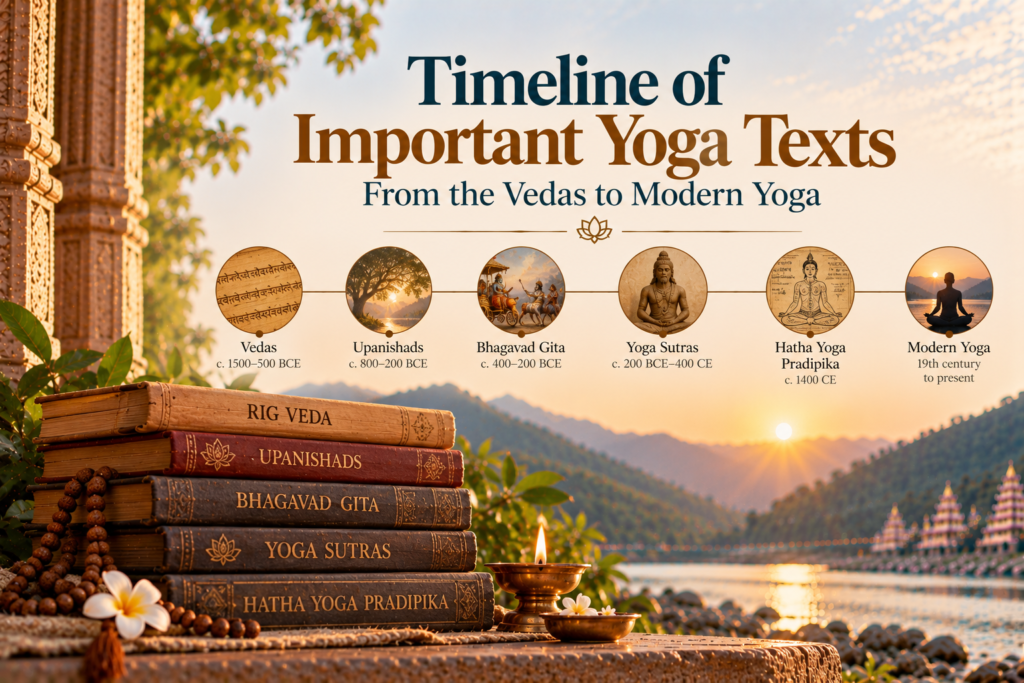
The table below brings together the main texts discussed in this article. The dates are approximate and indicate broad periods of composition or textual development.
| Text | Approximate period | Main contribution |
| The Vedas | c. 1500–500 BCE | Hymns, ritual, sacred recitation and early spiritual thought |
| Early Upanishads | c. 800–300 BCE | Atman, Brahman, self-inquiry and contemplative knowledge |
| Bhagavad Gita | c. 400 BCE–200 CE | Karma Yoga, Bhakti Yoga, Jnana Yoga and meditation |
| Yoga Sutras of Patanjali | Early centuries CE, often c. 350–450 CE | Eight limbs, mental discipline and liberation |
| Yoga Bhashya | c. 4th–5th century CE | Commentary on classical Yoga philosophy |
| Yoga Yajnavalkya | Date uncertain | Breath, postures, meditation and yogic discipline |
| Yoga Vasistha | Early medieval development, with complex textual history | Consciousness, mind and liberation |
| Amritasiddhi | c. 11th century CE | Early Hatha Yoga techniques in a tantric Buddhist setting |
| Dattatreya Yoga Shastra | Medieval period, often c. 13th century | Multiple yoga methods and their organization |
| Hatha Yoga Pradipika | Early 15th century CE | Asana, pranayama, mudra, bandha and meditation |
| Shiva Samhita | Medieval period, exact date uncertain | Subtle body, breath, meditation and liberation |
| Bhagavata Purana | c. 9th–10th century CE | Devotion, remembrance and Bhakti traditions |
| Gheranda Samhita | c. 17th century CE | Seven-part system of Hatha Yoga |
| Raja Yoga, Swami Vivekananda | 1896 | Modern presentation of classical Yoga and meditation |
| Light on Yoga, B. K. S. Iyengar | 1966 | Detailed modern guide to asana and pranayama |
How did the focus of yoga texts change over time?
The timeline reveals several broad developments. Early Vedic literature centres on sacred knowledge, ritual and recitation, while the Upanishads explore the Self and ultimate reality. The Bhagavad Gita then brings together action, devotion, knowledge and meditation, presenting yoga as a discipline that can guide everyday life.
The Yoga Sutras offer a systematic account of mental discipline and liberation. Medieval works expand the range of techniques described in yoga literature, giving greater attention to posture, breath regulation, mudras and subtle-body concepts. These traditions developed in diverse philosophical and religious settings, with ideas often crossing boundaries between schools.
Modern publications introduced yoga to new audiences through translations, photographs, structured teaching systems and books written for contemporary readers. As a result, the yoga practised around the world today draws on several historical layers, including philosophical inquiry, meditation, devotional traditions and physical techniques.
Which yoga texts should beginners study first?
Beginners can start with accessible translations of the Bhagavad Gita and selected Upanishads. These works introduce major concepts such as dharma, Atman, Brahman, devotion and liberation. A reliable translation with explanatory notes can help readers understand the philosophical context and avoid treating individual verses as isolated quotations.
Students interested in classical Yoga can then study Patanjali’s Yoga Sutras with a reputable commentary. The aphorisms are concise, and their meaning often depends on the philosophical framework used by the commentator. Reading the Yoga Sutras alongside the Yoga Bhashya can help clarify the text’s traditional interpretation.
For students interested in physical and breath-based methods, the Hatha Yoga Pradipika provides a valuable historical source. The Shiva Samhita and Gheranda Samhita can extend that study by presenting other approaches to yogic techniques. These texts describe practices within traditional frameworks, so practical techniques should be learned with appropriate guidance.
Those interested in sound, mantra and devotional practice can explore the Samaveda, selected Upanishads and the Bhagavata Purana. Together, these sources provide context for understanding the role of chanting, recitation and attentive listening within Indian spiritual traditions.
The relevance of yoga texts for teacher training
Studying yoga texts helps teachers understand the ideas behind the methods they teach. Knowledge of the Yoga Sutras can inform discussions about ethical practice, concentration and meditation, while the Bhagavad Gita introduces students to different paths of yoga. Hatha Yoga manuals provide historical context for physical and breath-based techniques.
A well-rounded traditional yoga education can combine textual study with practical experience. Students benefit from learning how philosophical ideas relate to asana, pranayama, meditation and daily conduct. The aim is to develop a clear understanding of the tradition and the ability to explain its teachings responsibly.
At Nada Yoga School in Rishikesh, students interested in the relationship between yoga, mantra and sound can explore the Nada Yoga teacher training program. The study of Indian classical music, chanting and sound-based practices provides a context for examining how listening and vocal expression feature in traditional yogic practice.
Modern-day yoga has various forms of yoga that are being taught in yoga teacher trainings. One of the widely famous styles that is emerging is sound healing teacher training that deals with the therapeutic side of sound and yoga to heal the body using frequencies.
Frequently asked questions
What is the oldest yoga text?
The Vedas are among the oldest surviving textual sources in the wider Indian spiritual tradition. The Rigveda contains early uses of the Sanskrit term yoga, although its meaning in those passages differs from many later technical definitions. Clearer discussions of contemplative discipline appear in later Vedic literature, particularly the Upanishads.
Which text explains the eight limbs of yoga?
Patanjali’s Yoga Sutras are the best-known source for the eight-limbed framework, or Ashtanga Yoga. The eight limbs include ethical observances, posture, breath regulation, withdrawal of the senses, concentration, meditation and samadhi.
Is the Bhagavad Gita older than the Yoga Sutras?
The chronology remains debated because both texts have complex histories. The Bhagavad Gita is generally placed within the late centuries BCE and early centuries CE, while many scholars date the surviving Yoga Sutras to the early centuries CE, often around the fourth or fifth century. The exact relationship between their composition dates cannot be established with complete certainty.
Which text is most important for Hatha Yoga?
The Hatha Yoga Pradipika is one of the most influential surviving manuals of Hatha Yoga. The Shiva Samhita and Gheranda Samhita are also important sources, each presenting its own approach to physical practice, breath, meditation and subtle-body concepts.
Which yoga texts discuss sound and mantra?
The Vedas preserve extensive traditions of sacred recitation, and the Samaveda is especially associated with musical chanting. Several Upanishads discuss Om and contemplative knowledge, while the Nadabindu Upanishad is particularly relevant to meditation through sound. The Bhagavata Purana also offers important context for devotional singing and remembrance.
Why are the dates of ancient yoga texts uncertain?
Many teachings were transmitted orally before surviving manuscripts were produced. Texts were also expanded, edited and interpreted over time, and several works survive in different versions. Scholars therefore use linguistic evidence, references to other works, manuscript history and philosophical comparisons to estimate their dates.
Final thoughts
The timeline of important yoga texts shows how yoga developed through centuries of spiritual inquiry, philosophical debate and practical discipline. The Vedas and Upanishads provide early foundations, the Bhagavad Gita presents multiple paths of yoga, and Patanjali’s Yoga Sutras offer a systematic account of mental discipline and liberation. Medieval manuals then document the development of Hatha Yoga, while modern books helped bring yoga to international audiences.
Reading these works in historical context gives students a clearer understanding of yoga’s depth and diversity. Each text reflects a particular tradition and period, and together they reveal how yoga has continued to evolve while drawing on older sources of knowledge. For practitioners and teachers alike, studying these texts provides a meaningful foundation for understanding the philosophy behind the practice.