There is a quality of yoga that begins to change when awareness moves toward the heart. The breath becomes easier to observe, emotions become more visible, and qualities such as kindness, connection, forgiveness, and compassion gain a deeper place in practice.
In the traditional chakra system, these themes belong to Anahata Chakra, the fourth of the seven major chakras. Anahata sits at the center of the chakra system and connects the lower three chakras with the upper three.
The heart chakra is traditionally associated with the air element, the sense of touch, the color green, and the quality of love. Its practices encourage awareness of the heart, breath, relationships, and the way we respond to ourselves and others.
Yoga asana, pranayama, meditation, mantra, and Nada Yoga can all provide practical ways to explore these traditional ideas.
What is Anahata Chakra?
Anahata Chakra is traditionally described as the fourth chakra in the seven-chakra system. The Sanskrit word Anāhata is commonly translated as “unstruck” or “unbeaten.”
The name refers to a subtle sound that, according to yogic traditions, arises without the contact of two physical objects. This idea gives Anahata a particularly important connection with Nada, or inner sound.
The chakra is traditionally located in the region of the heart and chest. It represents qualities such as love, compassion, openness, balance, and connection.
Anahata also occupies the middle position within the seven chakras. From this perspective, it serves as a meeting point between the grounding qualities of the lower chakras and the more subtle qualities associated with the upper chakras.
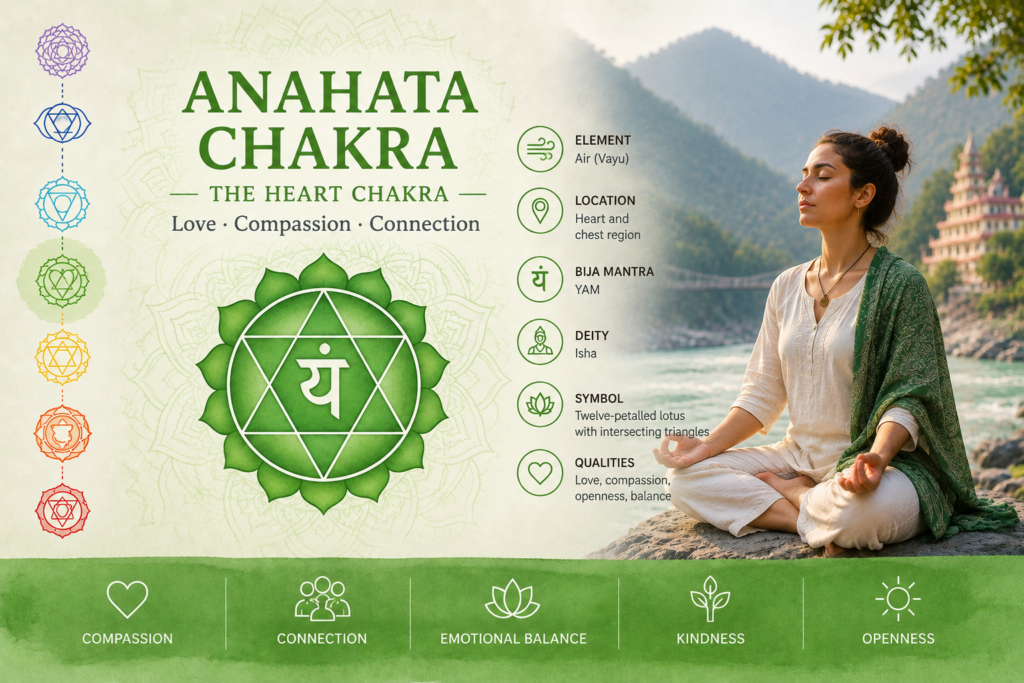
Anahata Chakra at a glance
| Aspect | Traditional understanding |
|---|---|
| Name | Anāhata Chakra |
| Meaning | Unstruck, unbeaten |
| Position | Fourth chakra |
| Location | Heart and chest region |
| Element | Air, Vayu |
| Quality | Love, compassion, openness, balance |
| Symbol | Twelve-petalled lotus with intersecting triangles |
| Bija mantra | YAM |
| Deity | Isha |
| When balanced | Compassion, openness, emotional balance, kindness, connection |
| When imbalanced | Grief, isolation, attachment, emotional heaviness, difficulty opening the heart |
These descriptions belong to the traditional subtle-body framework of yoga. The chakra system offers a contemplative map for self-observation and spiritual practice.
What does Anahata mean?
The Sanskrit term Anāhata carries the meaning of something unstruck or unbeaten.
In traditional Nada Yoga teachings, anahata nada refers to an inner sound that does not depend on the physical striking of two objects. This concept makes Anahata especially significant when studying the relationship between sound, meditation, and inner awareness.
The idea also carries a deeper symbolic meaning. The heart can become a place of quiet awareness where a practitioner observes thoughts, emotions, breath, and subtle sensations.
Through meditation and attentive listening, practitioners can gradually develop greater sensitivity to their inner experience.
Where is the Heart Chakra located?
Traditional yoga teachings place Anahata Chakra in the heart and chest region.
During meditation, practitioners often bring their attention toward the center of the chest. This area can become a point of concentration while observing the natural movement of the breath.
The physical heart and the traditional chakra represent different frameworks. Anahata belongs to the yogic subtle-body system, while the physical heart belongs to anatomy and physiology.
Keeping this distinction clear allows practitioners to study chakra traditions with both respect and accuracy.
Anahata and the air element
Anahata corresponds with air, or Vayu.
Air represents movement, expansion, lightness, and circulation. These qualities provide an important symbolic connection with the heart chakra.
Breathing also brings direct awareness to the chest. Every inhalation creates movement, while every exhalation creates release. Because of this relationship, pranayama can become a natural practice when exploring Anahata.
The air element traditionally connects Anahata with:
- openness
- movement
- expansion
- lightness
- breath
- connection
These qualities can become themes for meditation and self-reflection.
What does Anahata Chakra represent?
Anahata traditionally represents love, compassion, connection, and emotional balance.
The concept of love within yoga can take many forms. It can include kindness toward oneself, care for others, devotion, friendship, and a sense of connection with life.
Compassion also requires awareness. A practitioner learns to notice personal emotions while developing sensitivity toward the experiences of others.
Anahata therefore provides a useful framework for exploring how we relate, communicate, forgive, receive, and give.
The symbolism of Anahata Chakra
Anahata traditionally appears as a twelve-petalled lotus.
At the center of the symbol are two intersecting triangles. One triangle points upward and the other points downward. Their union represents the meeting of complementary forces.
The lotus represents unfolding awareness. The intersecting triangles express balance and integration.
The YAM bija mantra is another important part of Anahata symbolism. Practitioners use this sound during traditional mantra and meditation practices.
Anahata and the seven chakras
Anahata occupies the fourth position in the traditional chakra system.
The seven chakras are commonly presented as:
- Muladhara, associated with grounding and stability
- Svadhisthana, associated with emotional flow and creativity
- Manipura, associated with transformation and inner power
- Anahata, associated with love and compassion
- Vishuddha, associated with expression and communication
- Ajna, associated with inner awareness
- Sahasrara, associated with spiritual awareness
Anahata sits at the center of this sequence. Its traditional themes provide a bridge between personal development and deeper contemplative awareness.
Signs of balanced Anahata
Within the traditional chakra framework, balanced Anahata expresses through openness, kindness, compassion, and emotional steadiness.
A person may find it easier to connect with others while maintaining healthy emotional awareness. They can also develop greater acceptance of themselves and their experiences.
Traditional qualities associated with balanced Anahata include:
- compassion
- kindness
- openness
- emotional balance
- empathy
- connection
- acceptance
These qualities can develop through daily practice. Meditation encourages observation, while yoga and pranayama create opportunities to work with breath, body, and attention.
Signs of imbalanced Anahata
Traditional chakra teachings also describe patterns that can arise when Anahata becomes disturbed.
A practitioner may experience emotional heaviness, isolation, excessive attachment, grief, or difficulty opening emotionally.
Some traditional associations include:
- emotional withdrawal
- loneliness
- excessive attachment
- grief
- difficulty trusting
- emotional heaviness
- difficulty expressing affection
These descriptions provide themes for self-reflection. They do not represent medical diagnoses.
If persistent emotional distress affects daily life, appropriate professional support remains important.
Yoga poses for Anahata Chakra
Many yoga postures can bring awareness toward the chest, shoulders, spine, and breath. These areas play an important role when exploring heart-centered practice.
Bhujangasana
Bhujangasana, or Cobra Pose, creates an opening through the front of the chest.
Move gradually into the posture and keep the breath comfortable. Awareness can remain on the movement of the chest during each breath.
Ustrasana
Ustrasana, or Camel Pose, provides a deeper opening through the front body.
This posture requires careful preparation. Keep the movement controlled and avoid forcing the spine or shoulders.
Matsyasana
Matsyasana, or Fish Pose, creates space across the chest and can support focused awareness of breathing.
Use an appropriate variation according to your experience and mobility.
Setu Bandhasana
Setu Bandhasana, or Bridge Pose, combines chest opening with support from the legs and spine.
The posture can provide a steady environment for observing the breath.
Gomukhasana
Gomukhasana, or Cow Face Pose, can create a useful stretch through the shoulders and upper back.
Because shoulder mobility varies considerably, use a comfortable hand position and allow the breath to remain smooth.
Pranayama for Anahata
Breath awareness plays an important role in heart-centered yoga practice.
Simple breathing practices can bring attention toward the movement of the chest and rib cage. Anulom Vilom, or alternate nostril breathing, can also provide a steady practice for concentration and calm awareness.
Begin with comfortable breathing. Keep the breath smooth and avoid creating unnecessary strain.
During practice, notice the relationship between breath and emotion. A tense emotional state can affect breathing patterns, while deliberate breathing can provide a stable point of attention.
Anahata meditation
A simple Anahata meditation can begin in a comfortable seated position.
Close the eyes and allow the body to settle. Bring gentle awareness toward the center of the chest.
Observe the natural movement of the breath. Feel the expansion during inhalation and the release during exhalation.
After several breaths, introduce the traditional bija mantra YAM.
You can chant the sound aloud or repeat it silently. Allow the sound to become a steady object of concentration.
After several repetitions, sit quietly and observe the sensations, thoughts, and emotions that arise.
The purpose of the practice is attentive observation. Give yourself time to notice the experience before moving on.
YAM mantra and Anahata
The traditional bija mantra for Anahata is YAM.
Mantra practice gives the mind a focused sound while the practitioner remains aware of breath and bodily sensation.
Sit comfortably and take a few steady breaths. Then chant:
YAM
Allow the sound to finish naturally. Pause briefly before the next repetition.
As the practice continues, listen carefully to the tone and resonance of your own voice. This listening aspect creates a natural connection between Anahata practice and Nada Yoga.
Anahata and Nada Yoga
The meaning of Anahata has a particularly close relationship with Nada Yoga because of the traditional concept of anahata nada.
Nada Yoga explores sound as a pathway for concentration and inner awareness. External sounds, mantra, music, voice, and attentive listening can all become part of this broader practice.
When chanting YAM, the practitioner can pay attention to the sound itself. Notice its pitch, vibration, resonance, and gradual disappearance into silence.
The silence after the sound also becomes important. It creates an opportunity to listen more deeply and observe the mind.
This approach reflects a central principle of Nada Yoga: listening can become a form of meditation.
Anahata and compassion
Compassion requires awareness of both oneself and others.
Yoga practice can provide a practical space for developing this quality. When a posture feels challenging, for example, the practitioner learns to observe the body and respond with appropriate care.
The same principle can extend into daily life. A person can notice emotional reactions before responding and create space for a more thoughtful response.
Within the traditional chakra framework, Anahata provides a symbolic centre for this process.
Anahata and emotional balance
Emotional balance does not mean remaining in one emotional state. Human experience naturally includes happiness, sadness, frustration, affection, grief, excitement, and many other feelings.
Anahata practice encourages observation of these experiences.
Meditation can help a practitioner notice emotions as they arise. Breath awareness can provide a steady point of attention, while mantra can give the mind something stable to follow.
Over time, this combination can support a more conscious relationship with emotional experience.
Anahata and relationships
The heart chakra is traditionally associated with relationships and connection.
This includes relationships with family, friends, teachers, communities, and oneself. The practice of compassion can influence the way we listen, communicate, and respond.
A heart-centered practice can also encourage reflection on boundaries. Compassion includes care for others alongside appropriate care for oneself.
From a yogic perspective, healthy connection develops through awareness, respect, and conscious action.
Anahata and devotion
Anahata also has a strong relationship with bhakti, the yogic path of devotion.
Bhakti practices can include prayer, mantra, chanting, kirtan, and devotional singing. These practices engage the voice and heart while directing attention toward a chosen form of devotion.
Kirtan provides a particularly accessible way to explore this connection. Repeated mantra, melody, rhythm, and group singing can create a focused environment for devotional practice.
For practitioners studying Nada Yoga, kirtan can also demonstrate how sound becomes a vehicle for concentration and devotion.
Anahata and sound healing
Sound-based practices can support focused listening and relaxation. Singing bowls, mantra, chanting, and other sound practices can create sustained auditory experiences that encourage attention.
The traditional connection between Anahata and sound gives mantra a particularly relevant place in heart-centered practice.
Chanting YAM can become a simple practice for bringing together voice, breath, attention, and awareness of the chest region.
When exploring sound healing, it is useful to distinguish contemporary sound-based wellness practices from traditional Nada Yoga. They can share instruments and listening practices while following different frameworks and intentions.
A simple Anahata practice
You can create a short heart-centered practice by combining movement, breath, mantra, and silence.
Begin with a few gentle yoga movements. Spend several breaths observing the chest and rib cage.
Then sit comfortably and allow the breath to settle. Bring attention toward the centre of the chest and chant YAM several times.
After chanting, remain silent for a few minutes.
Notice the sound as it fades. Observe the breath, body, and emotional state without trying to create a particular experience.
Finish by bringing awareness back to the entire body.
How to bring Anahata into daily life
Anahata practice can continue beyond formal meditation.
Try bringing greater awareness to everyday interactions. Listen carefully when someone speaks. Notice your emotional response before reacting. Give yourself time to understand what you are feeling.
Small acts of kindness can also become part of a heart-centered practice.
At the same time, compassion requires appropriate boundaries. Caring for others can exist alongside caring for your own physical and emotional needs.
These simple actions can make the traditional qualities of Anahata more practical and easier to understand.
Understanding Anahata through yoga practice
Anahata represents the fourth stage in the traditional chakra journey. Its position at the centre of the seven-chakra system gives it a distinct role in yogic symbolism.
The lower chakras explore themes such as grounding, emotional movement, creativity, transformation, and personal strength. Anahata brings attention toward love, compassion, openness, and connection.
The upper chakras then move toward expression, inner awareness, and spiritual consciousness.
Through asana, pranayama, meditation, mantra, kirtan, and Nada Yoga, practitioners can explore these themes through direct experience.
Anahata also reminds us that yoga involves the quality of our relationships with ourselves, other people, and the world around us.
Continuing the seven chakra journey
Anahata brings the chakra journey toward the qualities of love, compassion, connection, and inner listening. Its association with the air element and the concept of Anahata Nada also creates a natural bridge between heart-centered practice and Nada Yoga.
The next chakra in the series is Vishuddha Chakra, the throat chakra. Its traditional themes include purification, expression, communication, and the conscious use of sound.
Frequently asked questions about Anahata Chakra
What is Anahata Chakra?
Anahata is the fourth chakra in the traditional seven-chakra system. It is associated with the heart and chest region, the air element, compassion, love, openness, and emotional balance.
What does Anahata mean?
Anahata commonly means “unstruck” or “unbeaten.” The term has an important connection with the traditional concept of anahata nada, or inner sound.
What element is associated with Anahata?
Anahata traditionally corresponds with air, or Vayu.
What is the Anahata Chakra mantra?
The traditional bija mantra for Anahata is YAM.
Where is Anahata Chakra located?
Traditional teachings place Anahata in the heart and chest region.
Which yoga poses are associated with Anahata?
Bhujangasana, Ustrasana, Matsyasana, Setu Bandhasana, and Gomukhasana can provide useful opportunities to explore chest opening, breath awareness, and heart-centered practice.
How can I practice Anahata meditation?
Sit comfortably, bring awareness toward the center of the chest, observe the breath, and use the YAM mantra as a focus. Finish with a period of quiet observation.
What is Anahata Nada?
In traditional Nada Yoga and yogic teachings, anahata nada refers to an inner or unstruck sound. It represents a subtle dimension of sound that becomes a subject of deep listening and meditation.