The way we use our voice can reveal a great deal about how we relate to ourselves and others. Speaking with clarity, listening carefully, expressing emotions, chanting a mantra, or sitting quietly with sound can all become practices of awareness.
In the traditional chakra system, these themes connect with Vishuddha Chakra, the fifth of the seven major chakras. Located in the throat region, Vishuddha is associated with communication, purification, truthful expression, listening, and the conscious use of sound.
The Sanskrit word Vishuddha means purification or especially pure. This gives the chakra a strong connection with the refinement of speech, thought, sound, and awareness.
Vishuddha also holds a special place in Nada Yoga, where sound and attentive listening form important parts of yogic practice. Mantra, chanting, music, and meditation can all provide ways to explore the traditional qualities of the throat chakra.
What is Vishuddha Chakra?
Vishuddha Chakra is traditionally described as the fifth chakra in the seven-chakra system. It is positioned between Anahata, the heart chakra, and Ajna, the third eye chakra.
Traditional teachings place Vishuddha around the throat region and associate it with the element of ether, or Akasha.
The chakra represents expression and communication. Its traditional qualities include clarity, truthfulness, listening, purification, and the ability to express one’s thoughts and feelings consciously.
Because sound travels through space, Vishuddha also has a particularly strong relationship with Nada, mantra, chanting, and the voice.
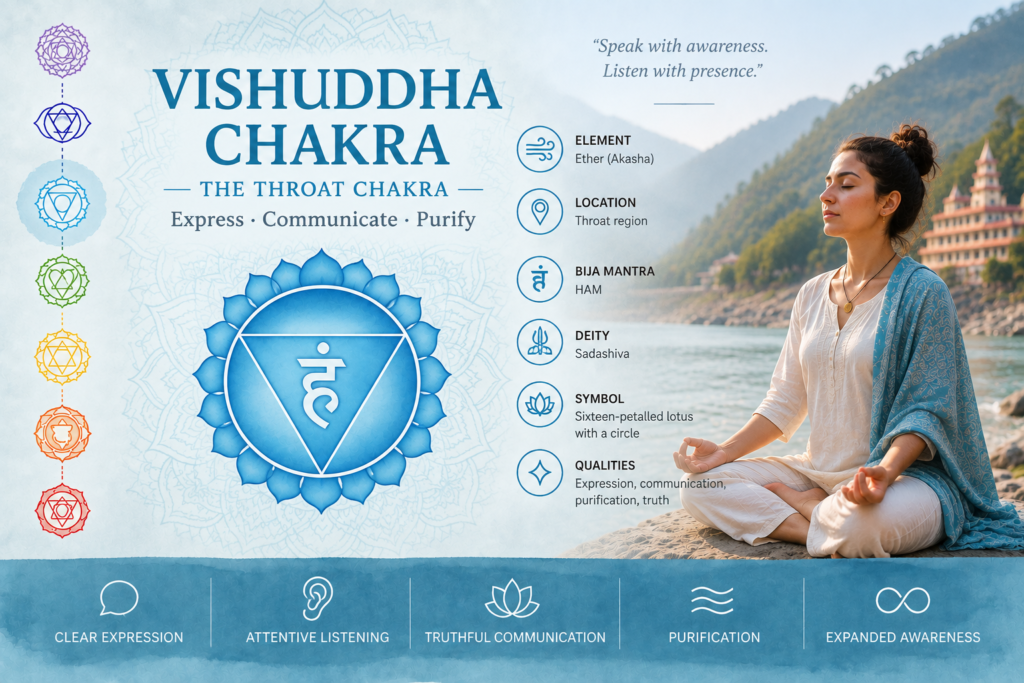
Vishuddha Chakra at a glance
| Aspect | Traditional understanding |
|---|---|
| Name | Viśuddha Chakra |
| Meaning | Purification, especially pure |
| Position | Fifth chakra |
| Location | Throat region |
| Element | Ether, Akasha |
| Quality | Expression, communication, purification |
| Symbol | Sixteen-petalled lotus with a circle |
| Bija mantra | HAM |
| Deity | Sadashiva |
| When balanced | Clear expression, truthful communication, attentive listening, confidence in speech |
| When imbalanced | Difficulty expressing oneself, excessive talking, fear of speaking, unclear communication |
These descriptions belong to the traditional subtle-body framework of yoga. The chakra system provides a contemplative structure for exploring qualities of awareness through practice.
What does Vishuddha mean?
The Sanskrit word Viśuddha comes from a root connected with purification. It is commonly understood as pure, purified, or especially pure.
This meaning gives Vishuddha a broader significance than speech alone.
Purification can refer to refining the way we communicate, the intentions behind our words, and the quality of our attention. A practitioner can therefore approach Vishuddha through speaking, listening, mantra, chanting, meditation, and silence.
The idea of purification also connects with the traditional role of Akasha. Ether provides the space through which sound travels, making it an important part of the symbolism surrounding Vishuddha.
Where is the Throat Chakra located?
Traditional chakra teachings place Vishuddha in the throat region.
During meditation, practitioners often bring awareness toward the throat and neck. The breath and voice naturally create sensations in this area, which can provide useful points of concentration.
Vishuddha belongs to the traditional subtle-body system. Its location describes a focus of yogic awareness rather than a specific anatomical organ.
This distinction helps keep chakra practice grounded in its traditional context.
Vishuddha and the ether element
Vishuddha traditionally corresponds with Akasha, often translated as ether or space.
The qualities of space provide an important symbolic connection with communication and sound. Sound moves through space, while silence also requires space for listening.
Akasha therefore gives Vishuddha an expansive quality.
Its traditional associations include:
- space
- sound
- communication
- openness
- subtle awareness
- purification
When practicing Vishuddha meditation, these qualities can become themes for observation.
What does Vishuddha Chakra represent?
Vishuddha represents expression, communication, listening, and purification within the traditional chakra system.
Communication includes both speaking and listening. A clear conversation requires attention to what we say as well as what we hear.
Vishuddha also relates to the conscious use of the voice. Mantra and chanting provide structured ways to explore pitch, pronunciation, breath, rhythm, and resonance.
This makes the chakra especially relevant to people interested in music, singing, mantra, public speaking, teaching, or Nada Yoga.
The symbolism of Vishuddha Chakra
Vishuddha traditionally appears as a sixteen-petalled lotus surrounding a central circle.
The sixteen petals connect with traditional Sanskrit phonetic symbolism and the relationship between sound and language. The circle represents the ether element and its quality of space.
The HAM bija mantra belongs to Vishuddha.
Practitioners can use HAM during meditation and mantra practice while bringing awareness toward the throat region.
The symbol therefore brings together several important themes: space, sound, language, expression, and purification.
Vishuddha and the seven chakras
Vishuddha occupies the fifth position in the traditional seven-chakra system.
The sequence is commonly presented as:
- Muladhara, associated with grounding and stability
- Svadhisthana, associated with emotional flow and creativity
- Manipura, associated with transformation and inner power
- Anahata, associated with love and compassion
- Vishuddha, associated with expression and communication
- Ajna, associated with inner awareness
- Sahasrara, associated with spiritual awareness
Vishuddha follows Anahata in this sequence. The traditional progression moves from the qualities of the heart toward expression and communication.
This creates an interesting relationship between the fourth and fifth chakras. What is experienced internally through the heart can find expression through the voice.
Signs of balanced Vishuddha
Within the traditional chakra framework, balanced Vishuddha expresses through clear communication and conscious listening.
A person may feel comfortable expressing ideas, emotions, and needs. They may also become more attentive to the effect of their words.
Traditional qualities associated with balanced Vishuddha include:
- clear communication
- truthful expression
- attentive listening
- confidence in speech
- thoughtful use of words
- creative expression
- comfort with silence
These qualities can develop through regular awareness practices.
Speaking slowly during mantra practice, listening carefully to sounds, and observing silence can all provide opportunities to explore them.
Signs of imbalanced Vishuddha
Traditional chakra teachings describe several patterns connected with disturbed Vishuddha.
A person may find it difficult to express feelings or communicate clearly. Another person may speak excessively, interrupt others, or use words without sufficient awareness.
Traditional associations include:
- difficulty expressing feelings
- fear of speaking
- unclear communication
- excessive talking
- difficulty listening
- suppressed expression
- hesitation in communication
These descriptions belong to the traditional chakra framework and can serve as prompts for personal reflection.
Persistent communication difficulties can also have many psychological, social, and practical causes. Chakra practice can complement self-reflection while appropriate professional support may be useful when deeper difficulties affect daily life.
Vishuddha and the power of speech
Speech carries intention.
A single sentence can encourage someone, create confusion, communicate affection, or cause harm. Yoga traditions therefore place importance on conscious speech.
The practice of Satya, or truthfulness, provides one ethical foundation for communication. Satya encourages speech that reflects truth and awareness.
Vishuddha practice can bring attention to the relationship between intention and expression.
Before speaking, a practitioner can pause briefly and observe the purpose behind the words. This simple pause can create greater awareness of communication.
Vishuddha and listening
Listening is an essential part of communication.
Nada Yoga places particular importance on attentive listening because sound itself becomes an object of meditation. The practitioner learns to notice changes in tone, rhythm, resonance, volume, and silence.
This same quality of attention can enter everyday conversations.
When listening to another person, stay aware of their words, tone, pauses, and emotional expression. Give the conversation enough space for understanding to develop.
Through this practice, listening becomes a form of awareness.
Vishuddha and Nada Yoga
Vishuddha has a strong connection with Nada Yoga because of its relationship with sound.
Nada Yoga explores sound through several forms of practice. These can include mantra, chanting, vocal exercises, Indian classical music, attentive listening, and meditation on subtle sound.
Vishuddha provides a traditional symbolic focus for working with the voice.
When chanting, practitioners can observe the complete process of sound. Notice the breath before the sound begins, the vibration created by the voice, the resonance that follows, and the silence that remains afterward.
This creates a direct experience of sound as a moving object of attention.
HAM mantra and Vishuddha
The traditional bija mantra associated with Vishuddha is HAM.
Mantra practice provides a simple way to bring together breath, voice, sound, and concentration.
Sit comfortably and allow the breath to settle. Bring gentle awareness toward the throat region.
Then chant:
HAM
Let the sound remain smooth and natural. Listen to the resonance created by the voice.
After each repetition, allow a short period of silence. Notice how the sound gradually fades.
Continue for several rounds and then sit quietly.
This practice can become especially meaningful when the practitioner pays close attention to the quality of listening.
Vishuddha and chanting
Chanting gives the voice a structured role in yoga practice.
A mantra provides specific syllables and sounds, while rhythm and repetition help maintain concentration. Group chanting can also create a shared field of listening.
Kirtan provides another form of vocal practice. Repeated devotional phrases, melody, rhythm, and collective singing allow participants to engage with sound through voice and listening.
For students exploring Nada Yoga, chanting can provide a practical introduction to the relationship between sound, breath, attention, and awareness.
Vishuddha and Indian classical music
Indian classical music offers a rich environment for studying sound and the voice.
Musical practice develops awareness of swara, pitch, rhythm, pronunciation, breath, and resonance. Vocal training also requires careful listening because a musician must hear the relationship between their own voice and the musical framework.
This attentive relationship with sound connects naturally with Nada Yoga.
Vishuddha can therefore become a useful contemplative theme for musicians and anyone interested in developing greater awareness of the voice.
Yoga poses for Vishuddha Chakra
Yoga asana can bring awareness toward the neck, shoulders, upper spine, chest, and breath.
Sarvangasana
Sarvangasana, or Shoulder Stand, traditionally appears in many classical yoga practices.
It places the neck and shoulders in a specific position, so appropriate preparation and teacher guidance are important.
Practitioners with neck concerns should seek qualified guidance before attempting the posture.
Matsyasana
Matsyasana, or Fish Pose, creates an opening through the front of the throat and chest.
Practice with steady breathing and maintain a comfortable range of movement.
Halasana
Halasana, or Plough Pose, creates a deep flexion through the neck and spine.
This posture requires suitable preparation and careful technique. Beginners can learn appropriate variations from an experienced teacher.
Bhujangasana
Bhujangasana, or Cobra Pose, opens the front body while encouraging awareness through the chest and throat.
Keep the neck relaxed and allow the movement to come primarily through the spine.
Simhasana
Simhasana, or Lion Pose, has a particularly direct relationship with the voice and facial muscles.
The posture traditionally includes a strong exhalation and expressive use of the face and tongue. It can provide an interesting practice for exploring vocal release and conscious expression.
Pranayama for Vishuddha
Breath and voice share an intimate relationship.
Every spoken word depends on the movement of breath. Pranayama therefore provides a natural foundation for exploring Vishuddha.
Ujjayi Pranayama is especially relevant because it creates an audible quality of breath through a gentle narrowing of the throat.
Practice Ujjayi with a comfortable breath and a relaxed face. The sound should remain soft and steady.
Bhramari Pranayama, or humming bee breath, also offers a direct connection with sound. The humming vibration creates a sustained auditory experience while the practitioner remains aware of the breath and resonance.
Both practices can develop greater sensitivity to the relationship between breath, sound, and attention.
Vishuddha meditation
A simple Vishuddha meditation can begin with a comfortable seated position.
Close the eyes and allow the body to settle. Bring attention toward the throat region.
Observe the natural breath for several cycles.
Then begin chanting HAM softly.
Listen to the sound as it emerges. Notice its pitch, vibration, resonance, and gradual movement into silence.
After several repetitions, stop chanting and remain still.
Listen to the surrounding environment. Then listen more closely to the quieter sounds within your experience.
This movement from vocal sound toward attentive listening reflects an important principle of Nada Yoga.
Vishuddha and silence
Silence forms an important part of sound practice.
When a mantra ends, there is a moment before the next repetition begins. That space can become an object of awareness.
Silence also changes the way we listen. Once external stimulation becomes quieter, subtle sounds become easier to notice.
A short period of silence after chanting can therefore deepen a meditation practice.
For Vishuddha, silence also offers a useful reflection on communication. Speaking consciously requires knowing when to speak and when to listen.
Vishuddha and authentic expression
Authentic expression begins with awareness.
A practitioner can observe what they genuinely feel, think, or intend before putting it into words. This process creates greater clarity between inner experience and outward communication.
Yoga philosophy provides ethical principles that can guide this process. Satya encourages truthfulness, while Ahimsa, or non-harming, encourages sensitivity toward the effect of our actions.
Together, these principles offer a thoughtful approach to speech.
The goal is conscious communication grounded in awareness and responsibility.
Vishuddha and creativity
The throat and voice provide powerful tools for creative expression.
Singing, chanting, storytelling, teaching, poetry, music, and spoken communication all depend on the ability to express ideas through sound.
Creative expression can become a form of self-observation. Notice how the voice changes with emotion, confidence, rhythm, and intention.
For musicians, singers, and students of Nada Yoga, this awareness can become part of regular practice.
Vishuddha and emotional expression
Emotions often influence the voice.
Fear can change breathing. Anger can alter volume and tone. Happiness can affect rhythm and expression. Sadness can change the way words emerge.
Vishuddha practice encourages observation of these relationships.
A practitioner can notice how emotions affect speech and breathing. This awareness creates an opportunity to respond with greater care.
Mantra and chanting provide structured environments for exploring the voice while maintaining steady attention.
Vishuddha and sound healing
Sound healing practices often involve singing bowls, voice, mantra, music, or other forms of sound.
These practices can create opportunities for focused listening and relaxation. When working with Vishuddha, vocal practices and mantra have a particularly clear traditional connection.
Chanting HAM, practicing Bhramari, or listening carefully to sustained tones can bring attention toward sound and resonance.
The experience can remain simple. Listen closely, observe the breath, and allow awareness to follow the sound.
A simple Vishuddha practice
You can create a short Vishuddha practice at home.
Begin by sitting comfortably and observing your breath for a few minutes. Relax the jaw, tongue, shoulders, and throat.
Take a slow breath and chant HAM at a comfortable pitch.
Listen to the sound from beginning to end. When the sound fades, remain silent for a few breaths.
Repeat several times.
Then stop chanting and listen to the surrounding environment.
Finish by sitting quietly for another minute.
This practice combines voice, breath, sound, listening, and silence in a simple sequence.
How to bring Vishuddha into daily life
Vishuddha practice can become part of everyday communication.
Speak with awareness of your intention. Give other people enough space to express themselves. Listen before preparing your response.
You can also observe your voice during ordinary conversations. Notice your volume, pace, tone, and choice of words.
A short period of silence each day can support this awareness. Five minutes of quiet sitting can provide enough space to observe the relationship between sound and attention.
These simple practices can make the traditional qualities of Vishuddha easier to understand through experience.
Understanding Vishuddha through yoga practice
Vishuddha represents the fifth stage in the traditional chakra journey.
Muladhara begins with grounding. Svadhisthana brings movement and emotional flow. Manipura develops themes of transformation and personal power. Anahata opens toward compassion and connection.
Vishuddha then brings these experiences into the realm of expression and communication.
Through asana, pranayama, mantra, chanting, meditation, kirtan, and Nada Yoga, practitioners can explore how inner experience becomes sound and expression.
The chakra also invites a deeper question: how consciously do we use our voice?
That question can become a powerful part of yoga practice.
Frequently asked questions about Vishuddha Chakra
What is Vishuddha Chakra?
Vishuddha is the fifth chakra in the traditional seven-chakra system. It is associated with the throat region, ether element, communication, expression, purification, and sound.
What does Vishuddha mean?
Vishuddha commonly means purification, purified, or especially pure.
What element is associated with Vishuddha?
Vishuddha traditionally corresponds with Akasha, or ether/space.
What is the Vishuddha Chakra mantra?
The traditional bija mantra for Vishuddha is HAM.
Where is Vishuddha Chakra located?
Traditional teachings place Vishuddha in the throat region.
Which yoga poses are associated with Vishuddha?
Matsyasana, Simhasana, Bhujangasana, Sarvangasana, and Halasana can all be explored within a suitable yoga practice. Some of these postures require preparation and qualified instruction.
How can I practice Vishuddha meditation?
Sit comfortably, bring awareness toward the throat, observe the breath, and chant HAM. After each repetition, listen to the sound as it fades into silence.
How is Vishuddha connected with Nada Yoga?
Vishuddha has a strong traditional relationship with sound, voice, mantra, and listening. These are also central areas of Nada Yoga practice, making the throat chakra particularly relevant when exploring sound as a meditative focus.
Continuing the seven chakra journey
Vishuddha brings the chakra journey into the realm of sound, communication, expression, and attentive listening. Its traditional connection with Akasha and Nada makes it especially significant for practitioners interested in mantra, chanting, music, and meditation.
The next chakra in the series is Ajna Chakra, traditionally known as the third eye chakra. Ajna introduces themes of concentration, inner awareness, intuition, and meditative insight.