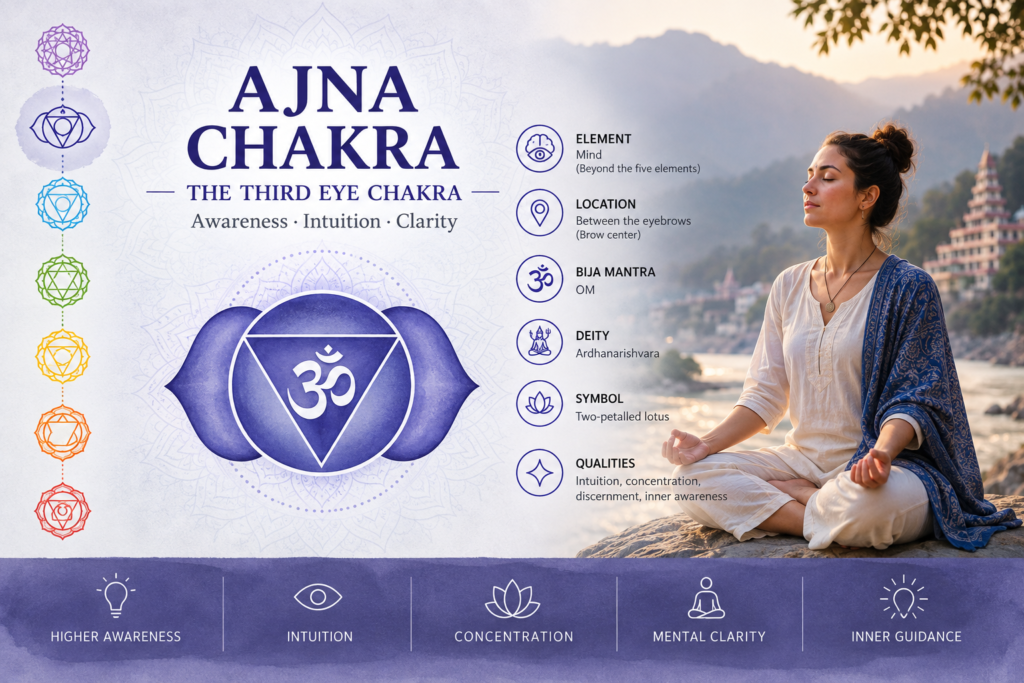
Meditation gradually changes the way we notice our own mind. At first, thoughts can seem constant and difficult to follow. With regular practice, attention becomes steadier, and the mind becomes easier to observe.
In the traditional chakra system, this inward movement connects with Ajna Chakra, the sixth chakra in the seven-chakra system. Ajna is commonly known as the third eye chakra and relates to concentration, inner awareness, discernment, intuition, and meditation.
The Sanskrit word Ajna carries meanings connected with command, guidance, and perception. Therefore, this chakra has an important place in traditional practices that develop focused attention.
Ajna also has a close relationship with mantra, visualization, meditation, and Nada Yoga. Through these practices, students can explore concentration and inner observation in a structured way.
What is Ajna Chakra?
Ajna Chakra is traditionally described as the sixth chakra among the seven major chakras. It comes after Vishuddha, the throat chakra, and before Sahasrara, the crown chakra.
Traditional teachings place Ajna in the area between the eyebrows, often called the brow center. This point becomes a common focus during meditation and concentration practices.
The chakra represents qualities such as inner awareness, concentration, discernment, intuition, and mental clarity. Because of these qualities, Ajna has a strong connection with practices that turn attention inward.
During meditation, the practitioner can observe thoughts, sensations, emotions, and images. Over time, this observation can help develop a more focused relationship with the mind.
Ajna Chakra at a glance
| Aspect | Traditional understanding |
|---|---|
| Name | Ājñā Chakra |
| Meaning | Command, guidance |
| Position | Sixth chakra |
| Location | Between the eyebrows, brow center |
| Element | Mind, traditionally associated with subtle awareness |
| Quality | Concentration, intuition, discernment, inner awareness |
| Symbol | Two-petalled lotus |
| Bija mantra | OM |
| Deity | Ardhanarishvara |
| When balanced | Clarity, concentration, discernment, intuitive awareness, steady observation |
| When imbalanced | Confusion, mental restlessness, poor concentration, excessive imagination, difficulty trusting one’s perception |
These qualities come from the traditional subtle-body framework of yoga. Therefore, the chakra system works as a contemplative model for meditation and self-observation.
What does Ajna mean?
The Sanskrit term Ājñā is commonly associated with meanings such as command, guidance, and authority.
This meaning connects Ajna with the idea of inner direction. Through meditation, practitioners learn to observe their thoughts before allowing those thoughts to guide every response.
In addition, traditional teachings describe Ajna as a centre of inner perception. The term “third eye” refers to this yogic idea of inward awareness.
During practice, the brow center becomes a point where attention can settle. As concentration develops, the practitioner can observe the movement of the mind with greater clarity.
Where is Ajna Chakra located?
Traditional yoga teachings place Ajna Chakra at the space between the eyebrows.
This area is commonly called the brow center. During meditation, practitioners may gently direct their attention toward it.
Mantra and visualization can support this practice. Similarly, the natural breath can provide a steady anchor while awareness rests around the brow center.
The brow center represents a focus of awareness within the traditional subtle-body system. It does not describe a separate anatomical organ.
For that reason, the practice should remain gentle. Keep the eyes, forehead, and facial muscles relaxed while maintaining attention.
Ajna and inner awareness
Ajna has a strong traditional association with inner awareness.
Meditation provides a direct way to explore this quality. A practitioner observes thoughts as they arise and gradually learns to return attention to a chosen object.
For example, the mind may move toward a memory during meditation. A sound, emotion, plan, or physical sensation can create the same shift.
When this happens, simply recognize the movement and return to the chosen focus. As a result, meditation becomes a practical exercise in awareness.
With regular practice, this repeated return can strengthen concentration.
Ajna and concentration
Concentration forms an important part of traditional yoga.
The Sanskrit term Dharana refers to concentration or holding attention on a chosen object. Ajna meditation provides a useful setting for exploring this principle.
First, choose one object of attention. You might use the breath, a mantra, a visual symbol, or the brow center.
Next, observe how attention behaves. When the mind moves away, gently bring it back.
This process requires patience. Each return gives the practitioner another opportunity to develop steadiness.
As practice continues, concentration can become more familiar during meditation and everyday activities.
Ajna and intuition
Traditional teachings associate Ajna with intuition and discernment.
Intuition can describe a subtle sense of understanding that appears before conscious reasoning has fully developed. Within the yogic framework, deeper awareness can help a practitioner examine such experiences with care.
Discernment adds another important quality. Yoga philosophy uses the term Viveka for the ability to distinguish clearly between different experiences.
For example, a strong emotional reaction can influence the way we understand a situation. A moment of reflection can reveal the difference between an immediate reaction and a considered response.
Therefore, Ajna practice can provide a useful framework for examining thoughts, reactions, assumptions, and choices.
The symbolism of Ajna Chakra
Ajna traditionally appears as a two-petalled lotus.
The two petals carry several layers of meaning within yogic traditions. They are often connected with Ida and Pingala, the two traditional energy channels that meet at the brow center.
At the centre of the symbol, traditional representations include the seed sound associated with Ajna. The OM mantra also has a central place in many yogic meditation practices.
Together, these elements represent concentration, inner awareness, and subtle perception.
The symbolism therefore supports the contemplative nature of Ajna practice.
Ajna and the seven chakras
Ajna occupies the sixth position in the traditional seven-chakra system.
The sequence is commonly presented as:
- Muladhara, associated with grounding and stability
- Svadhisthana, associated with emotional flow and creativity
- Manipura, associated with transformation and inner power
- Anahata, associated with love and compassion
- Vishuddha, associated with expression and communication
- Ajna, associated with inner awareness and concentration
- Sahasrara, associated with spiritual awareness
Ajna comes near the upper end of this sequence. Consequently, its traditional themes move toward deeper concentration and contemplative awareness.
The chakra journey therefore progresses from grounding and emotional experience toward personal strength, compassion, expression, inner awareness, and spiritual consciousness.
Signs of balanced Ajna
Within the traditional chakra framework, balanced Ajna expresses through clarity, concentration, discernment, and steady observation.
A practitioner may find it easier to remain focused on a chosen task. Similarly, meditation can become more stable as attention learns to return to one object.
Traditional qualities associated with balanced Ajna include:
- mental clarity
- concentration
- discernment
- intuitive awareness
- self-observation
- steady attention
These qualities can develop through regular meditation and mindful practice.
For example, returning to the breath during meditation trains the mind to recognize distraction. Each return then becomes part of the practice.
Signs of imbalanced Ajna
Traditional chakra teachings describe several patterns associated with disturbed Ajna.
Mental restlessness can make concentration difficult. Confusion may also affect decision-making and self-observation.
Other traditional associations include:
- difficulty focusing
- confusion
- mental restlessness
- excessive thinking
- excessive imagination
- difficulty trusting one’s perception
These descriptions belong to the traditional chakra system. Therefore, they work best as themes for personal reflection.
Persistent mental or emotional difficulties can have many causes. Appropriate professional support can provide useful guidance when such difficulties affect daily life.
Ajna meditation
Ajna meditation can begin with a simple approach.
First, sit comfortably with the spine naturally upright. Relax the shoulders, jaw, forehead, and eyes.
Next, close your eyes and observe the natural breath for several moments. Allow the body to settle before introducing another focus.
Then bring gentle attention toward the space between the eyebrows. Keep the eyes relaxed and avoid creating tension around the brow.
Afterward, choose the breath or OM as your meditation object.
When thoughts arise, recognize them and return to your chosen focus. Over time, this process can make focused attention more familiar.
Finally, release the focus from the brow center and bring awareness back to the whole body.
OM mantra and Ajna
The traditional bija mantra associated with Ajna is OM.
OM holds an important place in many yogic and contemplative traditions. It can provide a stable sound for meditation while also encouraging careful listening.
Begin by sitting comfortably and taking several natural breaths.
Then chant: OM
Allow the sound to emerge at a comfortable volume. Listen to the complete sound as it continues and gradually fades.
After each repetition, pause briefly.
This silence creates another opportunity for awareness. Notice the transition from sound to silence before beginning the next repetition.
With regular practice, attention can gradually move from producing the sound toward listening to it.
Ajna and Nada Yoga
Ajna has a natural connection with Nada Yoga because both traditions place strong emphasis on listening and concentration.
Nada Yoga explores sound as a pathway for developing awareness. Mantra, music, vocal practice, attentive listening, and meditation can all become part of this approach.
OM provides a traditional sound focus for Ajna practice. During chanting, listen carefully to the sound from beginning to end.
Notice its pitch, vibration, resonance, and gradual movement into silence. Then remain quiet for a few moments.
This transition from sound to silence encourages deeper listening. At the same time, it demonstrates how sound can become a practical meditation object.
Ajna and the breath
The breath provides a simple anchor for Ajna meditation.
Bring attention toward the brow center while observing the natural rhythm of inhalation and exhalation.
When thoughts appear, recognize them and gently return to the breath. In this way, the breath becomes a steady reference point.
The practice does not require forced concentration. Instead, repetition gradually trains the mind to return to the present moment.
As a result, breath awareness can support both meditation and everyday concentration.
Ajna and visualization
Visualization appears in several traditional meditation practices.
A practitioner may visualize a symbol, light, deity, mantra, or geometric form while maintaining awareness at the brow center.
Because visualization requires sustained attention, it can support concentration. For beginners, a simple image can provide an accessible starting point.
For example, visualize a small point of light for a few moments. Then return to the breath and allow the image to fade naturally.
Keep the practice comfortable and allow the eyes to remain relaxed.
Ajna and the mind
The traditional chakra system associates Ajna with the mind and its processes.
Thoughts constantly change. One thought can lead to another, creating chains of memory, planning, emotion, and imagination.
Meditation provides a space to observe this movement.
Rather than following every thought, the practitioner learns to recognize mental activity and return to the chosen focus.
For this reason, Ajna has a close relationship with Dhyana, or meditation.
As concentration becomes steadier, observation of the mind can become clearer.
Ajna and discernment
Discernment plays an important role in yoga philosophy.
Viveka refers to the ability to distinguish clearly. In everyday life, this quality can help us examine thoughts and reactions before accepting them as complete truth.
For instance, a strong emotional response can influence the way we interpret a situation. A moment of awareness creates space to examine that response.
From there, a more considered choice becomes possible.
Ajna offers a traditional symbolic framework for this kind of inner examination.
Through meditation and self-observation, practitioners can become more familiar with the patterns that influence their decisions.
Yoga practices for Ajna Chakra
Ajna practice focuses strongly on concentration, meditation, and awareness. Several yoga practices can support these qualities.
Balasana
Balasana, or Child’s Pose, creates a quiet environment for inward attention.
The posture can provide an opportunity to observe the breath and allow the mind to settle.
Padmasana
Padmasana, or Lotus Pose, appears traditionally in meditation practices.
A comfortable seated posture remains important. Sukhasana or another stable position can provide a suitable foundation for meditation.
Sukhasana
Sukhasana, or Easy Pose, offers a practical seated position for Ajna meditation.
Keep the spine naturally upright. Meanwhile, allow the shoulders, face, and jaw to relax.
Adho Mukha Svanasana
Adho Mukha Svanasana, or Downward-Facing Dog, develops full-body awareness while creating opportunities to observe the breath.
Use the posture as part of a balanced yoga sequence. Afterward, allow the body to settle before moving into meditation.
Child’s Pose with breath awareness
Returning to Balasana with slow breathing can provide a gentle transition from physical movement into meditation.
Allow attention to settle gradually as the breath becomes steady.
Pranayama for Ajna
Breath practices can support concentration and mental steadiness.
Nadi Shodhana, or alternate nostril breathing, is traditionally practiced to support balance and concentration. It can also provide a calm preparation for meditation.
Begin with natural breathing and learn the technique correctly from an experienced teacher.
After several rounds, sit quietly and observe the breath.
Then bring awareness toward the brow center and begin your meditation.
This sequence allows pranayama to prepare the mind for focused attention.
Trataka and Ajna
Trataka, or steady gazing, is a traditional yogic concentration practice.
One common form involves gazing steadily at a candle flame from a suitable distance. After a period of external gazing, the practitioner closes the eyes and observes the remaining visual impression.
Trataka requires appropriate care and technique, especially for the eyes.
The practice can develop concentration and prepare the mind for meditation. Furthermore, it creates a practical movement from external attention toward internal observation.
Ajna and silence
Silence becomes increasingly meaningful as concentration develops.
When external sound becomes quieter, the practitioner can observe subtler aspects of experience.
Nada Yoga offers a useful perspective here. Sound provides an object for attention, while the disappearance of sound creates an opportunity to observe silence.
After chanting OM, remain still for a few moments.
Listen carefully to the environment. Then notice the quieter aspects of your own experience.
Finally, observe how thoughts appear and disappear.
This simple process can become a valuable exercise in concentration.
Ajna and sound healing
Contemporary sound healing teacher training practices can provide sustained sounds that encourage relaxation and focused listening.
For Ajna-oriented practice, mantra and attentive listening have a particularly clear connection with traditional yoga.
A practitioner can listen to a singing bowl, sustained musical tone, or meditation sound while maintaining awareness of the brow center.
During the practice, observe the sound and notice how the mind responds.
Traditional Nada Yoga and contemporary sound healing follow different frameworks and intentions. Therefore, each practice should be understood within its own context.
A simple Ajna practice at home
A short Ajna practice can take around ten minutes.
Begin by sitting comfortably. Spend two minutes observing the natural breath.
Next, bring gentle awareness toward the space between the eyebrows.
Chant OM several times and listen carefully to each repetition.
Afterward, remain silent for a few minutes. Whenever thoughts arise, recognize them and return to the breath or brow center.
Finally, release the focused attention and become aware of the entire body.
Regular practice can gradually strengthen concentration and familiarity with meditation.
How to bring Ajna awareness into daily life
Ajna practice can extend into ordinary activities.
Before making an important decision, pause briefly and observe your thoughts. Notice emotional reactions, assumptions, and impulses.
During conversations, listen carefully and give yourself time to understand what another person is saying.
Similarly, while working, give one task your full attention for a defined period.
These simple actions develop the same basic skill used in meditation: bringing attention back to the present activity.
As a result, concentration can become easier to recognize in everyday life.
Understanding Ajna through yoga practice
Ajna represents the sixth chakra in the traditional chakra journey.
Muladhara introduces grounding. Svadhisthana brings emotional flow and creativity. Manipura develops transformation and personal power.
Anahata opens toward compassion and connection. Vishuddha brings expression and communication.
Ajna then turns attention toward inner awareness, concentration, and discernment.
Through meditation, mantra, pranayama, visualization, Trataka, and Nada Yoga, practitioners can explore these qualities through direct experience.
The traditional purpose of Ajna practice centres on awareness. The practitioner learns to observe the mind, refine attention, and develop greater clarity.
Frequently asked questions about Ajna Chakra
What is Ajna Chakra?
Ajna is the sixth chakra in the traditional seven-chakra system. It is commonly called the third eye chakra and is associated with inner awareness, concentration, intuition, and discernment.
What does Ajna mean?
Ajna is commonly associated with meanings such as command, guidance, or authority.
Where is Ajna Chakra located?
Traditional teachings place Ajna at the space between the eyebrows, known as the brow center.
What is the Ajna Chakra mantra?
The traditional bija mantra associated with Ajna is OM.
What does Ajna Chakra represent?
Ajna traditionally represents concentration, inner awareness, discernment, intuition, and observation of the mind.
Which practices are useful for Ajna Chakra?
Meditation, mantra, Nadi Shodhana, Trataka, visualization, and Nada Yoga can all provide suitable practices for exploring Ajna-related qualities.
How can I meditate on Ajna Chakra?
Sit comfortably, relax the face, bring gentle awareness toward the brow center, and use the breath or OM mantra as a focus. Continue with steady observation for several minutes.
Is the third eye a physical organ?
The third eye is a traditional yogic concept associated with Ajna Chakra. It describes a focus of inner awareness within the subtle-body system.
Continuing the seven chakra journey
Ajna brings the chakra journey toward concentration, inner awareness, discernment, and meditation.
Its traditional connection with OM and Nada Yoga also highlights the role of sound in developing focused attention. For this reason, Ajna can be especially interesting for students who want to explore the relationship between sound, meditation, and inner awareness.
The final chakra in this series is Sahasrara Chakra, traditionally known as the crown chakra. Sahasrara introduces themes of spiritual awareness, consciousness, meditation, and transcendence within the traditional chakra system.