Starting yoga gives you an opportunity to build strength, flexibility, balance, and body awareness at your own pace. For beginners, learning a few foundational yoga poses can make regular practice easier and more enjoyable.
Many beginner yoga poses also teach principles that become useful as your practice develops. You learn how to position the body, coordinate movement with the breath, maintain balance, and stay attentive to physical sensations.
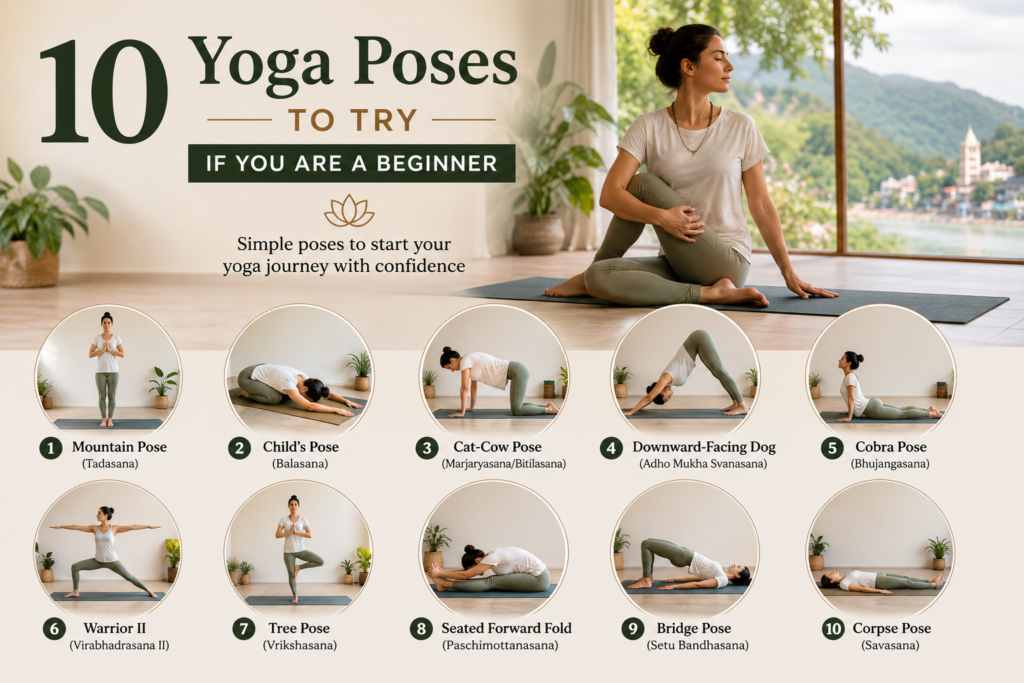
This guide introduces 10 yoga poses for beginners that you can explore at home, in a beginner yoga class, or as part of a Hatha Yoga practice.
1. Mountain Pose
Sanskrit name: Tadasana
Mountain Pose provides a foundation for many standing yoga poses.
Stand comfortably with your feet grounded and your spine upright. Let your shoulders relax and allow your arms to rest naturally beside your body.
Bring your attention to your feet and notice how your weight is distributed. Then observe your posture from the feet upward, keeping the head balanced comfortably over the spine.
Take several slow breaths while maintaining a relaxed posture.
Tadasana teaches an important aspect of beginner yoga: learning to observe the body while remaining steady.
2. Child’s Pose
Sanskrit name: Balasana
Child’s Pose is a gentle resting posture that can help beginners become familiar with relaxation during yoga practice.
Start on your hands and knees. Slowly move your hips toward your heels while bringing your torso toward your thighs. Extend your arms forward or allow them to rest alongside your body.
Place your forehead on the mat or use a cushion for additional support.
Breathe comfortably and notice the movement of your back and ribs.
Child’s Pose can also provide a useful resting position between more active yoga asanas.
3. Cat-Cow Pose
Sanskrit names: Marjaryasana and Bitilasana
Cat-Cow introduces gentle movement through the spine while creating an easy connection between breath and movement.
Begin on your hands and knees, keeping your wrists below your shoulders and your knees below your hips.
As you inhale, gently lift your chest and allow your spine to move into a comfortable extension. As you exhale, round your spine and allow your head to follow the movement naturally.
Continue slowly for several rounds.
The practice helps beginners develop awareness of spinal movement while learning how breathing can guide a yoga sequence.
4. Downward-Facing Dog
Sanskrit name: Adho Mukha Svanasana
Downward-Facing Dog is one of the most familiar yoga poses for beginners and experienced practitioners alike.
Start on your hands and knees. Tuck your toes under and gradually lift your hips upward, creating an inverted V shape.
Keep your knees slightly bent if that allows you to maintain a comfortable position. Focus on creating length through the spine and keeping your breathing steady.
Your heels can remain lifted while you become familiar with the posture.
For beginners, comfortable alignment and steady breathing provide useful points of attention.
5. Cobra Pose
Sanskrit name: Bhujangasana
Cobra Pose introduces a gentle backbend and encourages awareness through the chest, shoulders, and spine.
Lie on your stomach with your hands placed near the sides of your chest. Keep the tops of your feet grounded.
As you inhale, gently lift your chest while keeping the movement controlled. Allow the arms to support the movement while keeping your shoulders relaxed.
Maintain a comfortable range of motion and breathe naturally.
Bhujangasana can become part of a beginner yoga sequence, particularly when paired with gentle spinal movements.
6. Warrior II
Sanskrit name: Virabhadrasana II
Warrior II develops strength, stability, balance, and awareness through the legs.
Stand with your feet wide apart and turn one foot outward. Bend the corresponding knee while keeping the opposite leg extended.
Extend your arms in opposite directions and keep your gaze toward the front hand.
Pay attention to the position of your feet, legs, hips, and shoulders.
The posture can feel physically demanding when you first begin practicing. Keep the front knee at a comfortable depth and maintain smooth breathing.
Warrior II introduces beginners to the grounded quality of standing yoga asanas.
7. Tree Pose
Sanskrit name: Vrikshasana
Tree Pose introduces balance and concentration.
Begin in a comfortable standing position and shift your weight onto one foot. Place the sole of the opposite foot against the inner calf or thigh, depending on your level of balance.
Bring your hands together at your chest or extend them overhead.
Choose a steady point in front of you and keep your gaze there.
Balance naturally changes from day to day. Beginners can practise near a wall and use it for support while becoming familiar with the posture.
Vrikshasana offers a simple way to explore the relationship between physical balance and concentration.
8. Seated Forward Fold
Sanskrit name: Paschimottanasana
Seated Forward Fold works with the back of the body and encourages a quieter quality of attention.
Sit with your legs extended forward. Keep the spine comfortable and begin to hinge forward from the hips.
Place your hands wherever they reach naturally, such as your thighs, shins, or feet.
Allow the movement to remain gradual. Flexibility develops through consistent practice, so focus on breathing and maintaining a comfortable position.
Paschimottanasana can also introduce beginners to the slower pace of seated yoga poses.
9. Bridge Pose
Sanskrit name: Setu Bandhasana
Bridge Pose strengthens the legs and creates a gentle opening through the front of the body.
Lie on your back with your knees bent and your feet placed on the floor. Keep your feet approximately hip-width apart.
Press through your feet and gradually lift your hips. Keep the movement controlled and allow the chest to open comfortably.
Maintain steady breathing while holding the pose.
Beginners can keep their hands resting beside the body. As your practice develops, you can explore variations with guidance from a qualified yoga teacher.
10. Corpse Pose
Sanskrit name: Savasana
Savasana brings the physical practice toward stillness.
Lie comfortably on your back and allow your arms and legs to rest naturally. Close your eyes if that feels comfortable.
Bring your attention toward the breath and observe sensations throughout the body.
Remain here for several minutes.
Savasana gives the body and mind time to settle after movement. It also introduces beginners to the quieter, contemplative side of yoga.
How to practise these yoga poses as a beginner
A beginner yoga practice can remain simple while you become familiar with each posture.
Start with Mountain Pose and move into Cat-Cow to warm up the spine. Continue with Downward-Facing Dog and Cobra Pose before exploring Warrior II and Tree Pose.
From there, move toward the seated poses and finish with Bridge Pose and several minutes of Savasana.
Move slowly between each posture and give yourself enough time to understand how your body responds.
A yoga teacher can help you understand alignment, breathing, modifications, and appropriate variations as your practice develops.
How long should beginners hold a yoga pose?
The appropriate duration depends on the pose and your individual experience.
When you are learning yoga for beginners, start with several comfortable breaths in each posture. You can gradually increase the duration as your familiarity and physical capacity develop.
Breathing provides useful feedback throughout the practice. Smooth and comfortable breathing can help you recognise when a posture feels appropriate for your current level.
Props such as blocks, straps, bolsters, and blankets can also provide useful support.
Common mistakes to watch for in beginner yoga
Beginners often focus heavily on achieving the final shape of a pose. A more useful approach is to understand how the posture feels and how the breath moves while you hold it.
Keep these principles in mind during your practice:
- Move gradually into each pose.
- Keep your breathing comfortable.
- Use props when they provide useful support.
- Give your body time to develop flexibility and strength.
- Pay attention to alignment.
- Take rest when your body needs it.
- Learn unfamiliar poses from a qualified yoga teacher.
Yoga develops through regular practice and attentive observation.
The role of breathing in beginner yoga
Breathing plays an important role throughout yoga practice.
As you become familiar with physical postures, begin observing how your breath changes during movement and stillness. You can gradually learn to coordinate simple movements with inhalation and exhalation.
This awareness creates a foundation for pranayama, meditation, and other aspects of yoga practice.
Breath also helps bring attention away from mechanical movement and toward a more mindful experience of each yoga pose.
These poses within Hatha Yoga
Many of these postures appear in Hatha Yoga practice.
Hatha Yoga works with physical postures, breath, concentration, and awareness. Beginners can use asana practice to develop familiarity with the body while gradually exploring other dimensions of yoga.
As your practice develops, you may become interested in meditation, pranayama, yoga philosophy, mantra, Nada Yoga, and other traditional practices.
The physical practice can provide a practical starting point for this wider exploration.
How often should beginners practise yoga?
Regular practice helps you become familiar with the postures and develop greater awareness of your body.
A beginner can start with a few sessions each week and gradually establish a routine that fits comfortably into daily life.
Short sessions can still be valuable. Ten or fifteen minutes of attentive practice can give you time to work with several poses and observe your breathing.
As your experience grows, you can gradually explore longer sessions and more structured yoga sequences.
Learning yoga in Rishikesh
Rishikesh has a strong connection with yoga, meditation, pranayama, mantra, and traditional yoga education.
Students who come to study yoga in Rishikesh can explore different approaches to practice, including Hatha Yoga, meditation, yoga philosophy, pranayama, mantra, and Nada Yoga.
A yoga school in Rishikesh can provide a structured environment where beginners learn physical postures alongside the principles that support a wider yoga practice.
Learning directly from experienced teachers can also help students develop a better understanding of alignment, breathing, sequencing, and the purpose behind different practices.
Building your yoga practice beyond the poses
The ten poses in this guide provide a useful introduction to physical yoga.
As you become comfortable with these foundational yoga poses, you can gradually explore different sequences and approaches. Hatha Yoga can introduce you to a deeper understanding of asana and breath, while meditation and pranayama can bring greater attention to the mental aspects of practice.
Mantra, yoga philosophy, and Nada Yoga offer further pathways into the wider tradition.
Yoga becomes increasingly meaningful when physical practice develops alongside awareness.
Final thoughts
These ten poses provide a practical starting point for anyone beginning yoga.
Mountain Pose develops awareness of standing alignment. Child’s Pose introduces rest and relaxation. Cat-Cow connects movement with breathing, while Warrior II and Tree Pose develop strength, stability, and concentration. Seated poses encourage a slower quality of attention, and Savasana gives the body time to settle.
Begin with a comfortable level and give yourself time to understand each posture.
With regular practice, these foundational yoga poses can become part of a broader journey involving breath, meditation, yoga philosophy, mantra, and mindful awareness.