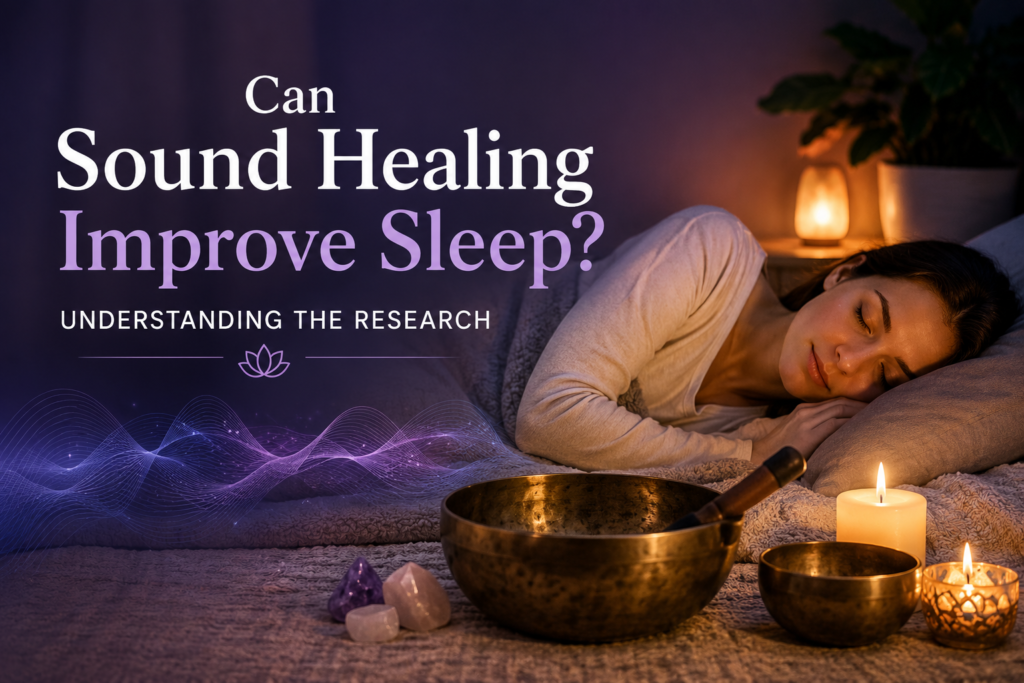
Sleep is closely connected with the state of the mind before bedtime. When the mind remains active after a long day, settling into sleep can become difficult even when the body feels tired. This has led many people to explore practices that create a calmer transition into the night, including meditation, breathwork and sound healing for sleep.
Sound has a particularly interesting role in this process. A gentle, sustained tone can give attention something simple to follow. Listening to a singing bowl, practising humming or spending a few minutes with a guided sound meditation can create a quieter atmosphere before bed.
Research into music, auditory stimulation and relaxation suggests that sound can influence aspects of the sleep experience. The evidence becomes more varied when we look specifically at sound healing methods, so it helps to understand what research supports and where traditional practices offer a different perspective.
How sound healing may support sleep
The transition into sleep involves a gradual reduction in alertness. Our surroundings, thoughts and activities during the evening can influence how easily this transition happens.
A sound-based practice can become part of that process by giving the mind a steady object of attention. During sound meditation, for example, a person may listen to a sustained tone while allowing the breath to become comfortable. The attention remains with the sound instead of continually moving toward thoughts about the day.
A sound bath creates a similar setting on a larger scale. Participants generally rest in a comfortable position while a practitioner produces sounds using instruments such as singing bowls. The changing tones provide an auditory environment in which people can relax and become more aware of their breathing and physical sensations.
This experience can be particularly useful in the evening because it creates a clear transition between active daytime behaviour and a quieter period before sleep.
The effect varies from person to person. Someone may find a particular sound deeply calming, while another listener may prefer silence or gentle music. Personal associations, volume and the character of the sound all influence the experience.
What does research say about sound and sleep?
Research on sound and sleep covers several different areas, with music-based interventions receiving considerable attention.
Studies have explored whether listening to calming music before bedtime can improve perceived sleep quality. Findings have generally been encouraging for some groups, particularly when people choose music that they find relaxing.
Researchers have also examined auditory stimulation and rhythmic auditory stimulation. Some studies investigate whether carefully designed sound patterns can influence aspects of brain activity associated with sleep. This field remains under development, and results vary depending on the method and population being studied.
These studies are useful when discussing sound therapy, although they should not automatically be applied to every form of sound healing.
A singing bowl meditation and a laboratory experiment using precisely timed auditory stimulation involve very different conditions. The term sound therapy itself covers a wide range of practices, from music-based interventions to structured therapeutic sessions.
The clearest evidence currently comes from research into music and relaxation, while scientific investigation into specific sound healing techniques continues to develop.
Can singing bowls help with sleep?
Singing bowls have become widely associated with modern sound healing. Their long resonance makes them particularly suitable for meditation because a single strike can produce a sound that continues for an extended period before gradually fading.
The sound produced by a bowl contains a fundamental tone along with additional harmonics. These harmonics and overtones contribute to the character of the sound and give each bowl a distinctive acoustic quality.
During a singing bowl meditation, the listener can follow the sound from its initial attack through its resonance and eventual decay. This gives the mind a simple sensory experience to observe.
Research specifically examining singing bowls and sleep remains limited when compared with the much larger body of research on music and sleep. For this reason, claims that singing bowls directly produce a particular physiological or neurological effect should be treated carefully.
Their value within a bedtime routine can still be meaningful. The combination of quiet surroundings, attentive listening and relaxation may help someone prepare mentally for sleep.
The experience also illustrates an important principle in sound healing: the way a sound is used can matter as much as the instrument itself.
The role of vibration and resonance
The words vibration and resonance appear frequently in discussions about sound healing. They also have precise meanings in acoustics.
Sound begins with vibration. When an object vibrates, it can create pressure changes in the surrounding medium. Our ears detect these changes and the brain processes them as sound.
Resonance describes a system responding strongly to particular frequencies. Musical instruments rely on resonance to produce their characteristic sounds, and the construction of a singing bowl influences the resonant qualities we hear.
In a sound healing session, people may also describe feeling vibration physically. The experience depends on the instrument, distance, volume and environment.
Traditional Indian approaches to sound add another dimension to this subject. Nada Yoga explores sound through attentive listening and meditation, with the practice gradually moving toward increasingly subtle forms of awareness.
This provides a useful distinction between the physical properties of sound and the contemplative experience of listening.
Nada Yoga and sound meditation before sleep
Nada Yoga is a traditional Indian approach in which sound becomes a means of concentration and meditation. The Sanskrit word Nada is associated with sound or resonance, and the practice places considerable emphasis on attentive listening.
A person practising Nada Yoga may begin with an audible sound, including the human voice, a mantra or a musical tone. The attention remains with the sound and returns to it whenever the mind becomes distracted.
This approach can work well within an evening routine because the practice gives the mind a simple point of focus.
Traditional teachings also describe increasingly subtle forms of sound. The concept of Anahata Nada, often translated as the “unstruck sound,” refers to a subtle inner sound discussed in yogic texts. It belongs to the deeper philosophical and meditative dimensions of Nada Yoga.
For someone interested in sound meditation for sleep, there is no requirement to pursue unusual experiences. A simple practice of listening carefully to a sustained tone can provide a useful beginning.
The quality of attention is central. Instead of analysing the sound, the practitioner observes it as it changes and gradually disappears.
Can humming help you relax before sleep?
Humming offers one of the simplest forms of vocal sound practice because it requires no external instrument.
A gentle hum naturally involves the breath and creates a continuous tone. The vibration can be felt around the face and throat, while the sound gives attention something steady to follow.
Some people use humming as part of relaxation or meditation before bed. The practice can also be combined with slow, comfortable breathing.
Chanting follows a related principle. Repeating a mantra gives the mind a consistent auditory focus, while the voice connects the practice with breathing.
Traditional Indian practices have used mantra meditation and vocal sound for centuries. Om chanting is one familiar example, although different traditions use many forms of mantra according to their particular teachings.
Modern interest in humming has also led to discussion about the vagus nerve, breathing and the nervous system. There are plausible physiological pathways worth studying, yet online claims often extend well beyond what current research can establish.
A sensible approach is to treat humming as a relaxation and meditation practice while allowing scientific research to determine its specific physiological effects.
How to use sound healing for better sleep
A sound healing sleep routine can remain simple.
- Begin by reducing bright light and stimulating activity before bedtime. Sit or lie somewhere comfortable and choose a sound that feels pleasant to hear. A singing bowl, gentle recording or your own voice can work well.
- Keep the volume low. Sound intended to support sleep should feel comfortable within the environment, allowing attention to rest on it without becoming overly stimulated.
- Listen to the sound as it changes. If you are using a singing bowl, follow the resonance from the moment the bowl is struck until the sound fades. If you are humming, pay attention to the tone and the movement of the breath.
- When thoughts appear, allow them to pass and return to listening.
- After several minutes, let the sound end and remain quietly for a short while. This final period of silence can become an important part of the practice because it gives the mind time to settle without another stimulus.
A consistent bedtime routine can make the practice easier to maintain. The same sequence repeated each evening can gradually become a familiar signal that the day is coming to a close.
Is there a best frequency for sleep?
The search for a “best frequency” for sleep has become common in the online sound healing community. Videos and recordings often promote specific frequencies with precise claims about their effects on the brain or body.
Scientific evidence does not currently establish one universal frequency that guarantees better sleep.
Frequency certainly affects how a sound is perceived. A low tone can feel very different from a high tone, and the harmonic structure of a sound changes its character. Individual preference also plays an important role.
This is why choosing sound for sleep should begin with personal response. A gentle piece of music may work beautifully for one person, while another may prefer a sustained drone, a singing bowl or quiet humming.
The same principle applies to sound healing frequencies. Frequency is one property of sound, and its effect cannot be understood separately from volume, duration, timbre, context and the listener.
Sound healing, relaxation and the nervous system
Sound can influence attention and emotional state, which helps explain its place in relaxation practices.
When a person listens to a calming sound in a quiet environment, attention may become less occupied with external tasks. Slow breathing can accompany the practice, and the body may gradually move toward a more relaxed state.
This relationship between sound and the nervous system is an area of continuing scientific interest. Researchers are examining how music, rhythm and vocal practices interact with physiological processes.
Traditional sound practices approach the experience from another direction. Nada Yoga focuses on cultivating awareness through listening. The practice can support a person’s ability to remain present with a sound and observe changes in attention.
Both perspectives can inform a modern understanding of sound-based relaxation, provided traditional teachings and scientific findings remain clearly distinguished.
Learning sound healing in a traditional setting
People who develop a deeper interest in sound healing often begin looking beyond individual relaxation sessions. They may want to understand how instruments work, how to structure a sound meditation, how to work with the voice or how sound fits within traditional Indian contemplative practices.
This is where structured education can be useful.
A sound healing course in Rishikesh can introduce students to sound-based meditation within the wider environment of yoga and Indian spiritual traditions. Rishikesh has a long association with yoga, meditation and traditional learning, making it a natural setting for students who want to explore the subject in greater depth.
A well-rounded course can include practical work with sound while also explaining the principles behind the practice. Students may encounter singing bowls and other instruments alongside Nada Yoga, mantra, vocal practice and traditional approaches to attentive listening.
For someone intending to teach sound meditation or incorporate sound into yoga sessions, understanding the foundations of the practice becomes especially important. Sound healing carries a responsibility to communicate claims carefully and work within the limits of one’s training.
Can sound healing replace treatment for sleep problems?
Sound healing can support relaxation and become part of a healthy evening routine. It should not be presented as a replacement for medical assessment or treatment when someone has persistent sleep difficulties.
Long-term insomnia can have many causes, including stress, lifestyle factors, medication, physical conditions and sleep disorders. A person experiencing ongoing problems with sleep may benefit from speaking with a qualified healthcare professional.
Sound meditation can still have a place alongside appropriate care. A calming practice before bed may help create a more settled environment, particularly when combined with consistent sleep habits.
The most useful approach is to treat sound as one element within a broader practice of sleep care.
Building a personal sound practice for sleep
There is no single sound that works for everyone.
The most practical approach is to experiment gently and observe your response. Try a short singing bowl meditation on one evening. On another, use quiet humming or a simple mantra. You may discover that a particular sound helps your attention settle more easily than another.
Keep the practice comfortable and allow silence to become part of it. Over time, the association between the practice and bedtime can become stronger.
Sound healing offers an interesting meeting point between contemporary wellness and traditional contemplative practice. Research into music and auditory stimulation provides encouraging evidence for some applications, while specific claims about sound healing frequencies and particular instruments require further study.
Nada Yoga adds a valuable traditional perspective by teaching that sound can become an object of sustained awareness. Through careful listening, the practitioner learns to notice the relationship between sound, attention and silence.
For someone looking for sound healing for sleep, that may be the most useful place to begin. Choose a gentle sound, create a quiet environment and give yourself enough time to listen without rushing toward the next activity. The practice becomes meaningful through consistency, attention and a realistic understanding of what sound can offer.